
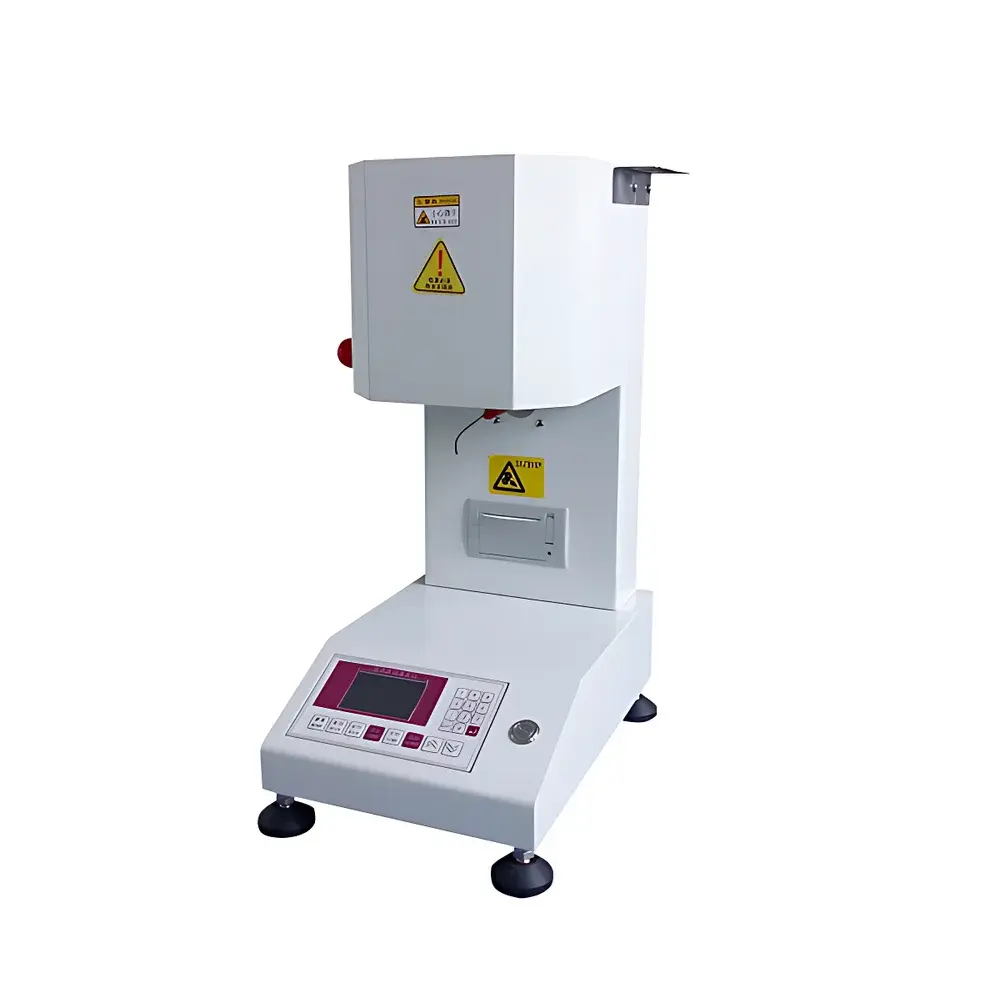
Hengyi HY(RZ)PO Plastic Melt Flow Indexer
| Brand | Hengyi / Hengyitest |
|---|---|
| Origin | Shanghai, China |
| Manufacturer Type | Direct Manufacturer |
| Country of Origin | China |
| Model | HY(RZ)PO |
| Pricing | Available Upon Request |
| Standards Compliance | GB/T 3682-2018, JB/T 5456-2005 |
| Max Operating Temperature | ≥400 °C |
| Temperature Control Accuracy | ≤±0.2 °C |
| Temperature Stabilization Time (to max temp) | ≤30 min |
| Thermal Recovery Time (after loading) | 2–4 min |
| Timing Resolution | ≥0.1 s |
| Piston Displacement Resolution | ≥0.01 mm |
| Die Dimensions | Ø2.095±0.005 mm × 8.000±0.025 mm |
| Barrel ID | Ø9.550±0.025 mm, Length: 152±0.1 mm |
| Piston Head OD | 9.475±0.015 mm, Length: 6.350±0.100 mm |
| Standard Load Sets | 8-level砝码 system (0.325 kg to 21.600 kg |
| Test Modes | Mass Flow Rate (MFR) and Volume Flow Rate (MVR) |
| Control Interface | Full-color PLC touchscreen with embedded control software |
| Safety | Insulated high-temp components, anti-scald design, modular replaceable wear parts |
Overview
The Hengyi HY(RZ)PO Plastic Melt Flow Indexer is a precision-engineered instrument designed for the standardized determination of melt mass flow rate (MFR) and melt volume flow rate (MVR) of thermoplastic polymers under controlled temperature and load conditions. Based on the principle of extrusion rheometry—where molten polymer is forced through a standardized capillary die under defined gravitational or applied loads—the HY(RZ)PO delivers repeatable, traceable data essential for quality assurance, material specification compliance, and process development in polymer manufacturing and R&D laboratories. Its operation conforms strictly to ISO 1133-1:2011 (equivalent to GB/T 3682-2018) and meets the mechanical and metrological requirements specified in JB/T 5456-2005. The system employs a robust, vertically oriented barrel-and-die architecture with gravimetric force application via calibrated weight sets, ensuring minimal mechanical hysteresis and long-term calibration stability.
Key Features
- High-temperature capability up to 400 °C with PID-controlled heating and thermal uniformity across the barrel zone, achieving ±0.2 °C steady-state accuracy.
- Dual-mode testing: Simultaneous support for ASTM/ISO-compliant MFR (g/10 min) and MVR (cm³/10 min), with automatic volumetric calculation derived from real-time piston displacement and calibrated die geometry.
- Eight-tier standard load configuration (0.325 kg to 21.600 kg), covering the full spectrum of common test conditions for polyolefins, engineering thermoplastics, and high-performance resins—including PE, PP, PS, ABS, PC, PA, POM, and fluoropolymers.
- Full-color industrial PLC touchscreen interface with intuitive navigation, enabling direct parameter entry (temperature setpoint, cut interval, load selection), real-time monitoring of barrel temperature profile, live piston position tracking, and immediate MFR/MVR result display with timestamped data logging.
- Automated cutting mechanism synchronized with programmable time intervals or piston travel distance, minimizing operator intervention and inter-test variability.
- Modular mechanical design: Wear-prone components—including die, barrel liner, and piston head—are manufactured to tight geometric tolerances (e.g., die: Ø2.095 ± 0.005 mm × 8.000 ± 0.025 mm; barrel ID: Ø9.550 ± 0.025 mm) and engineered for rapid field replacement without recalibration.
- Integrated thermal safety architecture: All external surfaces exceeding 60 °C are insulated per IEC 61000-3-2 and equipped with passive shielding to prevent accidental contact burns during routine operation.
Sample Compatibility & Compliance
The HY(RZ)PO accommodates granular, pelletized, or powdered thermoplastic specimens with minimal preprocessing. It supports standard specimen masses (typically 4–8 g) and is validated for use with materials exhibiting melt viscosity ranges typical of commodity and engineering plastics (MFR range: ~0.1–1000 g/10 min at standard conditions). All dimensional specifications—including die geometry, barrel internal diameter, and piston head dimensions—adhere to ISO 1133 Annex A and GB/T 3682-2018 Clause 6 requirements. The instrument’s mechanical construction satisfies GB/T 13384 (packaging), GB/T 191 (handling markings), and GB/T 6388 (transportation) standards. While not inherently 21 CFR Part 11 compliant, its data export functionality (CSV/USB) enables integration into validated laboratory information management systems (LIMS) supporting GLP/GMP audit trails when deployed with appropriate procedural controls.
Software & Data Management
The embedded PLC-based control firmware provides deterministic real-time execution of thermal ramping, dwell stabilization, load application sequencing, and cut timing. Temperature history is recorded at 1 Hz resolution and stored alongside MFR/MVR results, piston displacement timestamps, and operator-entered batch IDs. Data export is supported via USB flash drive in comma-separated values (CSV) format, preserving column headers aligned with ISO 1133 reporting conventions (e.g., “Test Temp (°C)”, “Load (kg)”, “Cut Interval (s)”, “Mass Collected (g)”, “MFR (g/10 min)”). No proprietary binary formats or vendor-locked software dependencies are used. Calibration records—including date, technician ID, reference weights, and verification temperatures—can be manually logged within the system’s annotation field and exported with test reports.
Applications
- Quality control of incoming polymer resin batches against contractual MFR specifications (e.g., PE HD5070AA, PP HJ730).
- Monitoring thermal degradation effects during multiple extrusion passes or residence time studies.
- Correlating MFR with molecular weight distribution (MWD) trends in R&D screening of catalyst systems or polymerization kinetics.
- Validation of processing parameters for injection molding, blow molding, and extrusion line setup.
- Supporting technical documentation for ISO 9001-certified production environments and third-party certification bodies (e.g., UL, TÜV, SGS).
- Teaching laboratories requiring ISO/GB-aligned instrumentation for polymer physics and processing courses.
FAQ
What standards does the HY(RZ)PO comply with?
It fully implements GB/T 3682-2018 and JB/T 5456-2005, and is dimensionally and functionally equivalent to ISO 1133-1:2011 and ASTM D1238 (Method A).
Can the instrument perform both MFR and MVR measurements in a single test run?
Yes—real-time piston displacement tracking enables concurrent MFR and MVR calculation without additional hardware or manual intervention.
Is calibration traceability provided with the system?
The unit ships with a factory calibration certificate referencing national metrology institute-traceable weights and thermocouple calibrators; users are responsible for periodic in-house verification per ISO/IEC 17025 guidelines.
What maintenance intervals are recommended for critical components?
The die and barrel should be inspected visually before each test series; cleaning with brass brushes and solvent is advised after every 10–15 tests; full replacement is recommended after 500–1000 test cycles or upon dimensional deviation beyond tolerance limits.
Does the system support automated data transfer to LIMS or ERP platforms?
Direct network connectivity is not included, but CSV exports can be ingested by most LIMS via scheduled file polling or manual upload, satisfying basic data integrity requirements under GLP frameworks.



