
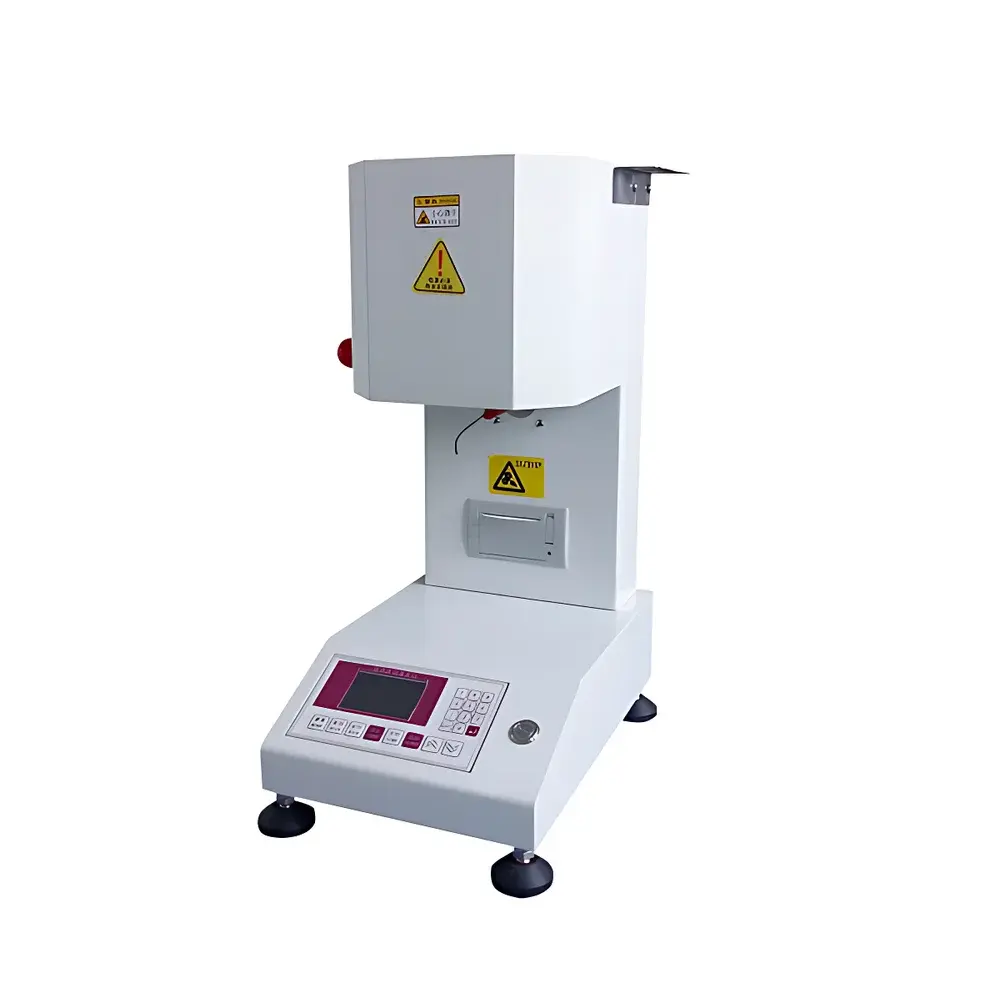
Hengyi HY(RZ)WE Melt Flow Rate Tester (MFR/MVR) for Thermoplastics
| Brand | Hengyi / Hengyitest |
|---|---|
| Origin | Shanghai, China |
| Manufacturer Type | Direct Manufacturer |
| Regional Category | Domestic (China) |
| Model | HY(RZ)WE |
| Pricing | Upon Request |
| Standards Compliance | GB/T 3682–2018, JB/T 5456–2005 |
| Max Operating Temperature | ≥400 °C |
| Temperature Control Accuracy | ≤±0.2 °C |
| Temperature Stabilization Time (to max temp) | ≤30 min |
| Temperature Recovery Time (after loading) | 2–4 min |
| Timing Resolution | ≥0.1 s |
| Piston Displacement Resolution | ≥0.01 mm |
| Load Weights | 8-level calibrated masses (0.325–21.600 kg |
| Die Dimensions | Ø2.095±0.005 mm × 8.000±0.025 mm |
| Barrel Dimensions | Ø9.550±0.025 mm × 152.0±0.1 mm |
| Piston Head | Ø9.475±0.015 mm × 6.350±0.100 mm |
| Test Methods | Mass Flow Rate (MFR) and Volume Flow Rate (MVR) |
| Control Interface | Full-color PLC-based touchscreen HMI |
| Safety | Thermal insulation & anti-scald design for high-temp components |
| Serviceability | Modular design with accessible wear parts (die, piston, barrel) and provision of spares |
Overview
The Hengyi HY(RZ)WE Melt Flow Rate Tester is a precision instrument engineered for the standardized determination of melt mass flow rate (MFR) and melt volume flow rate (MVR) of thermoplastic polymers under controlled temperature and load conditions. Based on the principle of capillary rheometry—where molten polymer is extruded through a standardized die under a defined gravitational load—the system quantifies material processability, thermal stability, and molecular weight distribution proxy. Designed in strict accordance with GB/T 3682–2018 (equivalent to ISO 1133–1:2011 and ASTM D1238–22) and JB/T 5456–2005, the tester supports routine quality control, incoming raw material verification, and R&D screening across polyolefins (e.g., PE, PP), engineering plastics (e.g., ABS, PC, PA6/66), and high-performance resins (e.g., POM, PTFE). Its dual-mode capability (MFR and MVR) enables cross-comparison of flow behavior independent of melt density variations, critical for compound formulation and batch-to-batch consistency assessment.
Key Features
- High-temperature operation up to 400 °C with ±0.2 °C closed-loop PID temperature control, ensuring repeatability across extended test cycles;
- Eight-tier calibrated weight set (0.325–21.600 kg; 3.187–211.82 N), traceable to national metrological standards, covering all standard test loads specified in ISO 1133 and ASTM D1238;
- Automated cut-off mechanism synchronized with real-time timer and piston displacement tracking, eliminating operator-dependent timing errors;
- Full-color PLC-driven touchscreen interface with embedded control logic for parameter setup, thermal ramping, auto-hold, cut initiation, calibration logging, and live graphical display of temperature profiles and flow results;
- Thermally insulated furnace assembly with surface temperature ≤50 °C at ambient conditions, compliant with IEC 61000-4-2 ESD and GB/T 13384 packaging safety requirements;
- Modular mechanical architecture: quick-release die, piston, and barrel assemblies; wear-prone components supplied with OEM spare kits to minimize downtime and maintain measurement integrity;
- Robust barrel geometry (Ø9.550 ± 0.025 mm × 152.0 ± 0.1 mm) and precision-machined die (Ø2.095 ± 0.005 mm × 8.000 ± 0.025 mm) manufactured to ISO 1133 tolerances for consistent shear history and minimal wall-slip deviation.
Sample Compatibility & Compliance
The HY(RZ)WE accommodates a broad spectrum of thermoplastic materials including but not limited to polyethylene (LDPE, HDPE, LLDPE), polypropylene (homopolymer, copolymer), polystyrene, acrylonitrile-butadiene-styrene (ABS), polyoxymethylene (POM), polycarbonate (PC), polyamide (PA6, PA66), and fluoropolymers (PTFE, PVDF). All test procedures adhere to internationally harmonized methodologies—GB/T 3682–2018 (identical technical content to ISO 1133–1), ASTM D1238 (Types A–D), and ISO 1133–2 for MVR. The instrument’s mechanical and thermal specifications meet the dimensional and performance criteria outlined in JB/T 5456–2005, ensuring conformance for domestic regulatory submissions and third-party laboratory accreditation (e.g., CNAS, CMA). While not inherently 21 CFR Part 11 compliant, audit-ready data logs—including timestamped temperature curves, load application events, cut timestamps, and calculated MFR/MVR values—are exportable in CSV format for integration into validated LIMS or QMS environments supporting GLP/GMP workflows.
Software & Data Management
The embedded PLC firmware provides deterministic real-time control without reliance on external PCs. All operational parameters—including target temperature, soak duration, load selection, cut interval, and calibration offsets—are stored in non-volatile memory with versioned configuration backup. During testing, the system records time-stamped piston displacement (0.01 mm resolution), elapsed time (0.1 s resolution), and furnace temperature (0.01 °C resolution) at 1 Hz sampling rate. Post-test, MFR (g/10 min) and MVR (cm³/10 min) are computed per ISO 1133–1 Annex B algorithms and displayed alongside raw time–displacement plots. Data export via USB port generates ASCII-formatted reports containing test ID, operator, date/time, material ID, test conditions, raw measurements, and final results—structured for direct ingestion into statistical process control (SPC) platforms or enterprise QA databases. Optional firmware updates are delivered via secure USB key with SHA-256 checksum verification.
Applications
- Quality assurance laboratories verifying supplier resin specifications against contractual MFR limits;
- Polymer compounding facilities optimizing stabilizer packages and filler dispersion via MFR drift monitoring;
- R&D teams correlating MFR shifts with degradation kinetics during accelerated aging or recycling studies;
- Regulatory submission support for medical-grade PE/PP where flow consistency impacts extrusion-based device manufacturing (e.g., catheters, tubing);
- Educational institutions teaching polymer rheology fundamentals using standardized, repeatable capillary extrusion methodology;
- Contract testing labs performing accredited MFR testing per ISO/IEC 17025:2017 scope requirements.
FAQ
What standards does the HY(RZ)WE comply with?
It fully conforms to GB/T 3682–2018, which adopts the technical content of ISO 1133–1:2011 and aligns with ASTM D1238–22. It also meets the mechanical and metrological requirements of JB/T 5456–2005.
Can the instrument perform both MFR and MVR measurements?
Yes—dual-mode operation is native. MFR is derived from gravimetric sample collection; MVR is calculated from piston displacement rate using calibrated barrel volume and real-time temperature-corrected melt density.
Is the temperature recovery time verified after each charge?
Yes. Following material loading, the system automatically monitors furnace temperature deviation and confirms stabilization within 2–4 minutes per GB/T 3682–2018 Clause 6.4.2.
Are calibration certificates provided for the weight set?
Each eight-tier weight set is supplied with a factory calibration report traceable to China National Institute of Metrology (CNIM), including uncertainty values at 23 °C.
What maintenance intervals are recommended for routine use?
Daily visual inspection of die orifice and piston surface; monthly cleaning of barrel interior with brass brush and solvent; annual verification of temperature sensor accuracy and load cell linearity by authorized service engineer.



