
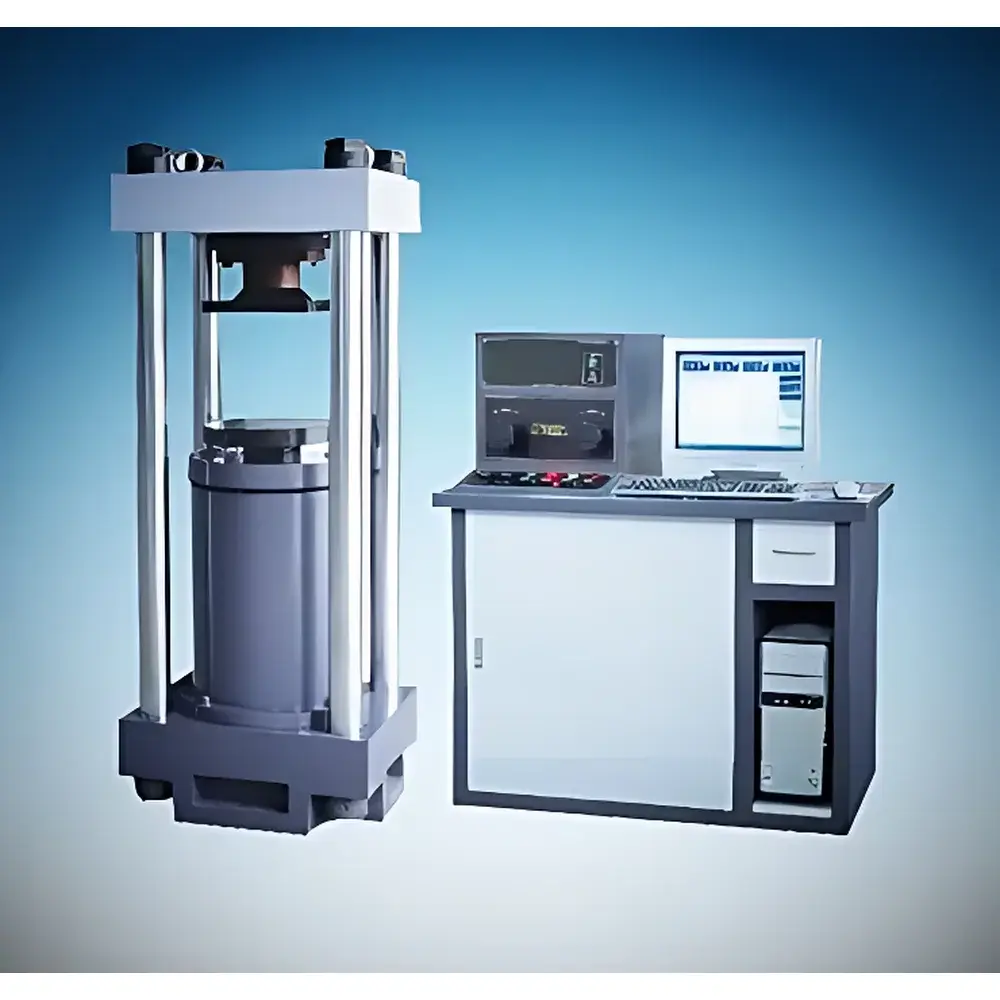
Hengyi HY(YE)-200008RTY 2000 kN Computer-Controlled Hydraulic Compression Testing Machine
| Brand | Hengyi / Hengyitest |
|---|---|
| Origin | Shanghai, China |
| Manufacturer Type | Direct Manufacturer |
| Regional Category | Domestic (China) |
| Model | HY(YE)-200008RTY |
| Quotation | Upon Request |
| Load Capacity | 2000 kN |
| Accuracy Class | Class 1 |
| Force Measurement Range | 80–2000 kN |
| Relative Indicated Error | ±1% |
| Loading Speed | 1–15 mm/s (adjustable) |
| Internal Clearance (between platens) | 320 mm |
| Upper Platen Dimensions | 220 × 220 mm |
| Lower Platen Diameter | 290 mm |
| Piston Stroke | 80 mm |
| Motor Power | 1.5 kW |
| Net Weight | ~1000 kg |
| Overall Dimensions | 520 × 440 × 1360 mm |
| Standard Configuration | Compression fixture set, one precision hydraulic load cell, Dell desktop PC + HP printer, micro-precision electro-hydraulic servo control system |
| Compliant Standards | GB/T 228–2002, GB/T 5224–1995, GB/T 232–1999 |
Overview
The Hengyi HY(YE)-200008RTY 2000 kN Computer-Controlled Hydraulic Compression Testing Machine is a high-capacity, electro-hydraulically actuated static testing system engineered for precise and repeatable uniaxial compressive strength evaluation of rigid construction materials. It operates on the principle of controlled displacement-driven loading via a servo-regulated hydraulic actuator, with real-time force feedback from a calibrated load cell integrated into the load train. Designed specifically for structural integrity assessment in civil engineering laboratories and quality control departments, the machine delivers stable, programmable loading profiles across its full 80–2000 kN operational range—covering standard test specimens including concrete cubes (150 mm × 150 mm × 150 mm), cylindrical concrete cores (Φ150 mm × 300 mm), fired clay bricks, natural stone blocks, and precast concrete elements. Its Class 1 accuracy per ISO 7500-1 and GB/T 228–2002 ensures traceability to national metrological standards, supporting accredited testing environments requiring documented measurement uncertainty.
Key Features
- Electro-hydraulic servo control architecture enabling closed-loop regulation of both displacement and load, with adjustable loading rates from 1 to 15 mm/s—fully programmable to match ASTM C39, ASTM C109, EN 12390-3, and GB/T 50081 requirements.
- Integrated micro-precision hydraulic measurement system featuring a high-stability load cell with ±1% relative indicated error over the 80–2000 kN span, validated against certified reference standards.
- Motorized vertical adjustment mechanism using precision-ground ball screws for rapid, repeatable specimen centering and height compensation—eliminating manual mechanical alignment errors.
- Dual-platen configuration: fixed lower platen (Ø290 mm) and upper platen (220 × 220 mm) optimized for uniform stress distribution across heterogeneous brittle materials; 320 mm internal clearance accommodates standard and oversized specimens.
- Embedded Windows-based control software with automatic data acquisition at ≥10 Hz sampling rate, real-time load–displacement curve plotting, peak load capture, and fracture point detection.
- Full audit trail capability: all test parameters, operator ID, timestamp, environmental notes, and raw sensor outputs are time-stamped and stored in encrypted binary format compliant with GLP documentation practices.
Sample Compatibility & Compliance
The HY(YE)-200008RTY supports compression testing of standardized and non-standard specimens conforming to major international and Chinese national standards. Compatible sample geometries include cubes (up to 200 mm side), cylinders (up to Ø200 mm × 400 mm), prisms, and irregular masonry units. The system meets mechanical and metrological requirements of GB/T 228–2002 (metallic materials), GB/T 5224–1995 (prestressed steel strands), and GB/T 232–1999 (metallic materials – bend testing), while its structural design aligns with ISO 16840-1 for compression testing machines. All force transducers are factory-calibrated and accompanied by NIST-traceable calibration certificates. Optional third-party verification per ISO/IEC 17025 is available upon request.
Software & Data Management
The included Hengyi TestMaster™ v4.2 software provides ISO 17025-aligned test workflow management. Functions include customizable test templates, multi-user role-based access control (administrator, technician, reviewer), electronic signature support, and automated report generation in PDF/A-1b format with embedded metadata (test ID, calibration status, environmental conditions). Raw data export is supported in CSV, Excel (.xlsx), and universal .tdms formats for integration with LIMS or statistical analysis platforms (e.g., Minitab, JMP). Software complies with FDA 21 CFR Part 11 requirements for electronic records and signatures when configured with audit log archiving and password-protected user accounts.
Applications
- Compressive strength validation of ready-mix and precast concrete in accordance with GB/T 50081 and ASTM C39.
- Quality assurance testing of fired clay bricks, autoclaved aerated concrete (AAC) blocks, and refractory ceramics.
- Mechanical characterization of geological core samples and quarried stone under controlled strain rates.
- R&D evaluation of novel cementitious composites, fiber-reinforced concretes, and geopolymer binders.
- Third-party certification testing for CE marking, CCC certification, and construction material approval under MOHURD directives.
FAQ
What standards does this machine support for calibration and operation?
It complies with ISO 7500-1 (static calibration), GB/T 228–2002 (tensile/compression testing), and GB/T 50081 (concrete strength testing); optional calibration to ASTM E4 is available.
Is remote diagnostics and firmware update supported?
Yes—via secure HTTPS-enabled web interface; requires local network configuration and administrator credentials.
Can the system be integrated into an existing LIMS environment?
Yes—through configurable RESTful API endpoints and HL7-compliant data exchange modules (optional add-on).
What is the recommended maintenance interval for hydraulic oil and seals?
Hydraulic fluid replacement every 24 months or 2000 operating hours; seal inspection annually or after 5000 test cycles.
Does the system meet requirements for ISO/IEC 17025-accredited laboratories?
Yes—when operated with documented procedures, traceable calibration records, and enabled audit logging features as specified in the User Manual Annex D.
Related Products



