
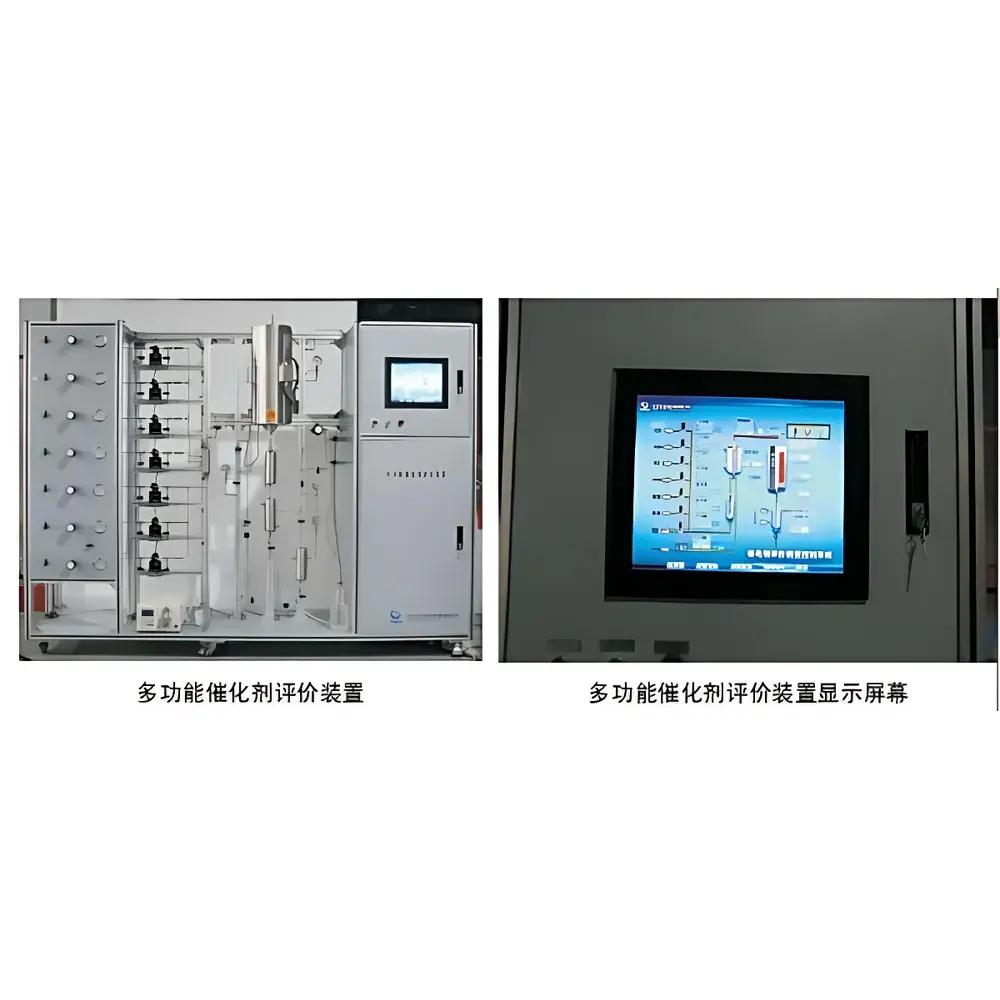
Henven BJHJ Catalytic Cracking Pilot Plant
| Brand | Henven |
|---|---|
| Origin | Beijing, China |
| Manufacturer Type | Direct Manufacturer |
| Country of Origin | China |
| Model | BJHJ |
| Price Range | USD 14,000 – 28,000 |
| Raw Material Capacity | 5 m³ |
| Operating Volume | 3 m³ |
| Heating Power | 10 kW |
| Circulation Pump Power | 0–4 kW (adjustable) |
| Circulation Flow Rate | 0–12 m³/h (adjustable) |
| Operating Pressure | Atmospheric |
| Temperature Range | Ambient to 80 °C |
| Continuous Operation Duration | Up to 20 h |
Overview
The Henven BJHJ Catalytic Cracking Pilot Plant is a bench-scale, fully automated fluidized-bed reaction system engineered for laboratory-scale evaluation of catalytic cracking processes under controlled thermal and hydrodynamic conditions. Designed in accordance with fundamental principles of heterogeneous catalysis and fluidization dynamics, the system enables reproducible simulation of key refinery unit operations—including feedstock pre-mixing, catalyst contact, vapor-phase product evolution, and heat-integrated reaction cycling. Unlike batch reactors or fixed-bed test rigs, the BJHJ plant implements a dedicated Henven-developed fluidized-bed control architecture that maintains stable bed expansion, uniform catalyst distribution, and consistent gas–solid mass transfer across variable throughput regimes. Its atmospheric-pressure operation and precise temperature regulation (ambient to 80 °C) support studies of low-temperature catalytic cracking pathways, enzyme-assisted upgrading, and mild thermal cracking of heavy fractions—making it particularly suitable for academic research, catalyst formulation screening, and process parameter optimization prior to pilot-plant scale-up.
Key Features
- Fully integrated touchscreen HMI interface with real-time PID-controlled temperature monitoring and logging
- Dedicated Henven fluidized-bed control system ensuring stable bed height, pressure drop consistency, and uniform catalyst suspension
- Automated raw material blending subsystem with programmable volumetric dosing for multi-feedstock formulations
- Independent safety interlock circuitry including overtemperature cutoff, flow loss detection, and emergency shutdown protocol
- Modular thermal management: 10 kW heating capacity with insulated jacket and redundant temperature sensors at reactor inlet, bed zone, and outlet
- Variable-speed circulation pump (0–4 kW) enabling precise adjustment of superficial velocity (0–12 m³/h) to match catalyst particle Reynolds number requirements
- Stainless-steel wetted components compliant with ASTM A240 and ASME B31.3 for corrosion resistance and long-term operational integrity
Sample Compatibility & Compliance
The BJHJ system accommodates a broad range of liquid hydrocarbon feedstocks—including vacuum gas oil (VGO), deasphalted oil (DAO), bio-oil emulsions, and model compounds such as tetralin or decalin—provided viscosity remains below 500 cSt at operating temperature. Solid catalysts (e.g., zeolite Y, ZSM-5, or metal-doped mesoporous silica) with particle sizes between 20–150 µm are compatible with the fluidized regime. The apparatus meets general laboratory safety standards per ISO/IEC 17025:2017 for test equipment qualification and supports GLP-compliant data generation when operated with audit-trail-enabled software configuration. While not certified for hazardous area use (e.g., ATEX or IECEx), its atmospheric design and intrinsic safety features align with OSHA 1910.119 process safety management guidelines for non-pressurized chemical testing.
Software & Data Management
The embedded control software provides synchronized acquisition of 16 analog channels (temperature, pressure, flow, power) at 1 Hz resolution, with local storage on industrial-grade SSD and optional Ethernet-based export to LIMS or SCADA platforms. All operational logs—including setpoint history, alarm timestamps, and manual override events—are time-stamped and digitally signed to satisfy FDA 21 CFR Part 11 requirements for electronic records and signatures when deployed in regulated environments. Customizable report templates support ASTM D3907 (fluid catalytic cracking activity testing) and ISO 10438-3 (petroleum refinery instrumentation standards) formatting. Remote diagnostics and firmware updates are supported via secure HTTPS API endpoints with TLS 1.2 encryption.
Applications
- Catalyst deactivation kinetics and regeneration cycle analysis under simulated industrial conditions
- Feedstock compatibility assessment for co-processing of biomass-derived oils with conventional VGO
- Hydrodynamic characterization of Geldart Group B and D particles in low-velocity fluidized beds
- Thermal stability mapping of acid-catalyzed cracking reactions below 100 °C
- Calibration and validation of CFD models for riser reactor design
- Graduate-level teaching modules on reaction engineering, transport phenomena, and process control theory
FAQ
Is the BJHJ system suitable for high-pressure catalytic cracking experiments?
No. The BJHJ operates exclusively at atmospheric pressure and is not rated for pressurized service. For elevated-pressure studies, supplementary containment vessels or external backpressure regulators must be integrated externally.
Can third-party catalysts be used without modification to the control logic?
Yes. The fluidized-bed control algorithm is feedstock- and catalyst-agnostic; users may define custom density, size, and minimum fluidization velocity parameters during setup.
Does the system include calibration certificates for temperature and flow sensors?
Each unit ships with factory calibration reports traceable to NIST standards for primary temperature sensors; flow meter calibration is user-verifiable using gravimetric methods per ISO 5167.
What is the expected maintenance interval for the circulation pump and heater elements?
Under continuous operation at ≤80 °C and ≤80% maximum flow rate, scheduled maintenance is recommended every 1,500 operating hours, including bearing inspection, seal replacement, and thermocouple verification.
Is remote operation supported over institutional networks?
Yes—via secure web interface with role-based access control (RBAC), two-factor authentication, and configurable session timeouts aligned with NIST SP 800-63B digital identity guidelines.



