
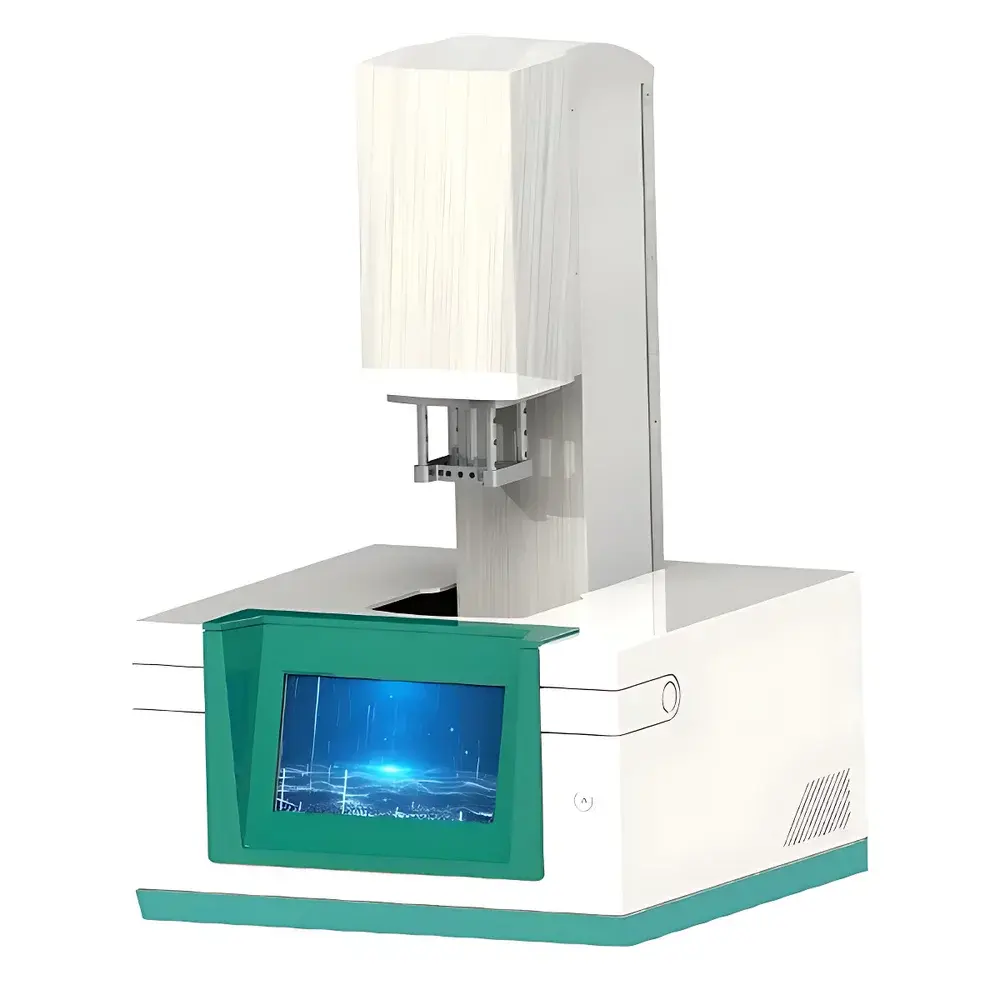
Henven DMA-101 Dynamic Mechanical Analyzer
| Brand | Henven |
|---|---|
| Origin | Beijing, China |
| Manufacturer Type | Direct Manufacturer |
| Instrument Type | Dynamic Mechanical Analyzer (DMA/DMTA) |
| Temperature Range | -150 °C to 600 °C |
| Temperature Accuracy | ±0.1 °C |
| Maximum Applied Force | 50 N |
| Displacement Range | 2.5 mm |
| Frequency Range | 0.01–100 Hz |
| Heating Rate | 0.1–20 °C/min (dual-loop self-learning PID control) |
| Force Resolution | 0.001 N |
| Displacement Resolution | 0.01 µm |
| Atmosphere Control | Dual-channel mass flow controller (0–200 mL/min), inert/oxidizing/reducing/static/dynamic gas modes |
| Sample Dimensions | Height 0.3–25 mm, Diameter ≤10 mm |
| Operating Modes | Tension, Compression, Bending (3-point & cantilever), Shear, Penetration |
Overview
The Henven DMA-101 Dynamic Mechanical Analyzer is a precision-controlled thermomechanical instrument engineered for the quantitative characterization of viscoelastic behavior in solid and semi-solid materials under controlled thermal, mechanical, and atmospheric conditions. Based on the principle of forced oscillatory deformation—where a sinusoidal stress is applied to a sample while simultaneously monitoring the resulting strain—the DMA-101 measures storage modulus (E′), loss modulus (E″), and damping factor (tan δ) as functions of temperature, frequency, time, and atmosphere. Its dual-loop self-learning PID temperature control ensures linear, reproducible heating/cooling ramps from −150 °C to 600 °C with ±0.1 °C accuracy, enabling high-fidelity detection of transitions such as glass transitions (Tg), crystallization, crosslinking, and decomposition. The system’s modular architecture supports interchangeable fixtures—including tension, three-point bending, dual-cantilever, shear, and penetration geometries—allowing standardized testing per ASTM D4065, ASTM D7028, ISO 6721-1/4/5, and ISO 11359-2.
Key Features
- Modular fixture platform compatible with standard and custom sample holders for tension, compression, bending, shear, and penetration testing
- Ergonomic bottom-loading design with quick-release mechanism for rapid fixture exchange and reduced operator fatigue
- Integrated high-resolution force transducer (0.001 N resolution) and displacement sensor (0.01 µm resolution) for simultaneous multi-parameter acquisition
- Hermetically sealed furnace with programmable dual-gas mass flow control (0–200 mL/min per channel), supporting inert (N2, Ar), oxidizing (air, O2), reducing (H2/N2), static, or dynamic atmospheres
- Real-time touchscreen interface with local data preview, status monitoring, and emergency stop functionality
- Optional cryogenic cooling modules: liquid nitrogen delivery system for sub-ambient operation down to −150 °C; rapid air-cooling accessory for accelerated thermal cycling
- Comprehensive thermal control algorithm with adaptive learning for stable ramp rates between 0.1 and 20 °C/min across full temperature range
Sample Compatibility & Compliance
The DMA-101 accommodates specimens up to 25 mm in height and 10 mm in diameter, covering standard geometries used in polymer, elastomer, composite, ceramic, and metallic material evaluation. Its mechanical design conforms to ISO/IEC 17025 requirements for calibration traceability, and test protocols align with internationally recognized standards including ASTM D4065 (standard practice for dynamic mechanical testing of plastics), ASTM D7028 (glass transition temperatures of polymer matrix composites), and ISO 11359-2 (thermomechanical analysis of polymers). All firmware and data acquisition software support audit trails, electronic signatures, and user-access controls compliant with FDA 21 CFR Part 11 for regulated environments operating under GLP or GMP frameworks.
Software & Data Management
Control and analysis are performed via Henven’s proprietary DMA Analysis Suite—a Windows-based application that enables full method definition, real-time curve overlay, automated baseline correction, and advanced modeling tools including Time-Temperature Superposition (TTS) master curve generation. Raw data files are stored in vendor-neutral ASCII format with embedded metadata (operator ID, timestamp, instrument serial number, calibration certificate ID). The software supports batch processing, statistical comparison across sample sets, and export to CSV, Excel, or PDF for regulatory submission. Audit logs record all parameter changes, data exports, and user logins with timestamps—ensuring full traceability required for quality assurance documentation.
Applications
- Determination of glass transition temperature (Tg) and secondary relaxations in amorphous, semi-crystalline, and highly crosslinked polymers
- Quantification of cure kinetics and degree of crosslinking during thermoset polymerization and post-cure processes
- Evaluation of aging effects—including oxidative degradation, hydrolytic cleavage, and UV-induced embrittlement—under controlled atmospheres
- Characterization of creep compliance and stress relaxation behavior over extended time scales using isothermal hold protocols
- Multifrequency sweep analysis to assess frequency-dependent moduli and construct Cole-Cole or van Gurp-Palmen plots
- Phase compatibility assessment in polymer blends via tan δ peak broadening, splitting, or shifting
- Thermo-mechanical stability profiling of thin films, coatings, adhesives, and fiber-reinforced composites under simulated service conditions
FAQ
What sample geometries does the DMA-101 support out of the box?
Standard configurations include tensile bars, rectangular flexural specimens (three-point and dual-cantilever), cylindrical compression samples, and shear sandwiches. Custom fixtures—including micro-bending stages and humidity-controlled chambers—are available upon request.
Can the instrument perform tests under humidified atmospheres?
Yes—optional humidity control accessories integrate with the dual-gas MFC system to deliver precise relative humidity levels (10–90% RH) during thermal scans, enabling hygrothermal mechanical analysis per ISO 22088-3.
Is calibration traceable to national standards?
All force, displacement, and temperature sensors are calibrated using NIST-traceable reference standards. Certificate of Calibration includes uncertainty budgets and is issued with each instrument shipment.
Does the software support automated compliance with 21 CFR Part 11?
Yes—the DMA Analysis Suite includes role-based access control, electronic signature capture, immutable audit trails, and data integrity validation features fully aligned with FDA requirements for regulated laboratories.
What is the minimum measurable tan δ value?
The system achieves tan δ resolution of 0.001 under optimal signal-to-noise conditions, validated using certified reference materials such as poly(methyl methacrylate) and polystyrene standards.



