
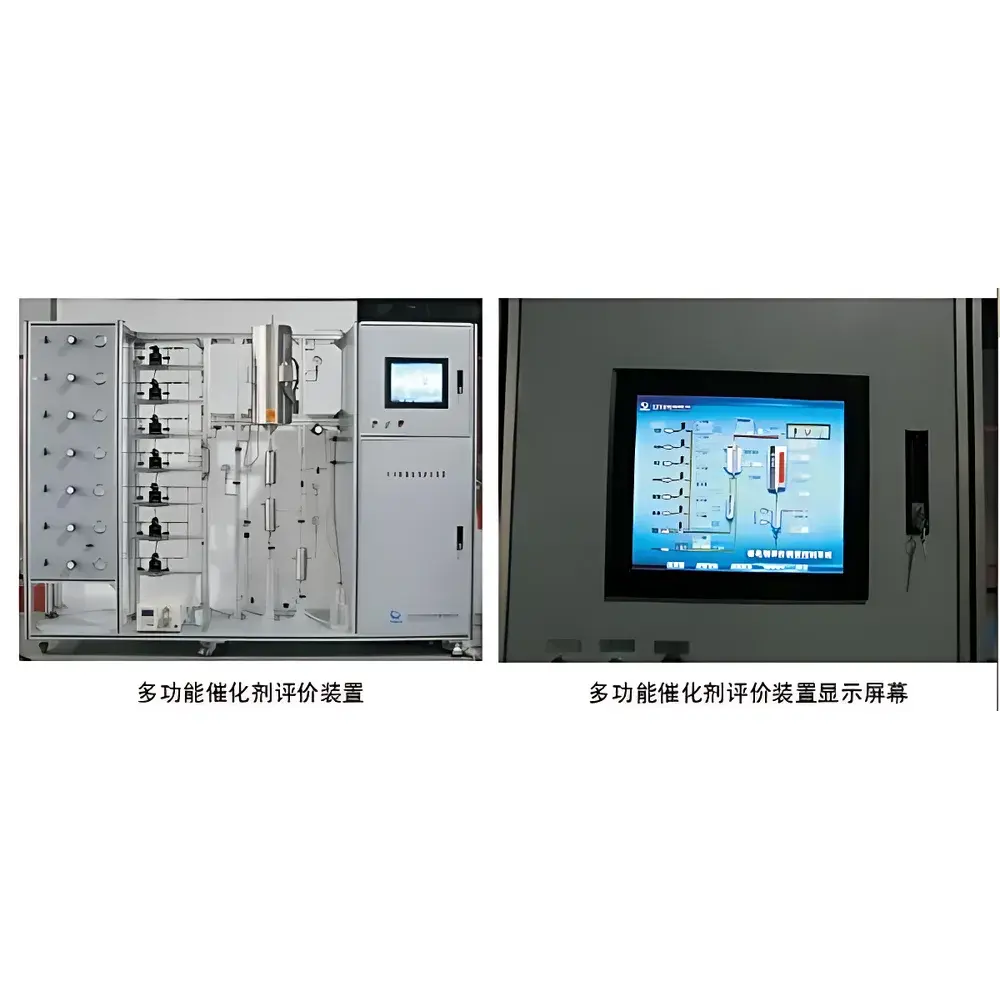
Henven HJ-1 Catalytic Evaluation System
| Brand | Henven |
|---|---|
| Origin | Beijing, China |
| Manufacturer Type | Direct Manufacturer |
| Model | HJ-1 |
| Temperature Range | 200 °C |
| Linear Ramp Rate | 0.1–40 °C/min |
| Isothermal Accuracy | ±0.1 °C |
| Reactor Pressure Range | 0.1–2 MPa |
| Gas Flow Range | 0–200 mL/min |
| Gas Flow Accuracy | ±0.1% FS |
| Liquid Flow Range | 0–10 mL/min |
| Liquid Flow Accuracy | ±0.01 mL/min |
| Catalyst Bed Volume | 0–100 mL (customizable) |
Overview
The Henven HJ-1 Catalytic Evaluation System is a fully integrated, bench-scale fixed-bed or fluidized-bed catalytic testing platform engineered for precision kinetic studies, catalyst screening, and process parameter optimization under controlled thermochemical conditions. It operates on the principle of continuous-flow heterogeneous catalysis, where gaseous and/or liquid reactants pass through a temperature- and pressure-regulated catalyst bed while real-time physicochemical parameters—including segmental temperature profiles, differential pressure drop, mass flow rates, and system backpressure—are continuously acquired and logged. Designed for laboratory-based R&D in academic catalysis labs, petrochemical research centers, and industrial catalyst development groups, the HJ-1 supports both steady-state and transient operation modes, enabling rigorous determination of turnover frequency (TOF), activation energy, deactivation kinetics, and selectivity profiles across diverse reaction chemistries—including Fischer–Tropsch synthesis, hydrodesulfurization (HDS), ammonia decomposition, CO₂ hydrogenation, and selective oxidation.
Key Features
- Modular dual-gas + single-liquid feed architecture with independent mass flow controllers (MFCs) and high-resolution syringe pumps, ensuring stoichiometric flexibility and reproducible reagent delivery.
- Intelligent touchscreen HMI (Human–Machine Interface) with intuitive configuration menus—enabling full parametric setup (ramp rates, hold times, pressure setpoints, flow profiles) without external software or PC dependency.
- Segmented reactor heating zone with PID-controlled cartridge heaters and embedded Pt100 RTD sensors (±0.1 °C isothermal stability over ≥24 h), supporting multi-zone linear ramping (0.1–40 °C/min) and synchronized cooling via optional air-cooling jacket.
- Integrated Renmai Fluidized-Bed Control Module—dynamically adjusts gas velocity, distributor plate pressure drop, and bed expansion ratio using closed-loop feedback from differential pressure transducers and capacitance-based bed height sensors.
- Dedicated fault detection subsystem with hardwired watchdog logic: monitors critical thresholds (e.g., T > 210 °C, P > 2.1 MPa, ΔP > 0.3 MPa across catalyst bed) and triggers automatic shutdown, venting, and alarm logging compliant with IEC 61508 SIL-2 functional safety principles.
- Structural framework fabricated from 316L stainless steel with electropolished panel surfaces; all wetted parts conform to ASTM A270 sanitary-grade finish standards for corrosion resistance and cleanability.
Sample Compatibility & Compliance
The HJ-1 accommodates catalyst forms including pellets, extrudates, powders, and monoliths within a standard 0–100 mL bed volume (customizable up to 500 mL). It is compatible with corrosive feeds (e.g., H₂S, NH₃, Cl₂-containing streams) when configured with Hastelloy C-276 reactor liners and fluoropolymer-sealed fittings. The system meets mechanical design requirements per ASME BPVC Section VIII Div. 1 and pressure equipment directive (PED 2014/68/EU) for Category II equipment. All electronic modules are CE-marked and EMC-compliant (EN 61326-1). Data acquisition and control firmware support audit-trail generation aligned with GLP and FDA 21 CFR Part 11 requirements when operated with optional validated software packages.
Software & Data Management
Local data logging occurs at 10 Hz resolution to internal industrial-grade SSD storage (32 GB), with timestamped CSV exports via USB or Ethernet. Optional PC-based software (Henven CatalystStudio™ v3.2) provides advanced features: dynamic reaction modeling (Langmuir–Hinshelwood and Mars–van Krevelen fitting), real-time conversion/selectivity calculation, multi-variable trend overlay, and automated report generation compliant with ISO/IEC 17025 documentation standards. Raw sensor outputs include calibrated analog signals (4–20 mA) and digital Modbus RTU interfaces for integration into existing DCS or SCADA environments.
Applications
- Accelerated catalyst lifetime testing under cyclic thermal/pressure stress
- Structure–activity relationship (SAR) mapping for supported metal and metal oxide catalysts
- Water–gas shift and steam reforming kinetics under realistic syngas compositions
- Deactivation mechanism analysis (coking, sintering, poisoning) via in situ TPO/TPD coupling
- Scale-up parameter derivation for pilot-plant reactor design (e.g., WHSV, GHSV, void fraction)
- Education and training in heterogeneous catalysis, reaction engineering, and process safety fundamentals
FAQ
Can the HJ-1 operate in both fixed-bed and fluidized-bed configurations?
Yes—the reactor section is mechanically interchangeable; users may install either a fixed-bed support grid or a porous distributor plate with adjustable gas sparging orifices.
Is remote monitoring supported out-of-the-box?
The base unit includes Ethernet connectivity and Modbus TCP server functionality; remote access requires configuration of firewall rules and optional secure VPN tunneling.
What calibration certificates are supplied with delivery?
Each system ships with NIST-traceable calibration reports for all primary sensors (RTDs, pressure transducers, MFCs) valid for 12 months from commissioning.
Does the system comply with explosion-proof requirements for flammable gas handling?
The standard configuration is rated for Class I, Division 2 hazardous locations; ATEX/IECEx Zone 2 certification is available as an optional upgrade with purged enclosure and intrinsically safe signal conditioning.
Can third-party analytical instruments be interfaced directly?
Yes—standard GC, MS, and FTIR outputs (analog voltage or RS232) can be synchronized via TTL trigger inputs and time-stamped alignment in CatalystStudio™.
Related Products



