
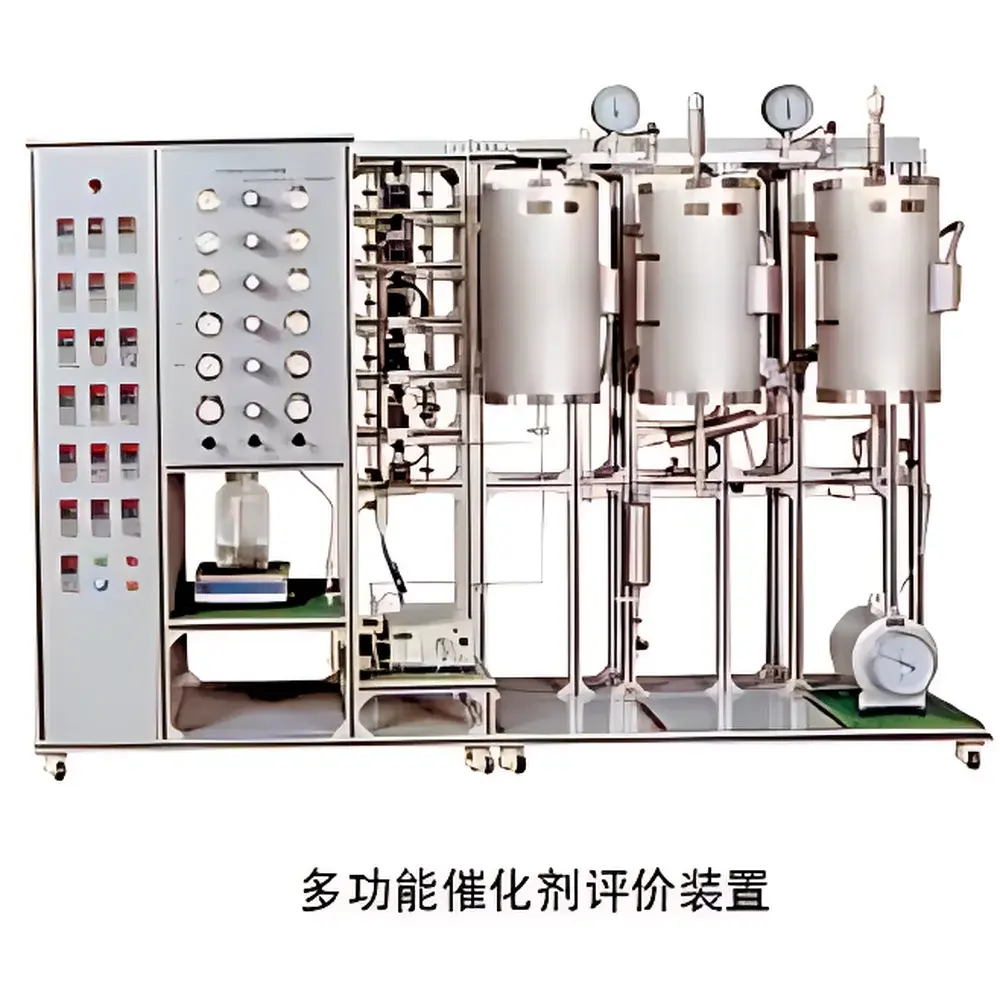
Henven HJ1 Catalyst Performance Evaluation System
| Brand | Henven |
|---|---|
| Origin | Beijing, China |
| Manufacturer Type | Direct Manufacturer |
| Model | HJ1 |
| Temperature Range | Up to 800 °C |
| Linear Ramp Rate | 0.1–40 °C/min |
| Isothermal Stability | ±0.1 °C |
| Pressure Range | 0.1–10 MPa |
| Gas Flow Range | 0–20 L/min |
| Gas Flow Accuracy | ±0.1% FS |
| Liquid Flow Range | 0–10 mL/min |
| Liquid Flow Accuracy | ±0.01 mL/min |
| Catalyst Bed Volume | 0–10 mL (customizable) |
Overview
The Henven HJ1 Catalyst Performance Evaluation System is a fully integrated, bench-scale catalytic testing platform engineered for rigorous kinetic studies, deactivation analysis, and process validation under realistic reaction conditions. It operates on the principle of continuous-flow fixed-bed or fluidized-bed catalysis, supporting both gas-phase and liquid-phase feed introduction with precise thermal and pressure control. Designed specifically for petroleum refining, petrochemical R&D, and heterogeneous catalyst development labs, the HJ1 enables reproducible evaluation of activity, selectivity, stability, and regenerability across diverse catalytic chemistries—including hydrodesulfurization (HDS), hydrocracking, Fischer–Tropsch synthesis, and oxidative dehydrogenation. Its modular architecture allows seamless configuration for single- or multi-reactor operation, while its embedded sensor network provides real-time, high-fidelity monitoring of thermodynamic and hydrodynamic parameters critical to mechanistic interpretation.
Key Features
- Four independent, mass-flow-controlled gas channels and one precision syringe-pump-driven liquid channel—enabling complex co-feed, sequential injection, or transient response experiments.
- High-temperature reactor zone rated to 800 °C with programmable linear ramping (0.1–40 °C/min) and ultra-stable isothermal operation (±0.1 °C over >24 h).
- Full-pressure range operation from vacuum to 10 MPa, supported by redundant pressure transducers and fail-safe solenoid isolation valves.
- Renmai Fluidized-Bed Control Module: proprietary closed-loop algorithm that dynamically adjusts distributor gas velocity, bed temperature gradients, and solids circulation rate based on real-time differential pressure and thermocouple feedback.
- Segmented reactor zoning with individually addressable heaters and Pt100 RTD sensors—permitting axial temperature profiling and localized thermal management.
- Integrated fault-detection architecture: independent watchdog circuits continuously monitor critical nodes (e.g., reactor wall temperature, backpressure, cooling water flow); automatic shutdown and alarm logging occur upon threshold violation.
- Rugged 316L stainless-steel frame and panel construction compliant with IP54 environmental rating; all wetted parts are electropolished and traceable per ASME BPE standards.
Sample Compatibility & Compliance
The HJ1 accommodates catalyst forms including powders, extrudates, pellets, and monoliths (0–10 mL bed volume, scalable upon request). It supports corrosive feeds (e.g., H2S, NH3, Cl-containing streams) via optional Hastelloy-C276 reactor liners and fluoropolymer-sealed fittings. The system meets mechanical integrity requirements of PED 2014/68/EU and complies with electrical safety standards IEC 61010-1. For regulated environments, it supports audit-ready operation: event logs with timestamped operator actions, sensor calibration history, and parameter change tracking—all exportable in CSV or XML format. Optional 21 CFR Part 11-compliant software package available for GLP/GMP laboratories requiring electronic signatures and data integrity controls.
Software & Data Management
Control and acquisition are managed through the proprietary Henven TouchOS interface—a 10.1″ capacitive LCD touchscreen running a deterministic real-time Linux kernel. All hardware parameters (temperature setpoints, flow rates, pressure targets, valve states) are configured via intuitive graphical workflows—not scripting. Data streams (up to 128 channels at 10 Hz) are time-synchronized and stored locally on an industrial SSD with RAID-1 redundancy. Export formats include ASCII, HDF5, and ASTM E1968-compliant .tdms. Remote monitoring is enabled via secure TLS 1.3 web interface (HTTPS), supporting role-based access control (RBAC) and integration with LabArchives or Electronic Lab Notebook (ELN) platforms via RESTful API.
Applications
- Accelerated aging and lifetime prediction of hydrotreating catalysts under simulated refinery conditions.
- Structure–activity relationship (SAR) studies using step-change experiments (e.g., sulfur poisoning, coke deposition kinetics).
- Validation of microkinetic models through transient isotopic labeling (e.g., 13C, D2) coupled with online GC/MS or FTIR analysis.
- Fluidization quality assessment via minimum fluidization velocity (Umf) mapping and bubble dynamics characterization.
- Startup/shutdown protocol development and emergency response simulation for scale-up feasibility studies.
- Support for ASTM D2865, D3241, ISO 12205, and IP 229 test methods related to oxidation stability and deposit formation in distillate fuels.
FAQ
Can the HJ1 operate in true fluidized-bed mode with continuous catalyst circulation?
Yes—the Renmai control module supports external loop integration with cyclone separators and riser/standpipe configurations for circulating fluidized-bed (CFB) operation.
Is third-party analytical instrumentation (e.g., GC, MS) interfacing supported?
Standard analog (4–20 mA) and digital (RS485 Modbus RTU) outputs are provided; optional Ethernet/IP or OPC UA gateways enable direct integration with chromatographic systems.
What maintenance intervals are recommended for long-term reliability?
Gas mass flow controllers require annual NIST-traceable recalibration; reactor seals and thermocouples are inspected during each catalyst changeout (typically every 200–500 h runtime).
Does the system support automated regeneration cycles (e.g., coke burn-off)?
Yes—predefined O2/N2 ramp profiles with exotherm monitoring and dynamic air-to-fuel ratio adjustment are built into the regeneration workflow library.
Are custom reactor geometries or material upgrades available?
Custom reactor tubes (quartz, Inconel 600, SiC), multi-zone heating cartridges, and high-pressure viewports can be engineered per project specifications.



