
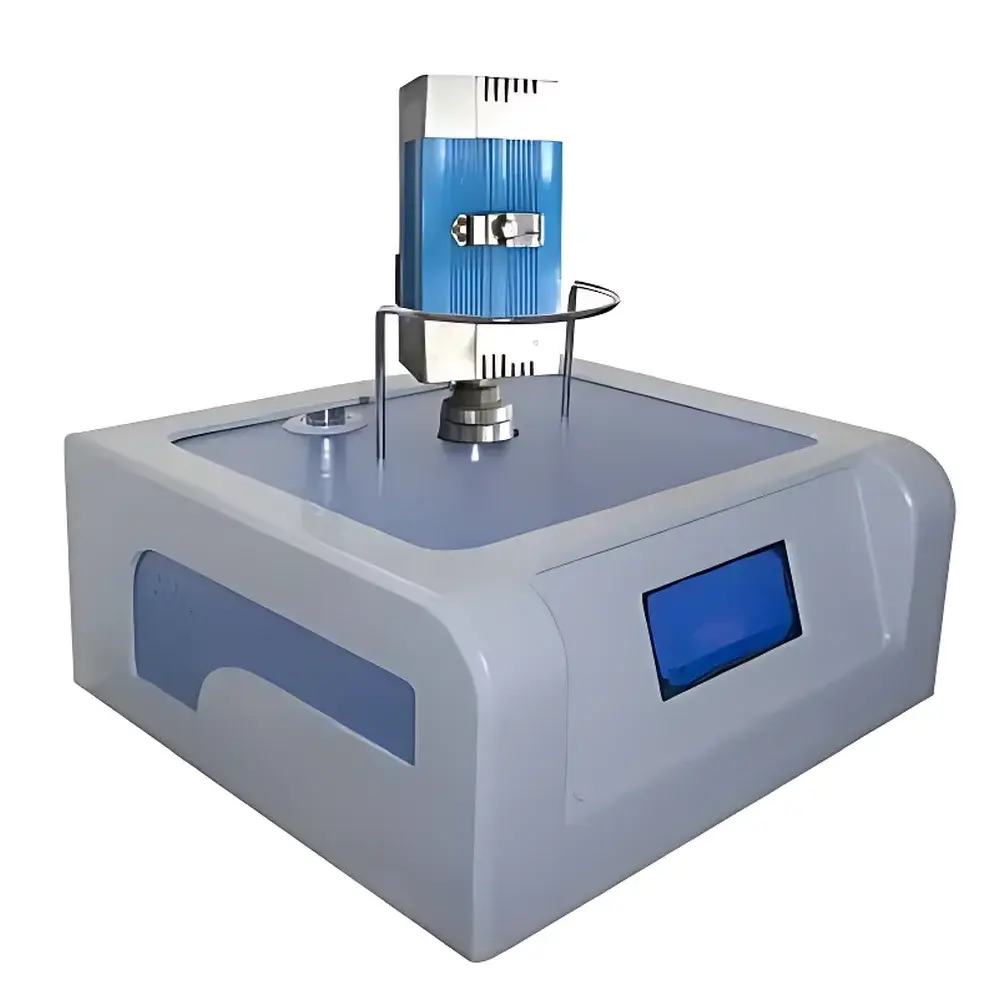
Henven HKR Differential Thermal Analyzer
| Brand | Henven |
|---|---|
| Origin | Beijing, China |
| Manufacturer Type | Direct Manufacturer |
| Model | HKR |
| Price Range | USD 7,000–14,000 |
| Temperature Range | Ambient to 1150 °C |
| Temperature Accuracy | ±0.1 °C |
| Heating/Cooling Rate | 0.1–100 K/min |
| DSC Measurement Range | ±1 mW to ±500 mW |
| DSC Precision | ±10 µW |
| DTA Signal Range | ±10 µV to ±2000 µV |
| DTA Resolution | 0.01 µV |
| DTA Noise Level | <0.01 µV |
| Vacuum Capability (optional) | 2.5×10⁻² Pa |
| Isothermal Controller Range (optional) | 0–400 °C |
| Standard Crucibles | Al₂O₃, 0.06 mL or 0.12 mL |
| Optional Crucibles | Aluminum, Graphite, Quartz |
Overview
The Henven HKR Differential Thermal Analyzer (DTA) is a precision benchtop thermal analysis instrument engineered for high-fidelity detection of endothermic and exothermic transitions in solid and powdered materials. Unlike conventional DSC systems that rely on heat flux compensation, the HKR employs a symmetric dual-thermocouple configuration—measuring temperature differentials between sample and reference simultaneously—to deliver robust, drift-compensated DTA signals with sub-microvolt resolution. Its core architecture integrates a high-stability resistive furnace capable of continuous operation up to 1150 °C, coupled with independent thermocouple monitoring of both furnace ambient and sample-stage temperatures. This dual-sensing design enables real-time validation of thermal gradients and supports rigorous calibration protocols per ASTM E794 and ISO 11357-1. The system is purpose-built for laboratories requiring traceable thermal event detection—including glass transition (Tg), crystallization onset, polymorphic transitions, decomposition kinetics, and reaction enthalpy quantification—under controlled atmospheres or high vacuum.
Key Features
- High-accuracy dual thermocouple measurement: One Type-K thermocouple continuously monitors furnace ambient temperature; a second independently positioned thermocouple tracks actual sample temperature during dynamic heating/cooling cycles.
- Programmable heating/cooling rates from 0.1 to 100 K/min, with ramp linearity verified per ASTM E1269 across full temperature range (ambient to 1150 °C).
- Mass-flow-controlled dual-gas atmosphere system with automatic switching, supporting inert (N₂, Ar), oxidative (air, O₂), reducing (H₂/N₂), and corrosive gas environments (e.g., HCl, SO₂)—custom corrosion-resistant manifolds available upon request.
- Auto-ranging signal acquisition: Real-time gain adjustment ensures optimal signal-to-noise ratio across wide DTA output spans (±10 µV to ±2000 µV) without manual intervention.
- Integrated isothermal controller (optional) with 0–400 °C range, enabling precise temperature hold for kinetic studies, phase stability assessment, and coupling to GC/MS via heated transfer lines.
- Onboard LCD interface displays live furnace temperature, sample temperature, gas flow status, and active program parameters—no external PC required for basic operation.
- Factory-calibrated baseline stability: DTA noise floor <0.01 µV RMS over 30-minute dwell at 500 °C, supporting detection of low-energy transitions such as secondary relaxations and weak crystallization events.
Sample Compatibility & Compliance
The HKR accommodates standard ceramic (Al₂O₃) crucibles (0.06 mL and 0.12 mL volumes) optimized for thermal inertia minimization and chemical inertness. Optional crucible materials include high-purity aluminum (for low-temperature DSC screening), graphite (for high-temperature metal alloy analysis), and fused quartz (for UV-transparent or halogen-free applications). All crucible mounts are designed for reproducible positioning and thermal contact consistency. The instrument meets mechanical and electrical safety requirements per IEC 61010-1 and supports GLP-compliant data integrity through optional audit-trail-enabled software. Calibration traceability is maintained using NIST-traceable standards (In, Sn, Pb, Zn) for temperature and enthalpy verification in accordance with USP and ISO 11357-2.
Software & Data Management
The HKR is operated via Henven’s proprietary ThermalAnalysis Suite v4.x, a Windows-based application compliant with FDA 21 CFR Part 11 for electronic records and signatures (with optional password-protected user roles and full audit trail logging). The software provides automated peak integration, baseline correction using polynomial or tangent methods, Tg determination via midpoint or inflection algorithms, and advanced kinetic modeling including Ozawa-Flynn-Wall, Kissinger, and Friedman analyses. Users may import custom calculation templates (e.g., specific heat capacity via step-heating protocol or Avrami exponent derivation) for automated post-processing. Raw data export is supported in ASCII, CSV, and universal .itx formats compatible with OriginLab, MATLAB, and Thermo Scientific™ OMNIC™. Screen capture functionality allows timestamped snapshot capture at any point during acquisition for documentation or troubleshooting.
Applications
- Polymers: Quantification of Tg, cold crystallization, melting enthalpy, and degradation onset in thermoplastics, elastomers, and biopolymers.
- Pharmaceuticals: Solid-state form screening (hydrate/anhydrate, amorphous/crystalline), excipient compatibility, and stability-indicating assay development.
- Inorganics & Ceramics: Phase transformation mapping (e.g., α→β quartz, mullite formation), sintering behavior, and thermal expansion anomaly detection.
- Metals & Alloys: Eutectic melting point validation, solidus/liquidus determination, and precipitation kinetics under controlled atmospheres.
- Energy Materials: Cathode/anode thermal runaway profiling, electrolyte decomposition thresholds, and binder pyrolysis characterization for Li-ion battery R&D.
- Geochemical & Environmental Samples: Clay mineral dehydroxylation, carbonate decomposition, and organic matter combustion profiling in soil/sediment matrices.
FAQ
What calibration standards are recommended for routine verification?
Indium (156.6 °C), tin (231.9 °C), and lead (327.5 °C) are primary standards for temperature calibration; indium and zinc are used for enthalpy calibration per ISO 11357-2.
Can the HKR be interfaced with a mass spectrometer or FTIR?
Yes—via optional heated transfer line (0–400 °C) and vacuum-compatible coupling port; full synchronization with MS/FTIR trigger signals is supported in ThermalAnalysis Suite.
Is vacuum operation standard or optional?
Vacuum capability is optional and requires add-on vacuum pump station (2.5×10⁻² Pa ultimate pressure); base configuration operates under ambient or purged gas conditions.
How is baseline stability maintained during extended isothermal holds?
The dual-thermocouple architecture, combined with active furnace temperature feedback and low-drift analog circuitry, ensures baseline drift <±0.05 µV/hour over 24-hour dwell at 800 °C.
Does the system support modulated DTA (MDTA) or only conventional DTA?
The HKR performs conventional static-DTA; modulated techniques require separate DSC hardware configuration—not available on this platform.



