
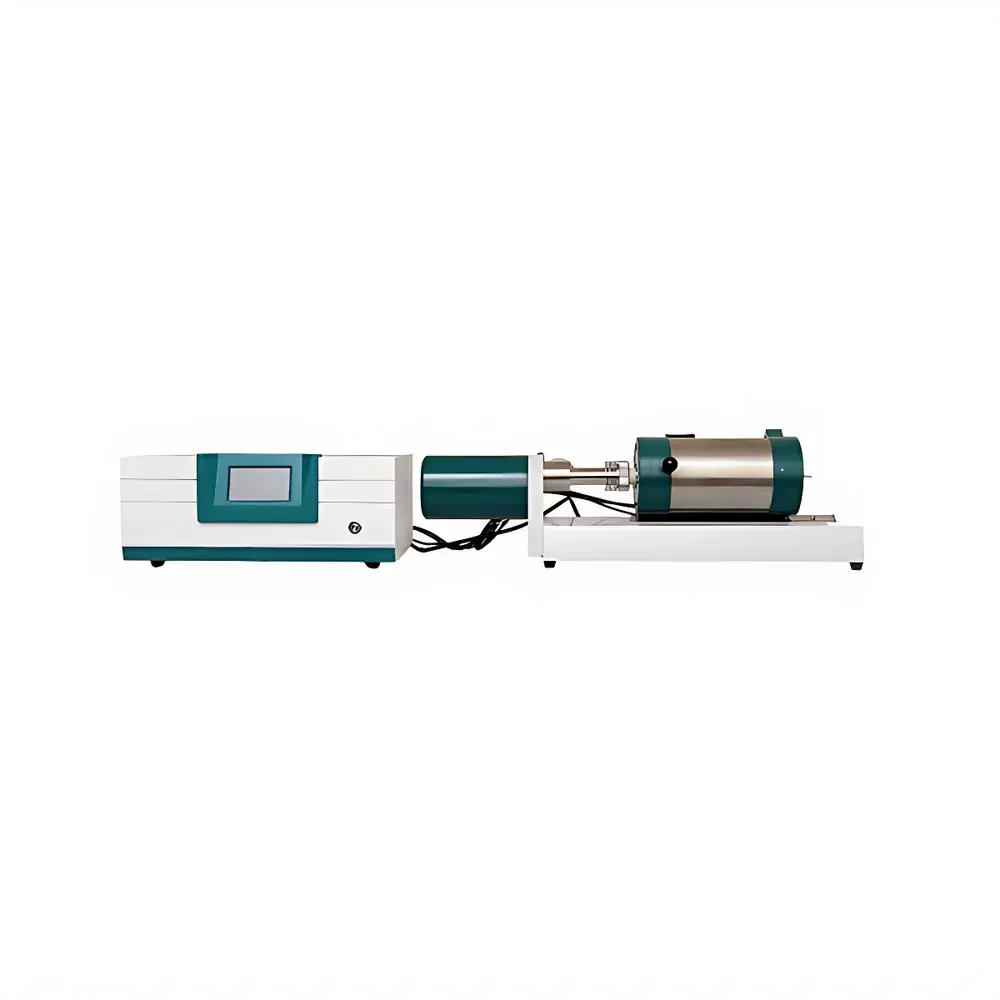
Henven HPY-3 Horizontal Dilatometer
| Brand | Henven |
|---|---|
| Origin | Beijing, China |
| Manufacturer Type | Direct Manufacturer |
| Model | HPY-3 |
| Temperature Range | Ambient to 1600 °C |
| Heating Rate | 0.1–100 °C/min |
| Temperature Accuracy | ±0.1 °C |
| Sample Chamber Dimensions | 600 × 400 × 300 mm |
| Expansion Measurement Range | ±5 mm |
| Resolution | 1 µm |
| Atmosphere Options | Inert gas (N₂, Ar), Vacuum (up to 0.1 MPa) |
| Compliance | GB/T 3810.9 & GB/T 3810.10–1999 |
Overview
The Henven HPY-3 Horizontal Dilatometer is a precision-engineered thermal expansion measurement system designed for high-temperature dimensional stability analysis of inorganic and metallic solids. Operating on the principle of contact-based linear displacement measurement under controlled thermal gradients, the instrument quantifies dimensional changes—primarily linear expansion—as a function of temperature. Its horizontal configuration minimizes gravitational sag effects and ensures optimal alignment between the sample, pushrod, and transducer during extended high-temperature experiments. The system supports continuous heating from ambient up to 1600 °C, enabling characterization across critical phase transitions, sintering regimes, glass transitions, and softening events in advanced ceramics, refractories, metallurgical compacts, graphite, carbon composites, and specialty glasses.
Key Features
- Horizontal furnace architecture with optimized thermal uniformity and minimal axial thermal gradient (<±2 °C over 50 mm sample zone at 1400 °C)
- High-stability quartz or alumina pushrod assembly with imported linear motion bearings, ensuring frictionless force transmission and long-term mechanical repeatability
- Digital linear variable differential transformer (LVDT) transducer with 1 µm resolution and full-scale range of ±5 mm
- PID-controlled programmable heating module supporting ramp rates from 0.1 to 100 °C/min with real-time feedback and overshoot suppression
- Integrated inert atmosphere chamber (N₂ or Ar) with optional vacuum capability (≤0.1 MPa absolute pressure) for oxidation-sensitive or reactive samples
- USB 2.0 and RS-232 dual interface support for seamless integration with Windows-based acquisition software and laboratory network environments
- Pre-calibrated reference standards (e.g., fused quartz, α-alumina) included for routine verification of thermal and dimensional accuracy per ISO 11359-2 and ASTM E228
Sample Compatibility & Compliance
The HPY-3 accommodates cylindrical or rectangular specimens measuring 5–10 mm in diameter (or thickness) and 40–150 mm in length, with maximum chamber volume of 600 × 400 × 300 mm permitting large-format refractory blocks or multi-sample trays. It meets the geometric and procedural requirements of GB/T 3810.9–2016 and GB/T 3810.10–1999 for linear thermal expansion testing of ceramic tiles. While not certified to ISO/IEC 17025, its measurement traceability aligns with national metrological standards through factory calibration using NIST-traceable reference materials. Data acquisition and storage comply with basic GLP documentation principles, including time-stamped raw displacement vs. temperature logs and user-annotated experimental metadata.
Software & Data Management
The bundled Windows application provides real-time visualization of displacement, temperature, and heating rate; automated calculation of linear expansion coefficient (αL), volumetric expansion coefficient (αV ≈ 3αL), sintering shrinkage rate, and inflection points corresponding to Tg, Tsoft, and phase transition onset. Curves are exportable in CSV, TXT, and PDF formats. Manual correction tools allow baseline adjustment and outlier removal prior to coefficient derivation. All raw data files include embedded instrument ID, operator name, date/time stamp, and environmental notes—supporting audit readiness for internal QA/QC workflows. Though not Part 11 compliant out-of-the-box, the software architecture permits integration with validated LIMS platforms via standardized API extensions.
Applications
- Quantification of thermal expansion anisotropy in polycrystalline ceramics and textured metals
- Sintering kinetics analysis—including densification onset, intermediate-stage shrinkage, and final-stage pore elimination—via derivative (dL/dT) profiling
- Softening point determination of glass-ceramic composites and low-melting-point alloys
- Thermal shock resistance evaluation through rapid-cool/reheat cycling protocols
- Validation of thermomechanical models used in finite element simulation of kiln furniture or casting mold behavior
- Educational demonstration of solid-state phase transformations (e.g., α↔β quartz inversion, martensitic transitions)
FAQ
What is the maximum recommended sample mass for stable HPY-3 operation at 1600 °C?
For optimal thermal homogeneity and pushrod longevity, samples should not exceed 250 g. Heavier specimens require extended equilibration times and may necessitate custom support fixtures.
Can the HPY-3 perform simultaneous dilatometry and thermogravimetry (TGA)?
No—the HPY-3 is a dedicated dilatometer. Integration with TGA requires external coupling via synchronized data acquisition systems and is not natively supported.
Is vacuum operation compatible with all temperature ranges?
Vacuum mode is rated for use up to 1200 °C. Above this, inert gas purge is mandatory to prevent hot-zone component oxidation and maintain seal integrity.
How frequently should system calibration be performed?
Daily zero-point verification is recommended before each test series; full calibration using reference standards is advised every 50 operating hours or after maintenance.
Does the instrument support multi-step heating/cooling programs?
Yes—up to 20 programmable segments, including isothermal holds, ramp reversals, and dwell periods, are fully configurable within the control software.



