
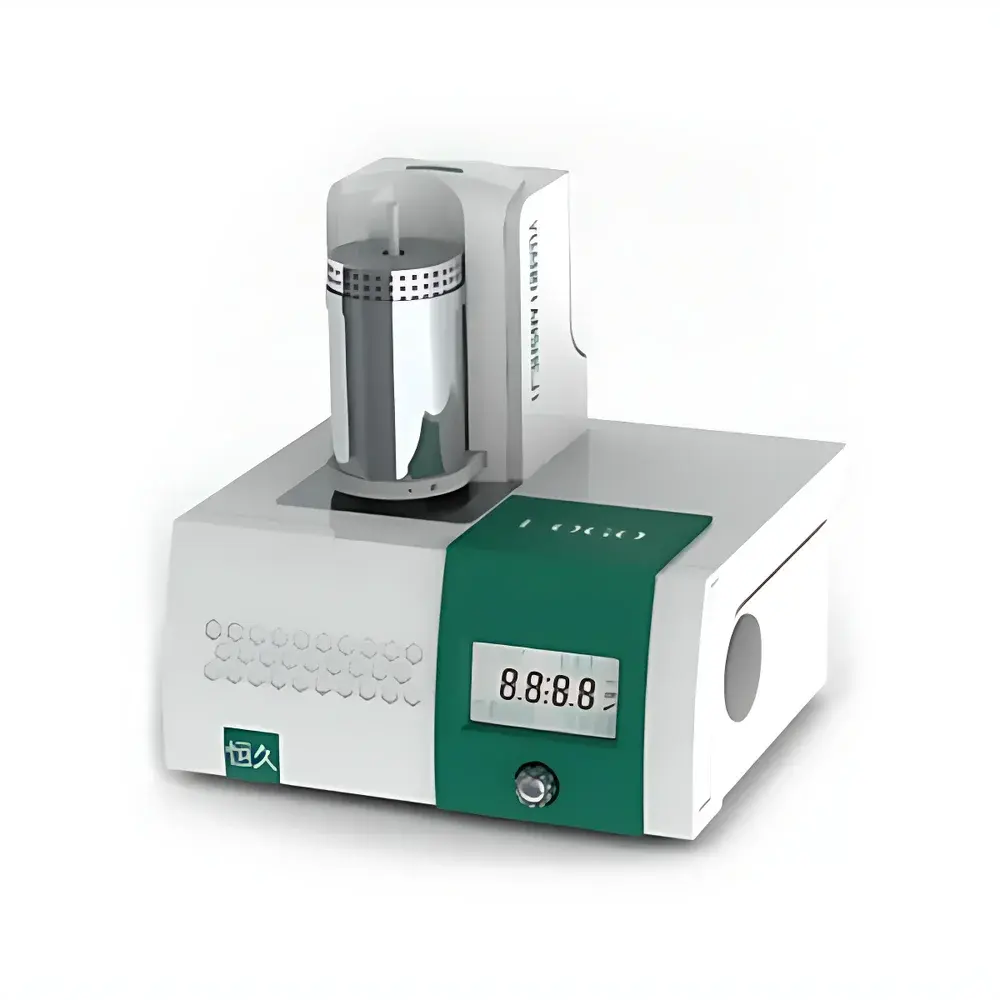
Henven HQC-2 Automated Differential Thermal Analyzer
| Brand | Henven |
|---|---|
| Origin | Beijing, China |
| Manufacturer Type | Direct Manufacturer |
| Instrument Type | DTA |
| Model | HQC-2 |
| Sample Capacity | Single |
| Temperature Range | RT to 1250 °C |
| Programmable Temperature Control | Heating & Isothermal Hold |
| Temperature Accuracy | ±0.1 °C |
| Temperature Stability | ±0.1 °C |
| Heating/Cooling Rate | 0.1–80 K/min |
| DTA Signal Range | ±10 µV to ±2000 µV (auto-ranging) |
| DTA Resolution | 0.01 µV |
| DTA Noise Level | <0.01 µV |
| DSC Measurement Range | 0 mW to ±500 mW |
| DSC Precision | ±0.1 µW |
| Atmosphere Control | Dual-channel mass flow controller (MFC), programmable gas switching |
| Optional Vacuum System | 2.5×10⁻² Pa |
| Standard Crucibles | Al₂O₃ (0.06 mL or 0.12 mL) |
| Optional Crucibles | Aluminum, Graphite, Quartz, Platinum |
| Isothermal Capability | Up to 72 h at any temperature within range |
| Software Features | Oxidation Induction Time (OIT) analysis, Crystallization Kinetics modeling, Step-Cooling Curve generation, ASTM/ISO-compliant thermal data processing, GLP/GMP-ready audit trail (optional), User-defined formula integration support |
Overview
The Henven HQC-2 Automated Differential Thermal Analyzer (DTA) is a precision-engineered benchtop instrument designed for quantitative measurement of temperature differentials between a sample and an inert reference material under controlled thermal conditions. Operating on the fundamental principle of differential thermal analysis—where thermocouple-based voltage signals reflect exothermic or endothermic transitions—the HQC-2 delivers high-fidelity thermal event detection across a wide operational window (room temperature to 1250 °C). Unlike conventional DSC systems that rely on heat flux compensation, the HQC-2 maintains strict adherence to classical DTA methodology, ensuring compatibility with legacy thermal characterization protocols defined in ASTM E473, ISO 11357-1, and USP . Its dual thermocouple architecture—one continuously monitoring furnace temperature (independent of heating state), the other dedicated exclusively to real-time sample temperature—enables rigorous decoupling of thermal lag effects and supports robust calibration traceability using certified reference materials (e.g., In, Sn, Pb).
Key Features
- Fully automated vertical furnace lift mechanism with repeatable positioning accuracy (<±5 µm), minimizing mechanical drift and enhancing inter-run reproducibility.
- Integrated dual-gas mass flow control system with independent MFCs for precise, programmable atmosphere switching during dynamic runs—compatible with inert (N₂, Ar), oxidative (air, O₂), reductive (H₂/N₂), and corrosive gas environments (custom corrosion-resistant MFC options available).
- Real-time 7-inch TFT LCD interface displaying furnace temperature, sample temperature, gas flow status, signal amplitude, and system diagnostics—no external PC required for basic operation.
- Extended isothermal capability: stable temperature hold up to 72 hours at any setpoint within the full 1250 °C range, critical for oxidation induction time (OIT), aging studies, and long-term stability assessment per ASTM D3895 and ISO 11357-6.
- Auto-ranging analog front-end with 24-bit ADC resolution, supporting seamless signal capture from microvolt-level baseline noise (<0.01 µV RMS) to millivolt-scale exotherms without manual gain adjustment.
- Modular software architecture enabling user-defined calculation modules—customers may supply mathematical expressions (e.g., Avrami kinetics, Kissinger activation energy, or custom Cp normalization algorithms), and Henven provides validated firmware-level implementation.
Sample Compatibility & Compliance
The HQC-2 accommodates standard ceramic crucibles (Al₂O₃, 0.06 mL or 0.12 mL) and supports optional high-purity alternatives—including aluminum (for low-T polymer screening), graphite (for high-T carbonaceous materials), quartz (for UV-transparent or volatile analyses), and platinum (for aggressive alkaline melts or redox-coupled reactions). All crucible mounts are thermally isolated and mechanically damped to suppress vibration-induced artifacts. The system complies with IEC 61000-6-3 (EMC emissions) and IEC 61010-1 (safety for laboratory equipment). When equipped with optional vacuum pumping and GLP-compliant software, it meets FDA 21 CFR Part 11 requirements for electronic records and signatures—including full audit trail logging, user access controls, and electronic signature validation workflows.
Software & Data Management
Acquisition and analysis are performed via HenvenTherm v4.x software—a Windows-based platform supporting both real-time monitoring and post-run processing. Core capabilities include peak integration (tangent, perpendicular, or Gaussian deconvolution), baseline correction (polynomial, spline, or linear), enthalpy quantification using certified standards, crystallization kinetics fitting (Avrami, Ozawa, Jeziorny models), and OIT determination per ASTM D3895. Raw data are stored in HDF5 format with embedded metadata (instrument ID, operator, calibration history, gas sequence logs). Export options include CSV, TXT, and universal .tdms formats compatible with MATLAB, OriginLab, and JMP. Optional networked deployment enables centralized data archiving via SQL Server or cloud-synced NAS with role-based permissions.
Applications
- Determination of melting point, crystallization onset, glass transition (Tg), and solid-solid phase transitions in polymers, pharmaceuticals, and metallic alloys.
- Oxidative stability evaluation of lubricants, polyolefins, and biofuels via oxidation induction time (OIT) and onset temperature (Tonset) under air/O₂.
- Decomposition kinetics analysis of energetic materials, catalysts, and battery electrode components using multi-heating-rate methods (e.g., Flynn-Wall-Ozawa).
- Thermal aging studies of composites and encapsulants requiring extended isothermal holds at elevated temperatures (e.g., 200–800 °C).
- Reaction calorimetry support for coupling with GC/MS or FTIR—enabled by optional heated transfer lines (RT–200 °C), vacuum-tight interfaces, and synchronized trigger outputs.
FAQ
What calibration standards are recommended for routine verification?
Indium (156.6 °C), tin (231.9 °C), and lead (327.5 °C) are primary reference materials for temperature calibration; benzoic acid (ΔHfus = 26.38 J/g) and sapphire are used for energy calibration per ISO 11357-2.
Can the HQC-2 perform simultaneous TGA-DTA measurements?
No—the HQC-2 is a dedicated DTA platform. For coupled thermogravimetric analysis, Henven offers the HTG-2 series with integrated microbalance and synchronous DTA signal acquisition.
Is remote operation supported?
Yes—via Ethernet-connected PC with VNC or TeamViewer-enabled secure access; full instrument control, real-time plotting, and alarm notification are retained.
What maintenance intervals are specified for the MFC and furnace assembly?
MFC zero-point calibration every 6 months; furnace insulation inspection annually; thermocouple replacement recommended after 500 cumulative hours above 1000 °C.
Does the software support IQ/OQ/PQ documentation packages for regulated labs?
Yes—validated installation qualification (IQ), operational qualification (OQ), and performance qualification (PQ) templates are provided upon request, aligned with GAMP5 and Annex 11 guidelines.



