
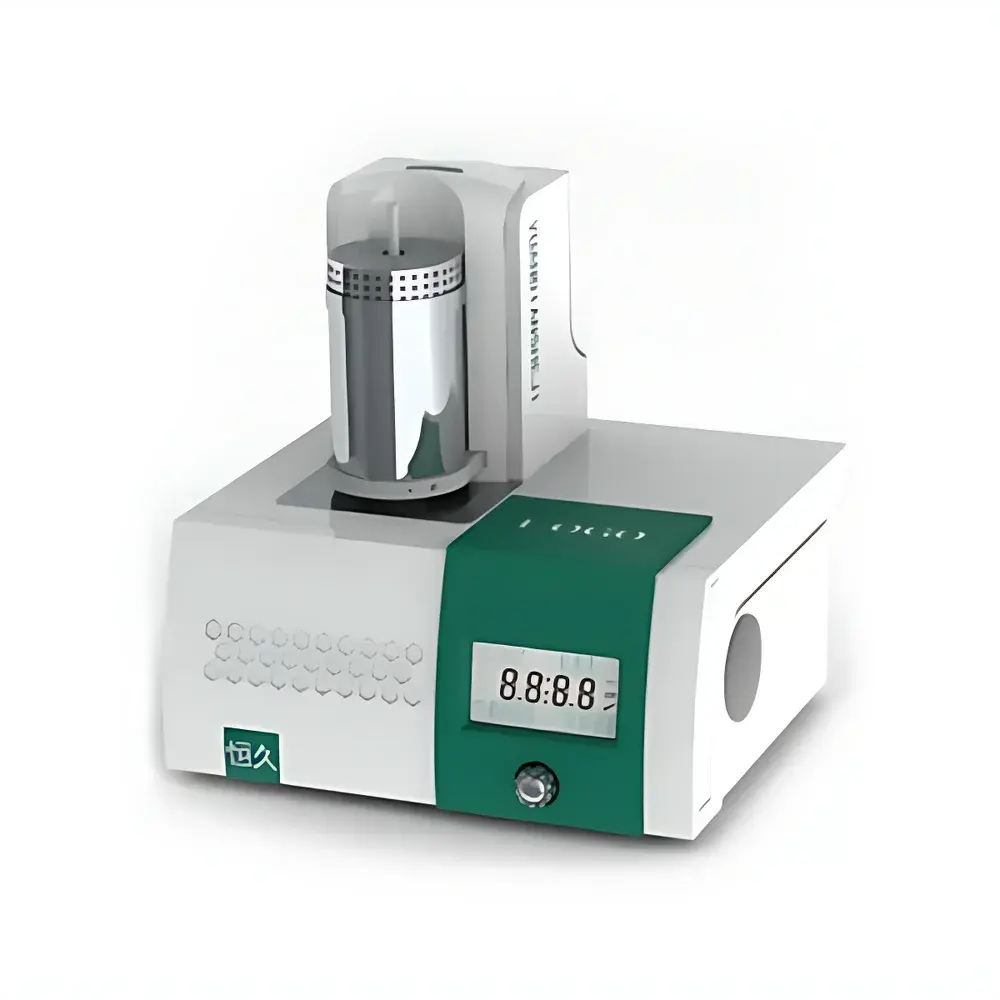
Henven HQC-3 Automated Differential Thermal Analyzer
| Brand | Henven |
|---|---|
| Origin | Beijing, China |
| Manufacturer Type | Direct Manufacturer |
| Regional Classification | Domestic (China) |
| Model | HQC-3 |
| Sample Capacity | Single-sample |
| Instrument Type | Differential Thermal Analyzer (DTA) |
| Temperature Range | RT to 1450 °C |
| Programmable Temperature Control | Heating & Isothermal Hold |
| Temperature Accuracy | ±0.1 °C |
| Temperature Stability | ±0.1 °C |
| Heating/Cooling Rate | 0.1–80 K/min |
| DTA Signal Range | ±10 µV to ±2000 µV (auto-ranging) |
| DTA Resolution | 0.01 µV |
| DTA Noise Level | <0.01 µV |
| DSC Measurement Range | 0 mW to ±500 mW |
| DSC Sensitivity | ±0.1 µW |
| Atmosphere Control | Dual-channel mass flow controller (MFC), auto-switching, corrosion-resistant options available |
| Vacuum Option | 2.5×10⁻² Pa (with optional vacuum unit) |
| Isothermal Duration | Up to 72 h at any temperature within range |
| Standard Crucibles | Al₂O₃ (0.06 mL or 0.12 mL) |
| Optional Crucibles | Aluminum, graphite, quartz, platinum |
Overview
The Henven HQC-3 Automated Differential Thermal Analyzer is a precision-engineered instrument designed for quantitative thermal analysis based on the differential thermal analysis (DTA) principle. It measures the temperature difference (ΔT) between a sample and an inert reference material as both are subjected to identical, programmable thermal profiles under controlled atmosphere or vacuum conditions. Unlike DSC instruments that quantify heat flow directly, the HQC-3 operates on the classical DTA method—detecting exothermic or endothermic transitions via thermocouple voltage differentials with high signal fidelity and low noise floor (<0.01 µV). Its operational range extends from ambient temperature to 1450 °C, making it suitable for high-temperature applications including ceramic sintering, metal alloy phase transformations, refractory decomposition, and advanced inorganic material characterization. The system integrates furnace lift automation, dual thermocouple monitoring (furnace + sample), and real-time digital display of thermal status, gas flow, and signal output—ensuring consistent positioning and minimizing mechanical drift-induced measurement variability.
Key Features
- Fully automated furnace lift mechanism with repeatable vertical positioning—enhancing inter-run reproducibility and reducing operator-induced error.
- Dual independent thermocouples: one continuously monitors furnace block temperature (active or idle), while the second tracks actual sample temperature during operation—enabling precise thermal lag correction and calibration traceability.
- High-resolution DTA detection system: 0.01 µV resolution over a dynamic range of ±10 µV to ±2000 µV with automatic gain switching—eliminating manual range selection and preserving signal integrity across baseline and peak regions.
- Programmable thermal control supporting linear heating, stepwise heating, and extended isothermal holds up to 72 hours at any setpoint within the 1450 °C range.
- Integrated dual-channel mass flow controller (MFC) for precise, stable, and switchable gas delivery—compatible with inert (N₂, Ar), oxidative (O₂, air), reductive (H₂, forming gas), and corrosive atmospheres (e.g., HCl, SO₂) via optional chemically resistant MFC modules.
- Modular interface for coupling with external analytical systems—including GC, GC-MS, and FTIR—via standardized heated transfer lines (optional, 200 °C max) and vacuum-compatible connection ports.
- Self-calibrating architecture: supports user-performed temperature and energy calibration using certified standards (In, Sn, Pb, Zn) per ASTM E794 and ISO 11357-1 protocols.
Sample Compatibility & Compliance
The HQC-3 accommodates a broad spectrum of solid and powdered materials—including polymers, pharmaceuticals, metals, ceramics, catalysts, and geological samples—using interchangeable crucibles (standard Al₂O₃; optional Al, graphite, quartz, Pt). Its high-temperature capability and corrosion-resistant atmosphere options ensure compatibility with aggressive chemistries encountered in battery cathode studies, sulfur-bearing mineral analysis, or halogenated polymer degradation testing. The instrument complies with core regulatory expectations for thermal analysis instrumentation: data acquisition meets GLP/GMP audit-trail requirements through timestamped, non-editable raw signal logging; software supports 21 CFR Part 11-compliant user access control and electronic signature when deployed with validated configurations. All thermal calibrations align with ISO 11357 series standards for DTA/DSC performance verification.
Software & Data Management
The embedded analysis suite provides comprehensive post-acquisition processing: baseline correction, peak integration (area, onset, offset), enthalpy calculation, kinetic modeling (Ozawa-Flynn-Wall, Kissinger, Friedman), glass transition identification (Tg), and comparative overlay of multiple runs. The software includes dedicated modules for oxidation induction time (OIT) analysis per ASTM D3895, crystallization kinetics (Avrami modeling), and step-cooling curve generation. Raw data is stored in vendor-neutral ASCII format (.txt) and supports export to common third-party platforms (OriginLab, MATLAB, Excel). Screen capture functionality allows annotation at any acquisition point, and users may define custom calculation routines—Henven’s engineering team provides validated script integration upon request. All data files retain full metadata: instrument ID, operator, date/time stamp, atmospheric conditions, crucible type, and calibration history.
Applications
- Determination of melting points, eutectic temperatures, and solidus/liquidus boundaries in metallurgical and ceramic systems.
- Quantification of phase transition enthalpies (e.g., martensitic transformation in shape-memory alloys, polymorphic transitions in APIs).
- Oxidation stability assessment via OIT testing for polyolefins and lubricants under accelerated aging conditions.
- Thermal decomposition profiling of energetic materials, flame retardants, and carbon-based composites.
- Crystallization behavior analysis in amorphous pharmaceuticals and polymer melts—supporting formulation development and shelf-life prediction.
- High-temperature stability evaluation of refractories, nuclear fuel matrices, and aerospace-grade superalloys.
- Multi-step reaction monitoring in catalytic processes, especially when coupled with evolved gas analysis (EGA) via GC-MS interface.
FAQ
What is the difference between DTA and DSC modes on the HQC-3?
The HQC-3 is fundamentally a DTA instrument. While it reports heat-flow-like signals (mW), its underlying measurement is ΔT—not absolute heat flow. DSC quantification is derived mathematically from DTA output using calibration factors and sample mass, and is therefore semi-quantitative unless rigorously validated per ISO 11357-4.
Can the HQC-3 operate under vacuum?
Yes—when equipped with the optional vacuum unit, the system achieves ≤2.5×10⁻² Pa, enabling pyrolysis studies without oxidative interference and improving detection limits for volatile decomposition products.
Is remote monitoring or networked data acquisition supported?
The standard configuration includes RS-232 and USB interfaces. Ethernet connectivity and remote desktop access can be implemented via OEM-customized firmware upgrades—subject to site-specific IT security review.
How often does the system require recalibration?
Temperature calibration is recommended before each critical measurement campaign using NIST-traceable standards; energy calibration is required after crucible replacement or major hardware maintenance, per ASTM E967 guidelines.
Are custom crucibles or specialized sample holders available?
Yes—Henven offers application-specific crucibles (e.g., sealed high-pressure, micro-volume, fiber-mounting) and can fabricate bespoke holders upon technical specification submission and feasibility review.
Related Products



