
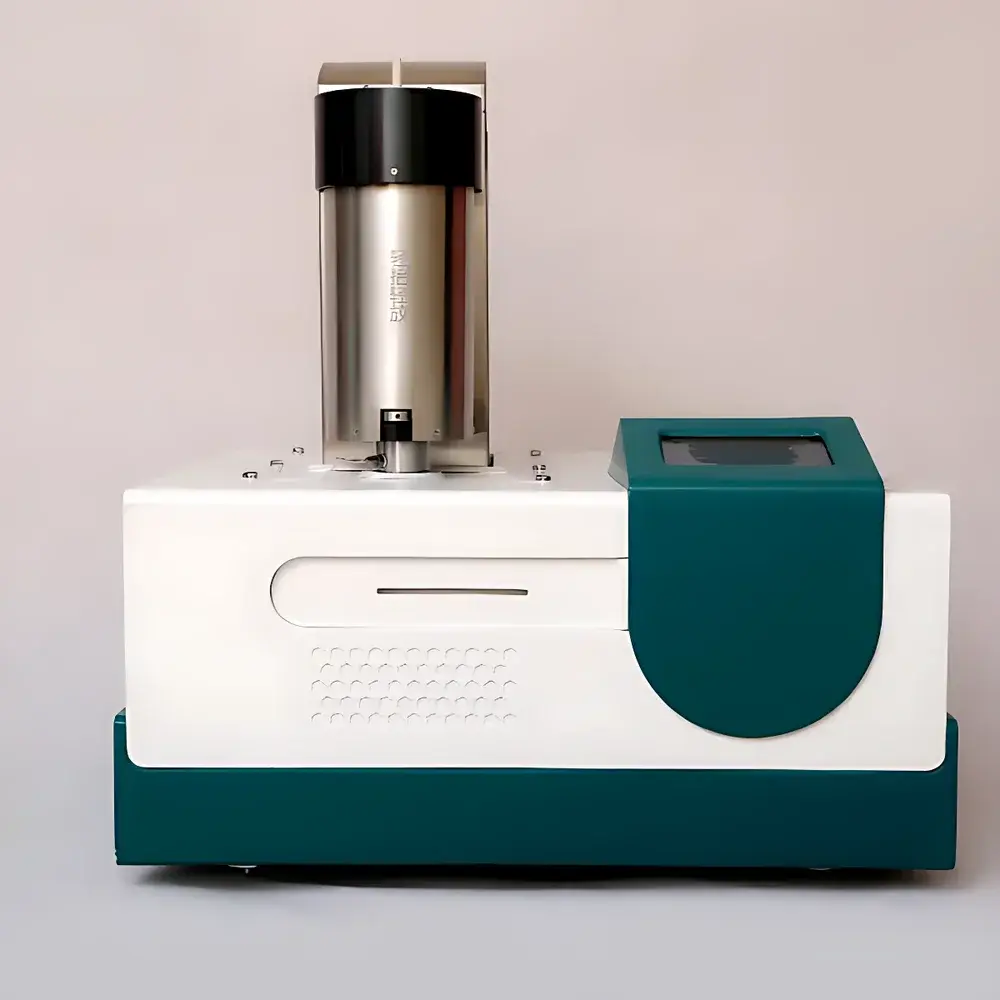
Henven HQG-3 Automated Thermogravimetric Analyzer
| Brand | Henven |
|---|---|
| Origin | Beijing, China |
| Manufacturer Type | Direct Manufacturer |
| Model | HQG-3 |
| Operating Environment | Ambient Pressure |
| Sample Capacity | Single Sample |
| Instrument Type | General-Purpose TGA |
| Temperature Range | Room Temperature to 1450 °C |
| Temperature Accuracy | ±0.1 °C |
| Temperature Precision | ±0.1 K |
| Dynamic Weighing Range | 0.01 mg – 5 g |
| Balance Sensitivity | 0.1 µg |
| Mass Accuracy | 0.1 µg |
| Heating/Cooling Rate | 0.1 – 100 K/min |
| Maximum Sample Mass | 5 g |
| Baseline Repeatability | 0.01 mg |
| Baseline Drift | 0.01 mg |
Overview
The Henven HQG-3 Automated Thermogravimetric Analyzer is a high-stability, microprocessor-controlled instrument engineered for precision measurement of mass change as a function of temperature or time under controlled atmospheric conditions. Based on the fundamental principle of thermogravimetry (TGA), the system employs a high-resolution electrobalance coupled with a programmable furnace to quantify thermal decomposition, oxidation, reduction, desorption, volatilization, and other mass-altering physicochemical transitions. Its operational range spans from ambient temperature to 1450 °C, enabling characterization of refractory ceramics, metallic alloys, catalysts, pharmaceutical excipients, polymer composites, and inorganic precursors. The instrument complies with core methodology standards referenced in ASTM E1131, ISO 11358, and USP , supporting GLP-compliant workflows when integrated with audit-trail-enabled software.
Key Features
- Integrated furnace-lift mechanism with motorized vertical positioning ensures reproducible sample placement and eliminates mechanical hysteresis during repeated thermal cycles.
- Dual thermocouple configuration: one continuously monitors furnace block temperature (active or idle), while the second measures actual sample temperature in real time—critical for kinetic analysis and calibration traceability.
- Mass flow controller (MFC)-based dual-gas atmosphere system enables seamless switching between inert (N₂, Ar), oxidizing (air, O₂), or reducing (H₂, CO) environments; optional corrosion-resistant MFC modules available for HCl, SO₂, or NH₃-compatible operation.
- Modular crucible support system accommodates standard geometries (Φ5×4 mm, Φ5×8 mm, Φ8×10 mm, Φ18×8 mm, Φ18×15 mm, Φ18×20 mm) in ceramic, alumina, graphite, quartz, and platinum variants—ensuring compatibility with aggressive melts or high-temperature redox reactions.
- Auto-ranging balance electronics dynamically adjust signal gain during acquisition, preserving resolution across full 0.01 mg–5 g mass span without manual intervention.
- Real-time LCD interface displays simultaneous live traces of mass (mg), derivative mass loss (DTG), furnace temperature (°C), sample temperature (°C), gas flow rates (mL/min), and system status flags.
Sample Compatibility & Compliance
The HQG-3 accepts solid powders, granules, thin films, fibers, and small monolithic specimens up to 5 g. Its wide dynamic weighing range and sub-microgram sensitivity accommodate both trace-additive quantification (e.g., residual solvents in APIs per ICH Q3C) and bulk thermal stability screening of structural ceramics. All hardware components—including furnace insulation, thermocouple sheaths, and gas lines—meet RoHS Directive 2011/65/EU material restrictions. When configured with password-protected user roles, electronic signature logging, and immutable raw-data archiving, the system supports FDA 21 CFR Part 11 compliance for regulated QC laboratories.
Software & Data Management
The proprietary TGA Control Suite provides full instrument automation and post-acquisition processing. Core functions include automatic baseline correction, peak deconvolution, isoconversional kinetics (Friedman, Ozawa-Flynn-Wall), residue quantification, and multi-curve overlay with statistical deviation mapping. Users may define custom calculation templates—for instance, calculating char yield at 800 °C under N₂ or moisture content via first-step mass loss below 150 °C—and export results directly to CSV, PDF, or XML formats compatible with LIMS integration. Raw data files are timestamped and checksum-verified to ensure chain-of-custody integrity.
Applications
- Decomposition kinetics of polymeric matrices in aerospace composites (ASTM D3850)
- Quantitative analysis of carbonate content in geological samples (ISO 10693)
- Thermal stability assessment of lithium-ion battery cathode materials (e.g., NMC, LFP) under air vs. argon
- Residual solvent profiling in lyophilized biopharmaceuticals (USP )
- Catalyst coking behavior and regeneration efficiency evaluation
- Oxidation onset temperature determination for high-entropy alloys
- Moisture, volatile organics, and ash content determination per ASTM E1356
FAQ
What is the maximum recommended sample mass for optimal signal-to-noise ratio in kinetic studies?
For high-fidelity activation energy calculations using model-free methods, we recommend ≤200 mg for most inorganic and polymeric samples to maintain uniform heat transfer and minimize intra-particle temperature gradients.
Can the HQG-3 be interfaced with a GC-MS or FTIR for evolved gas analysis (EGA)?
Yes—the instrument includes a standardized heated transfer line port (operable up to 200 °C) and optional vacuum-tight coupling kits for direct hyphenation with third-party gas analyzers, supporting real-time correlation of mass loss events with molecular speciation.
Is temperature calibration traceable to NIST standards?
Calibration procedures support use of certified reference materials (e.g., Ni, Cu, Al₂O₃) with documented NIST-traceable certificates; software allows user-defined calibration curves with polynomial fitting and uncertainty propagation.
How is baseline drift compensated during long-duration isothermal holds?
The system applies real-time adaptive baseline modeling using segmented linear regression over user-defined time windows, with optional manual anchor-point adjustment during post-processing.
Does the software support automated report generation compliant with ISO/IEC 17025 requirements?
Yes—templates include instrument ID, operator signature, environmental conditions, calibration records, uncertainty statements, and raw-data hash verification, fully configurable for accredited testing laboratories.



