
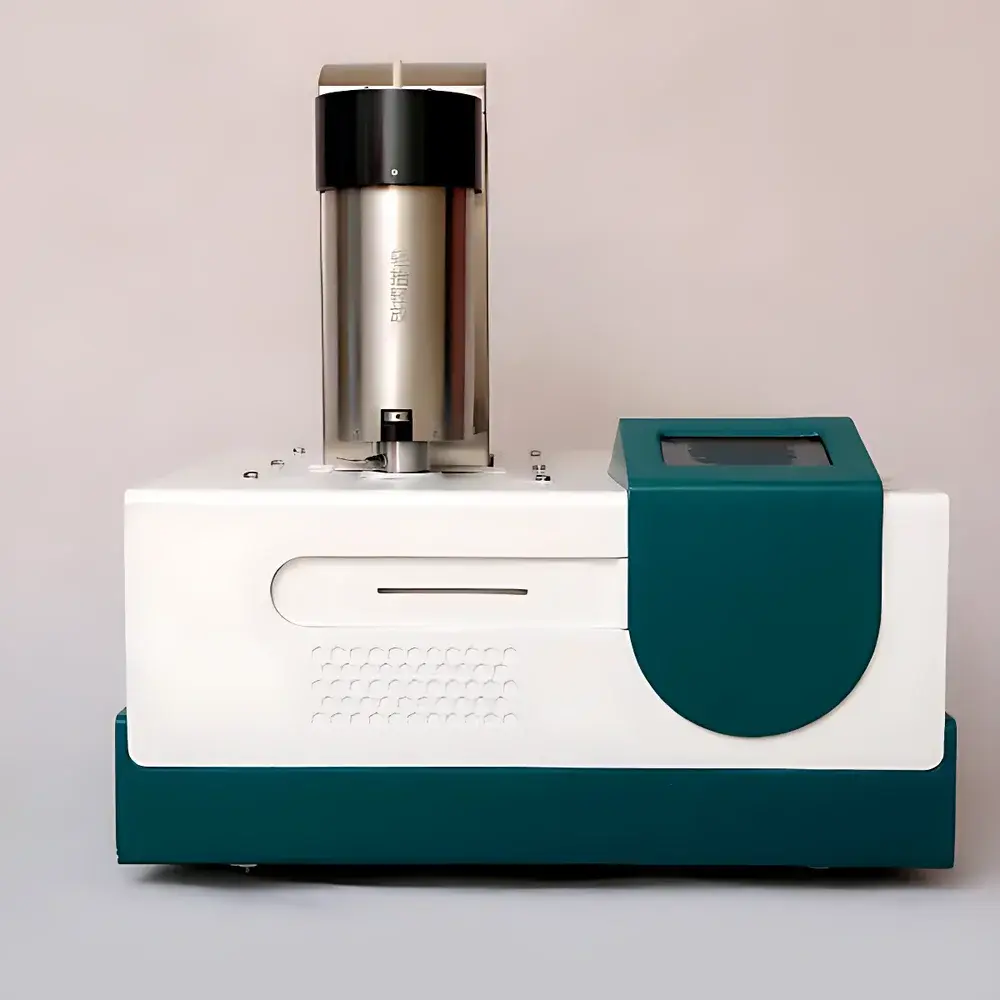
Henven HQT-1 Automated Simultaneous Thermal Analyzer
| Brand | Henven |
|---|---|
| Origin | Beijing, China |
| Manufacturer Type | Direct Manufacturer |
| Model | HQT-1 |
| Price Range | USD 16,800 – 23,800 (FOB Beijing) |
| Temperature Range | Ambient to 1150 °C |
| Heating Rate | 0.1–100 °C/min (user-definable) |
| Temperature Stability | ±0.1 °C |
| Maximum Sample Mass | 5 g |
| Atmosphere Control | Dual-channel mass flow controller (MFC) |
Overview
The Henven HQT-1 Automated Simultaneous Thermal Analyzer is an integrated thermoanalytical platform engineered for precision measurement of concurrent thermal and mass changes in solid and powdered materials under controlled atmospheric conditions. It combines thermogravimetric analysis (TG) and differential scanning calorimetry (DSC) — or differential thermal analysis (DTA), depending on configuration — into a single instrument, enabling synchronized acquisition of mass loss/gain, heat flow, and temperature response from one sample during a single heating/cooling cycle. Based on the principle of heat-flux DSC coupled with high-resolution microbalance detection, the HQT-1 delivers reproducible data for quantifying endothermic and exothermic transitions, decomposition kinetics, phase transformations, oxidative stability, and compositional evolution. Its modular furnace design, dual thermocouple monitoring (furnace + sample), and vacuum-compatible architecture support applications ranging from polymer degradation studies to inorganic oxide synthesis validation and pharmaceutical polymorph screening.
Key Features
- Automated lift-and-position furnace mechanism ensuring precise, repeatable sample placement and thermal contact;
- Dual independent thermocouples: one continuously monitors furnace block temperature (active or idle), the other tracks real-time sample temperature with ±0.1 °C accuracy;
- High-sensitivity microbalance with 0.1 µg resolution and <0.1 µg noise floor over 1–200 mg dynamic range;
- Dual-channel mass flow controller (MFC) for programmable, stable gas delivery; supports automatic switching between inert, oxidizing, or reactive atmospheres during a run;
- Configurable crucible options including alumina (0.06 mL / 0.12 mL), aluminum, graphite, quartz, and platinum — each selected per thermal stability and chemical compatibility requirements;
- Real-time LCD interface displaying furnace temperature, sample temperature, mass, atmosphere status, and system diagnostics;
- Programmable isothermal holds up to 72 hours at any temperature within 25–1150 °C range;
- Auto-ranging signal amplification and on-the-fly screenshot capture during data acquisition;
- Modular auxiliary interfaces: optional heated transfer line (up to 200 °C), GC/MS coupling port, and vacuum connection (compatible with external vacuum pumps down to 2.5×10⁻² Pa).
Sample Compatibility & Compliance
The HQT-1 accommodates samples from sub-milligram research quantities to 5 g industrial batches via interchangeable support rods and crucible mounts. It supports heterogeneous solids, powders, thin films, and compressed pellets across ceramics, metals, polymers, pharmaceuticals, catalysts, and geological specimens. The system meets fundamental requirements for GLP-compliant thermal characterization workflows. While not pre-certified to ISO 11357 or ASTM E1269/E1641 out-of-box, its traceable calibration protocols (using NIST-traceable indium, zinc, and alumina standards), audit-ready software logging, and configurable user-defined calculation modules enable full alignment with ISO/IEC 17025 laboratory accreditation criteria. Optional firmware upgrades support 21 CFR Part 11-compliant electronic signatures and audit trails upon request.
Software & Data Management
Built-in thermal analysis software provides native support for TG, DTG, DDTG, DSC, and DTA curve generation, with customizable X-axis (temperature or time) and Y-axis (absolute mass, % mass, µW, µV) scaling. Advanced processing includes peak integration (enthalpy calculation), isoconversional kinetic modeling (e.g., Friedman, Ozawa-Flynn-Wall), glass transition determination (Tg onset/midpoint), specific heat estimation via comparative method, and multi-curve overlay with statistical deviation mapping. Users may import custom algorithms or mathematical expressions — Henven’s engineering team provides validated script integration within 5 business days. All raw data are stored in ASCII-compatible .txt format; export options include CSV, Excel, and image (PNG/JPEG) with embedded metadata (operator ID, date/time stamp, method file hash).
Applications
- Determination of melting point, crystallization onset, and enthalpy of fusion/crystallization in thermoplastics and small-molecule APIs;
- Oxidative induction time (OIT) assessment per ASTM D3895 for polyolefin stabilization;
- Decomposition pathway analysis of metal-organic frameworks (MOFs) and battery cathode materials;
- Quantification of bound water, carbonate content, and filler loading in composites;
- Thermal stability profiling of catalysts under simulated regeneration conditions (air/N2/CO2 switching);
- Reaction calorimetry for solid-state synthesis (e.g., mechanochemical coupling, sol-gel condensation);
- Residue analysis and ash content verification per ISO 3451 or USP <467> residual solvent guidelines.
FAQ
What calibration standards are supported for temperature and enthalpy verification?
Indium, tin, zinc, and alumina reference materials are recommended for temperature and energy calibration; certified reference materials (CRMs) from NIST or LGC may be used with user-supplied correction factors.
Can the HQT-1 operate under reducing atmospheres such as H₂ or NH₃?
Yes — when equipped with the optional corrosion-resistant MFC and quartz/tungsten furnace liner package, the system is rated for continuous operation with H₂, NH₃, CO, and H₂S up to 800 °C.
Is remote monitoring or networked data export possible?
The instrument features Ethernet connectivity and supports OPC UA protocol; third-party SCADA integration and cloud-based data forwarding (via MQTT or REST API) are available through Henven’s OEM software development kit (SDK).
How is baseline drift compensated during long-duration isothermal tests?
The system applies real-time buoyancy correction using pre-measured empty-crucible baselines and implements adaptive zero-tracking algorithms that update reference mass every 30 seconds during static holds.
Does the software support automated report generation compliant with regulatory submission formats?
Standard PDF reports include method parameters, raw curves, processed results, and operator signature fields; IQ/OQ documentation packages and 21 CFR Part 11 add-ons are available as licensed modules.



