
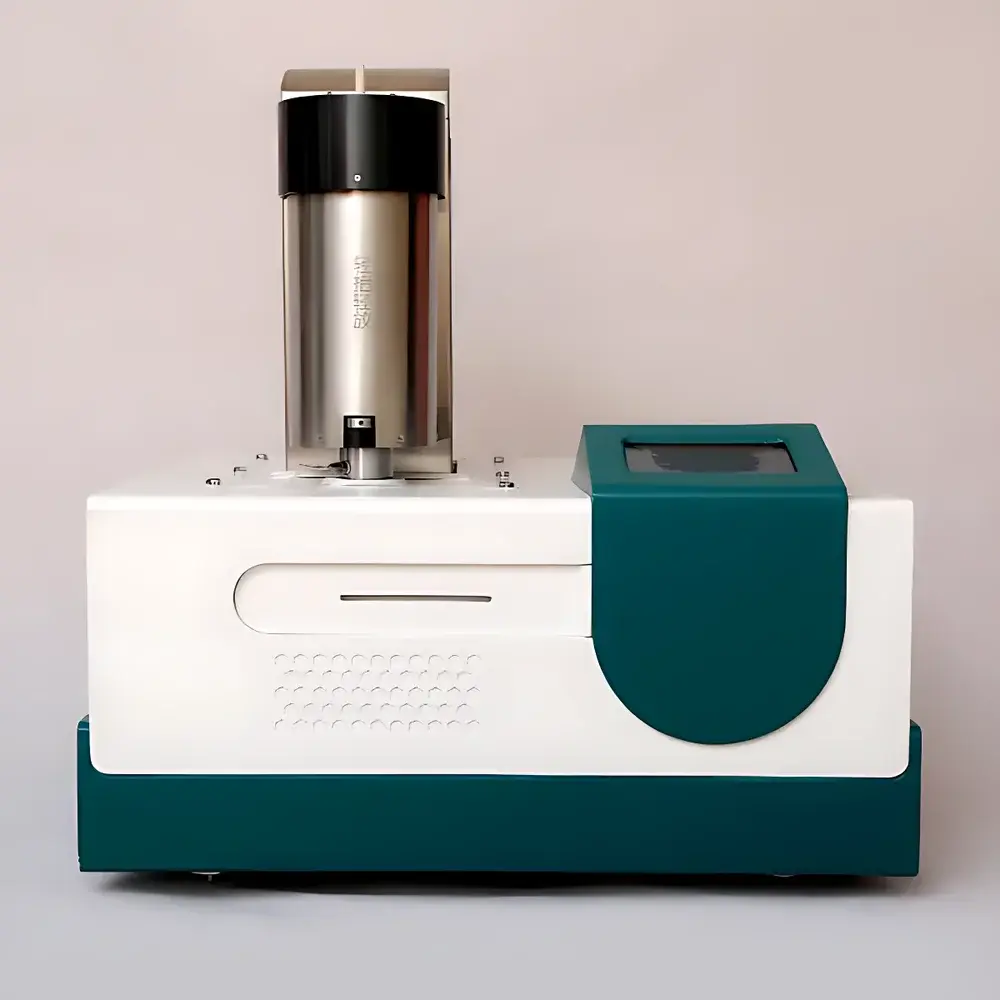
Henven HQT-3 Automated Simultaneous Thermal Analyzer
| Brand | Henven |
|---|---|
| Origin | Beijing, China |
| Manufacturer Type | Direct Manufacturer |
| Model | HQT-3 |
| Price Range | USD 19,500 – 26,000 (FOB Beijing) |
| Temperature Range | Ambient to 1450 °C |
| Heating Rate | 0.1–100 °C/min (user-definable) |
| Temperature Stability | ±0.1 °C |
| Maximum Sample Mass | 5 g |
| Atmosphere Control | Dual-channel mass flow controller (MFC) |
Overview
The Henven HQT-3 Automated Simultaneous Thermal Analyzer is an integrated thermogravimetric (TG) and differential thermal analysis (DTA) instrument engineered for precision measurement of mass change and thermal effects occurring in a single sample under controlled temperature programs. Operating on the principle of simultaneous dual-signal acquisition—measuring both sample mass loss/gain (via high-resolution microbalance) and endothermic/exothermic transitions (via differential thermocouple pair)—the HQT-3 delivers synchronized TG, DTG, DTA, and derivative data in one experimental run. Designed for materials science laboratories, R&D centers, and quality control units, it supports fundamental characterization of thermal stability, phase transitions, decomposition kinetics, oxidative induction time (OIT), glass transition (Tg), crystallization behavior, and compositional analysis across ceramics, polymers, pharmaceuticals, catalysts, and metallurgical precursors.
Key Features
- High-stability furnace with programmable vertical lift mechanism ensuring precise sample positioning and enhanced inter-run reproducibility.
- Dual thermocouple system: one continuously monitors furnace temperature (active or idle), while the second measures real-time sample temperature during operation.
- Microbalance with 0.1 µg resolution and <0.1 µg noise floor; full-scale range 1–200 mg; configurable support rod enabling 0–5 g sample capacity.
- Two-channel mass flow controller (MFC) for independent, stable, and switchable gas delivery; optional chemically resistant gas manifold available for H2S, HF, Cl2, NH3, or other corrosive atmospheres.
- Thermally isolated DSC-style heat-flow detection with ±1 mW to ±500 mW dynamic range and ±0.1 µW sensitivity; no auto-ranging required for DTA signal (±10 µV to ±2000 µV, 0.01 µV resolution).
- Real-time LCD interface displaying furnace temperature, sample temperature, mass, atmosphere status, and heating rate; customizable time/temperature x-axis and absolute/percentage y-axis scaling.
- Extended isothermal capability: up to 72 hours at any setpoint within 0–1450 °C; step-cooling curve generation and crystallization kinetics modeling included.
Sample Compatibility & Compliance
The HQT-3 accommodates diverse sample geometries and chemistries through interchangeable crucibles: standard 0.06 mL and 0.12 mL alumina; optional quartz, graphite, platinum, and aluminum variants. Its vacuum-ready design (base vacuum ≤2.5×10⁻² Pa with optional pump) enables inert, reducing, oxidizing, or reactive gas environments compliant with ASTM E1131, ISO 11358, and USP <1163> thermal analysis guidelines. The system supports GLP/GMP-aligned workflows via audit-trail-capable software logging (user actions, method parameters, calibration events), and optional integration with GC/MS via heated transfer line (room temperature to 200 °C) and custom interface flange.
Software & Data Management
Proprietary thermal analysis software provides automated baseline correction, peak deconvolution, kinetic modeling (e.g., Kissinger, Ozawa-Flynn-Wall, Friedman methods), activation energy calculation, Tg determination (tangent, inflection, midpoint), specific heat estimation (comparison method), and OIT quantification. All data files are saved in vendor-neutral ASCII format with metadata tags (timestamp, operator ID, method name, instrument serial). Real-time screenshot capture at user-defined intervals ensures traceable intermediate states. Software permits post-acquisition reprocessing—including variable smoothing, derivative recalculations (DTG, DDTG), and multi-curve overlay—with export to CSV, PDF, and image formats. Custom algorithm implementation (e.g., proprietary enthalpy models or reaction order fitting) is supported upon client specification.
Applications
- Decomposition pathway mapping of battery cathode materials (e.g., LiCoO2, NMC) under air/N2/O2.
- Quantification of filler content, moisture, and volatile organics in polymer composites per ISO 3347.
- Thermal stability assessment of pharmaceutical APIs and excipients under ICH Q1A(R3) conditions.
- Oxidative induction time (OIT) testing of polyolefins per ASTM D3895.
- Crystallization kinetics and glass transition analysis in amorphous metals and chalcogenide glasses.
- In-situ monitoring of catalyst deactivation and coke formation in petrochemical feedstocks.
- Residue quantification and ash composition profiling in coal, biomass, and waste-derived fuels.
FAQ
What calibration standards are recommended for routine verification?
Certified reference materials including Ni, In, Sn, Zn, and Al for temperature accuracy; CaC2O4·H2O for mass loss steps; sapphire for heat capacity calibration.
Is the system compatible with regulatory-compliant electronic records?
Yes—software supports 21 CFR Part 11-compliant user authentication, electronic signatures, and immutable audit trails when configured with role-based access control.
Can the HQT-3 be interfaced with external analytical instruments?
Yes—dedicated heated transfer lines (up to 200 °C), vacuum-tight GC/MS coupling ports, and analog/digital I/O ports enable synchronization with FTIR, Raman, or XRD systems.
What maintenance intervals are advised for optimal long-term performance?
Furnace insulation inspection every 12 months; MFC recalibration annually; microbalance zero-check before each session; ceramic crucible replacement after 50 high-temperature cycles (>1000 °C).
Does the system support non-linear heating profiles?
Yes—multi-segment ramp-hold programs, including dynamic rate modulation and user-defined temperature vs. time tables, are fully supported.



