
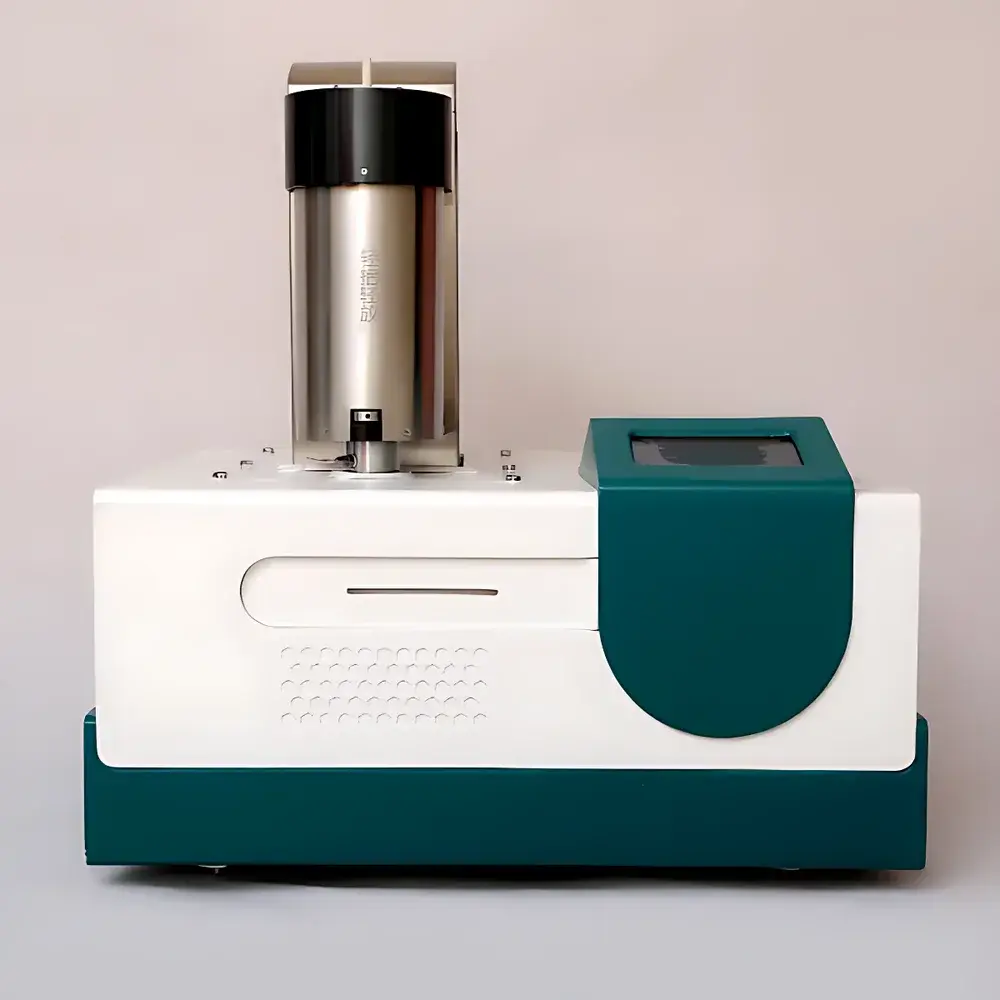
Henven HQT-4 Automated Simultaneous Thermal Analyzer
| Brand | Henven |
|---|---|
| Origin | Beijing, China |
| Manufacturer Type | Direct Manufacturer |
| Model | HQT-4 |
| Price Range | USD 19,500 – 27,800 (FOB Beijing) |
| Temperature Range | Ambient to 1550 °C |
| Heating Rate | 0.1–100 °C/min (user-definable) |
| Temperature Stability | ±0.1 °C |
| Maximum Sample Mass | 5 g |
| Atmosphere Control | Dual-channel mass flow controller (MFC)-based gas delivery system |
| TG Resolution | 0.1 μg |
| TG Noise Level | < 0.1 μg |
| DSC Range | ±1 mW to ±500 mW |
| DSC Sensitivity | ±0.1 μW |
| DTA Range | ±10 μV to ±2000 μV |
| DTA Resolution | 0.01 μV |
| Vacuum Capability | 2.5×10⁻² Pa (with optional vacuum pump) |
| Isothermal Hold Duration | Up to 72 h at any temperature within range |
| Crucible Options | Al₂O₃ (0.06 mL / 0.12 mL), Al, graphite, quartz, Pt |
Overview
The Henven HQT-4 Automated Simultaneous Thermal Analyzer is an integrated thermogravimetric-differential scanning calorimetry (TG-DSC) system engineered for high-precision, real-time concurrent measurement of mass change and thermal energy flow under controlled atmospheric conditions. Based on the principle of simultaneous thermogravimetry (TG) and heat-flux DSC, the instrument employs a single furnace, dual thermocouple configuration (furnace and sample), and symmetrical microbalance architecture to deliver synchronized, co-registered thermal data from one sample in a single run. This eliminates inter-run variability and enables direct correlation between mass loss events (e.g., dehydration, decomposition, volatilization) and corresponding enthalpic transitions (e.g., melting, crystallization, glass transition, oxidation). Designed for laboratories requiring compliance with ASTM E1131, ISO 11357, ISO 11358, and USP <1151>, the HQT-4 supports rigorous method development, material qualification, and stability-indicating analysis across pharmaceuticals, advanced ceramics, metallurgy, polymers, and energy materials.
Key Features
- Automated furnace lift mechanism with repeatable positioning accuracy (<±5 μm), ensuring consistent thermal coupling and enhanced inter-run reproducibility.
- Dual independent thermocouples: one continuously monitors furnace temperature (active or idle); the second measures actual sample temperature during operation—critical for accurate kinetic modeling.
- High-resolution microbalance with 0.1 μg resolution and sub-0.1 μg noise floor, calibrated traceably to NIST-traceable standards.
- Programmable heating rates from 0.1 to 100 °C/min, with isothermal capability up to 72 h at any point in the 25–1550 °C range.
- Two-channel MFC-driven atmosphere control system enabling seamless, software-triggered switching between inert, oxidative, reductive, or corrosive gas streams (e.g., H₂S, Cl₂, HF)—custom corrosion-resistant wetted-path options available.
- Modular crucible support system accommodating 0.06–0.12 mL ceramic, aluminum, graphite, quartz, or platinum crucibles; interchangeable rods enable full 0–5 g sample mass range without hardware modification.
- Real-time LCD interface displaying furnace temperature, sample temperature, mass, derivative (DTG), DSC signal, gas flow status, and vacuum level (if equipped).
Sample Compatibility & Compliance
The HQT-4 accommodates solid powders, granules, thin films, fibers, and small metallic specimens—ideal for R&D and QC labs analyzing catalysts, battery cathode materials, polymer composites, pharmaceutical excipients, and refractory oxides. Its robust construction meets CE safety directives and electromagnetic compatibility (EMC) Class B requirements. For regulated environments, the system supports audit-ready data handling: all raw signals (TG, DTG, DSC, DTA) are timestamped, version-controlled, and stored with full metadata (operator ID, method file hash, calibration history, gas composition logs). Optional software modules provide 21 CFR Part 11-compliant electronic signatures, audit trails, and user role-based access control—fully aligned with GLP and GMP documentation workflows.
Software & Data Management
Proprietary HenvenTherm v5.x software delivers comprehensive post-acquisition analysis including peak integration (onset, peak, endset), enthalpy quantification (via standard reference materials), isoconversional kinetics (Friedman, Kissinger-Akahira-Sunose), crystallization kinetics (Avrami analysis), glass transition determination (Tg via midpoint or inflection), specific heat capacity (Cp) calculation by comparative method, and oxidation induction time (OIT) per ASTM D3895. Users may define custom mathematical expressions for derived parameters (e.g., activation energy vs. conversion degree), and the software engine executes them automatically across batches. Real-time signal scaling ensures optimal dynamic range utilization; screenshots can be captured at any acquisition point. Export formats include ASCII, CSV, and universal .tdms for third-party integration with MATLAB, Python (SciPy), or LIMS platforms.
Applications
- Decomposition pathway mapping of energetic materials and flame retardants.
- Thermal stability assessment of Li-ion battery cathodes (NMC, LFP) under air/N₂/Ar/O₂ atmospheres.
- Quantification of filler content (e.g., CaCO₃, SiO₂) in polymer blends via residue analysis.
- Hydration/dehydration behavior of pharmaceutical hydrates and cocrystals.
- Oxidation kinetics of Fe-, Ni-, or Co-based superalloys at elevated temperatures.
- Carbon burn-off profiling in spent catalyst regeneration studies.
- Compatibility screening of drug–excipient mixtures using dynamic and isothermal DSC-TG.
FAQ
Does the HQT-4 support coupling to external analytical instruments such as GC or MS?
Yes—optional thermostatted GC/MS transfer line (temperature range: ambient to 200 °C) and vacuum-compatible interface kits are available for evolved gas analysis (EGA) applications.
Can the system perform long-term isothermal experiments at 1000 °C?
Yes—the furnace and balance assembly are rated for continuous operation up to 1550 °C; 72-hour isothermal holds are fully supported with active temperature stabilization (±0.1 °C).
Is calibration traceable to international standards?
Yes—temperature calibration uses high-purity In, Sn, Pb, Zn, Al, Ag, and Au standards per ASTM E967; enthalpy calibration employs certified KCl and sapphire references; mass calibration follows ISO 17025-accredited procedures.
What maintenance is required for the microbalance and furnace?
The balance requires no routine recalibration; furnace thermocouples are field-replaceable; MFCs undergo annual verification using certified flow standards—documentation templates provided.
Is remote monitoring or networked data collection possible?
Yes—Ethernet-enabled operation allows secure remote access via VNC or dedicated client software; data can be routed directly to network storage or cloud-based QA repositories.



