
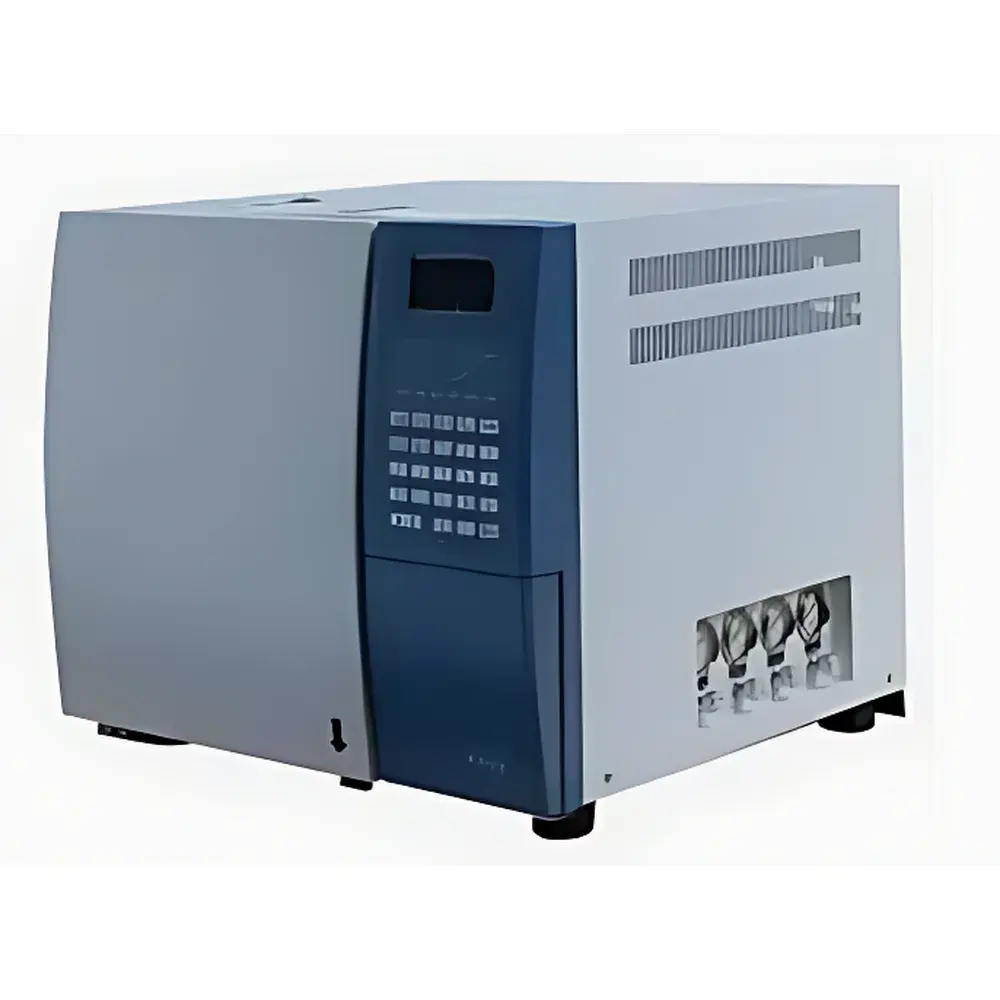
Henven HQX-2010 Laboratory Gas Chromatograph
| Brand | Henven |
|---|---|
| Origin | Beijing, China |
| Manufacturer Type | Direct Manufacturer |
| Region of Origin | Domestic (PRC) |
| Model | HQX-2010 |
| Instrument Type | Benchtop Laboratory Gas Chromatograph |
| Application Scope | General-Purpose Analytical GC |
| Temperature Control Accuracy | Better than ±0.1 °C |
| Oven Ramp Rate | 0.1–40 °C/min |
| Maximum Injector Temperature | 450 °C |
| Injector Temperature Setpoint Range | 5 °C above ambient to 450 °C |
| Injector Total Flow Setting Range | 5 °C above ambient to 450 °C |
| Number of Independent Temperature Zones | 6 |
| Programmed Temperature Ramps | 8-step |
| Column Compatibility | Capillary (including 0.53 mm ID) and Packed Columns |
| Injector Configurations | Dual or triple inlet options (gas/liquid), optional six-port valve and methanizer support |
| Detector Support | Multiple detector modules (FID, TCD, ECD, FPD — detector-specific specs not provided) |
Overview
The Henven HQX-2010 is a benchtop laboratory gas chromatograph engineered for precision, flexibility, and operational reliability in routine and method-development environments. It operates on the fundamental principle of differential partitioning of analytes between a mobile phase (inert carrier gas) and a stationary phase (coated capillary or packed column), enabling high-resolution separation of volatile and semi-volatile organic compounds. Designed for general-purpose analytical applications—including environmental monitoring, petrochemical profiling, food safety screening, pharmaceutical impurity testing, and forensic toxicology—the HQX-2010 integrates robust thermal management, modular detector architecture, and intuitive software-driven operation. Its column oven accommodates both narrow-bore capillary columns (down to 0.1 mm ID) and wide-bore capillaries (up to 0.53 mm ID), as well as traditional packed columns, supporting method transfer and legacy protocol compatibility.
Key Features
- Six independently controlled temperature zones—including column oven, up to three injector ports, and multiple detector compartments—enabling simultaneous optimization of vaporization, separation, and detection conditions.
- High-stability oven with ±0.1 °C temperature uniformity and programmable 8-step ramp profiles (0.1–40 °C/min), facilitating precise retention time reproducibility across multi-analyte methods.
- Vertically oriented, separately heated split/splitless injector with adjustable septum purge, tail-purge flow, and split ratio control—minimizing thermal carryover and enhancing peak shape integrity for trace-level analysis.
- Large-volume column chamber (≥25 L capacity) with dual-column mounting capability, permitting concurrent installation of capillary and packed columns without hardware reconfiguration.
- Modular detector design supports field-installation of common GC detectors—including Flame Ionization (FID), Thermal Conductivity (TCD), Electron Capture (ECD), and Flame Photometric (FPD)—with standardized electrical and gas interfaces.
- Integrated self-diagnostic system with real-time status monitoring, power-fail recovery, and non-volatile method storage (≥100 methods), compliant with GLP documentation requirements.
Sample Compatibility & Compliance
The HQX-2010 accepts liquid, gaseous, and headspace-derived samples via standard syringe injection, gas-tight loop, or optional six-port valve configurations. It supports derivatization-compatible inlet liners and deactivated flow paths suitable for active compounds (e.g., amines, organic acids, phenols). While detector-specific validation data are not included in base specifications, the platform’s thermal stability and flow consistency meet foundational requirements for ASTM D3606 (benzene/toluene in gasoline), ISO 11843 (detection limit estimation), and USP chromatographic system suitability criteria. The instrument’s firmware architecture supports audit trail generation and user-access logging—key prerequisites for laboratories operating under FDA 21 CFR Part 11 or ISO/IEC 17025 quality systems.
Software & Data Management
Controlled via a dedicated Windows-based acquisition and analysis workstation, the HQX-2010 software provides full method development tools—including gradient timing, event-triggered valve switching, and detector signal synchronization. Raw data are stored in vendor-neutral .CDF format (compatible with OpenChrom and Chromeleon), ensuring long-term archival integrity. Batch processing, calibration curve generation (linear, quadratic, weighted), and report templates conform to ISO 17025 reporting conventions. All method parameters—including temperature ramps, valve events, and detector gain settings—are digitally signed and timestamped, enabling full traceability from acquisition through final report export (PDF, CSV, Excel).
Applications
- Environmental: VOC analysis in water (EPA 524.2, 8260), soil headspace (EPA 8260), and air canisters (TO-14A).
- Petrochemical: Hydrocarbon group-type analysis (ASTM D5186), gasoline oxygenates (ASTM D4815), and refinery gas composition (ASTM D1945).
- Pharmaceutical: Residual solvent quantification per ICH Q3C guidelines; assay purity and degradation product profiling.
- Food & Flavor: Fatty acid methyl ester (FAME) profiling, pesticide residue screening (AOAC 2007.01), and aroma compound fingerprinting.
- Academic Research: Reaction monitoring, polymer additive migration studies, and metabolite profiling in biological matrices.
FAQ
Does the HQX-2010 support compliance with 21 CFR Part 11?
Yes—when operated with validated software and configured with electronic signatures, audit trails, and role-based access controls, the system meets core technical requirements for electronic records and signatures.
Can I install both FID and TCD detectors simultaneously?
Yes—the six-zone temperature control architecture and modular detector bays allow concurrent installation and independent operation of multiple detector types.
What is the maximum column length supported for 0.53 mm ID capillaries?
The column chamber accommodates up to 60 m lengths for 0.53 mm ID fused-silica capillaries with standard oven dimensions and proper coiling support.
Is remote monitoring or networked operation possible?
The system supports TCP/IP communication via Ethernet interface, enabling remote instrument status viewing, method upload, and basic run initiation through secure LAN environments.
Are consumables and service parts available internationally?
Henven maintains an authorized distributor network across Asia, Latin America, and select European markets; OEM-certified liners, septa, ferrules, and detector components are stocked regionally.





