
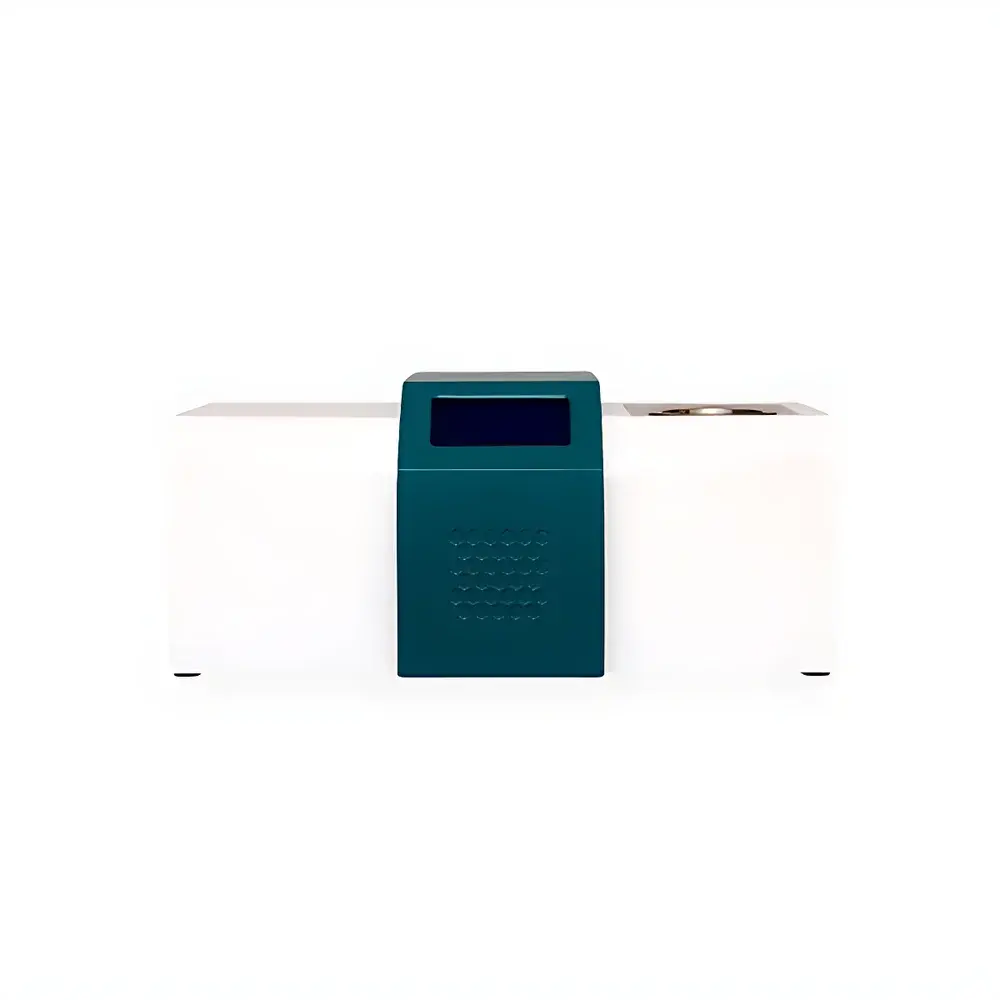
Henven HSC-2 Heat-Flow Differential Scanning Calorimeter
| Brand | Henven |
|---|---|
| Origin | Beijing, China |
| Manufacturer Type | Direct Manufacturer |
| Instrument Type | DSC |
| Model | HSC-2 |
| Sample Capacity | Single |
| Temperature Range | −30 °C to 680 °C (with optional mechanical cryo-cooling unit) |
| Programmable Temperature Control Accuracy | ±0.1 °C |
| Temperature Accuracy | ±0.1 °C |
| Temperature Precision (Repeatability) | ±0.1 °C |
| Heating/Cooling Rate | 0.1–100 °C/min |
| Scan Modes | Heating, Isothermal, Cooling |
| DSC Signal Range | ±500 mW |
| DSC Minimum Resolution | ±0.1 µW |
| DSC Power Noise | ±0.1 µW |
| DSC Power Accuracy | ±0.1 µW |
| Atmosphere Control | Dual-channel mass flow-controlled gas system (10–200 mL/min), software-switchable |
| Standard Crucibles | Al₂O₃, high-purity Al (0.06 mL capacity) |
| Optional Crucibles | Sealed Al (liquid/solid), ZrO₂, quartz, graphite, Pt/Rh |
| Display | Large-character Chinese LCD with dual thermocouples (sample + furnace) |
| Connectivity | RS232, USB interface |
| Software Features | Automated baseline correction, thermal event annotation (Tg, Tm, Tc, OIT), enthalpy integration, calibration with certified standards (In, Sn, Pb, Zn, Al), auto-report generation (DSC & OIT), remote diagnostics and parameter tuning via internet |
Overview
The Henven HSC-2 is a precision heat-flow differential scanning calorimeter (DSC) engineered for rigorous thermal characterization of solids, liquids, and semi-crystalline materials under controlled atmospheric conditions. Based on the heat-flux principle—where differential heat flow between sample and reference is measured as a function of temperature or time—the HSC-2 delivers high reproducibility in quantifying endothermic and exothermic transitions. Its operational range spans from −30 °C to 680 °C, enabled by an integrated mechanical cooling system that eliminates reliance on liquid nitrogen while maintaining thermal stability across sub-ambient segments. The instrument complies with core methodology standards referenced in ASTM E794 (melting and crystallization temperatures), ASTM E1356 (glass transition), ISO 11357 series (polymer thermal analysis), and USP (thermal analysis of pharmaceuticals). Designed for laboratory environments requiring traceable, auditable data, the HSC-2 supports GLP-compliant workflows through timestamped raw data logging, full audit trails, and electronic signature-ready reporting.
Key Features
- Monolithic furnace-controller architecture minimizes thermal lag and signal attenuation, enhancing baseline stability and measurement fidelity.
- Dual independent thermocouple monitoring: one embedded in the sample pan holder for real-time sample temperature; another positioned at the furnace wall to track ambient thermal gradient—enabling dynamic correction of heat-flux drift.
- Programmable dual-gas atmosphere system with mass flow controllers (MFCs) allows precise, software-triggered switching between inert (N₂, Ar) and oxidative (air, O₂) environments during a single run—critical for oxidation induction time (OIT) and decomposition kinetics studies.
- High-resolution DSC detection with ±0.1 µW minimum resolution and ≤±0.1 µW power noise ensures reliable quantification of low-energy transitions, including subtle glass transitions in amorphous polymers or weak crystallization events in nucleated blends.
- Integrated calibration suite includes certified reference materials (indium, tin, lead, zinc, aluminum) for user-performed temperature and enthalpy validation per ISO 11357-1, ensuring ongoing metrological traceability without third-party intervention.
- Remote maintenance capability via secure internet connection enables firmware updates, diagnostic logging, and parameter optimization without on-site service visits—reducing instrument downtime in multi-site or distributed lab networks.
Sample Compatibility & Compliance
The HSC-2 accommodates a broad spectrum of sample forms and chemistries through its modular crucible system. Standard alumina and high-purity aluminum pans provide inert, non-reactive platforms for routine polymer, pharmaceutical, and ceramic analyses. Optional sealed aluminum crucibles—used with dedicated crimping tools—enable high-pressure volatile containment for liquid samples, reactive organics, or moisture-sensitive compounds. Advanced crucible options—including zirconia (for alkaline melts), quartz (UV-transparent applications), graphite (high-temperature carbonaceous systems), and Pt/Rh (corrosion-resistant metal alloy studies)—extend analytical reach into demanding R&D and failure analysis scenarios. All crucibles feature a nominal volume of 0.06 mL, optimized for mass-limited samples while preserving signal-to-noise ratio. The instrument meets electromagnetic compatibility (EMC) requirements per IEC 61326-1 and safety standards per IEC 61010-1, supporting deployment in ISO/IEC 17025-accredited testing laboratories.
Software & Data Management
The proprietary HSC-2 acquisition and analysis software operates under Windows OS and provides full 21 CFR Part 11 compliance readiness. It records raw thermogram data with millisecond-level timestamping, stores metadata (operator ID, method name, calibration status, gas flow settings), and enforces role-based access control for method editing and report finalization. Baseline correction is performed using adaptive polynomial fitting, with manual anchor-point selection for complex overlapping transitions. Quantitative outputs include onset/midpoint/peak temperatures, enthalpy change (ΔH) in J/g, heat capacity step (ΔCp), and oxidation induction time (OIT) calculated per ASTM D3895. Reports are exportable in PDF (with digital signature fields) and CSV formats; raw data files retain native binary structure for third-party reprocessing in MATLAB or Origin. Audit trail logs capture all user actions—including data deletion, parameter modification, and calibration execution—with immutable timestamps and operator identifiers.
Applications
- Polymers: Determination of melting point (Tm), crystallization temperature (Tc), glass transition (Tg), cold crystallization, and degree of crystallinity via enthalpy integration.
- Pharmaceuticals: Polymorph screening, amorphous content assessment, excipient compatibility studies, and stability-indicating thermal profiling per ICH Q5C guidelines.
- Food Science: Quantification of solid fat content (SFC), lipid phase behavior, starch gelatinization, and protein denaturation profiles.
- Materials Science: Thermal stability evaluation of composites, catalyst deactivation kinetics, curing exotherms in thermosets, and reaction enthalpies in inorganic synthesis.
- Quality Control: Batch-to-batch consistency verification, shelf-life prediction via accelerated aging protocols, and root-cause analysis of thermal degradation events.
FAQ
What cooling mechanism does the HSC-2 use for sub-ambient operation?
The HSC-2 employs a closed-cycle mechanical refrigeration unit capable of reaching −30 °C without cryogens—ensuring operational continuity, reduced consumable costs, and simplified facility integration.
Can the instrument perform simultaneous DSC–GC or DSC–MS coupling?
Yes—optional thermostatted transfer lines (up to 200 °C), GC/MS interface adapters, and temperature-controlled gas chromatography ovens are available as factory-configured accessories to support evolved gas analysis (EGA) workflows.
Is calibration traceable to national standards?
All reference materials supplied (In, Sn, Pb, Zn, Al) are NIST-traceable or equivalent certified standards; calibration procedures follow ISO/IEC 17025-aligned documentation templates for internal audit readiness.
How is data integrity ensured during long-duration isothermal holds?
The dual-thermocouple architecture continuously cross-validates furnace and sample temperatures; any deviation >0.05 °C triggers automatic recalibration of heat-flux gain, preserving quantitative accuracy over 48+ hour experiments.
Does the software support automated method sequencing for unattended operation?
Yes—users can define multi-step temperature programs (e.g., heat → hold → cool → reheat) with conditional triggers (e.g., “hold until ΔH stabilizes”), enabling overnight or weekend thermal profiling with zero manual intervention.



