
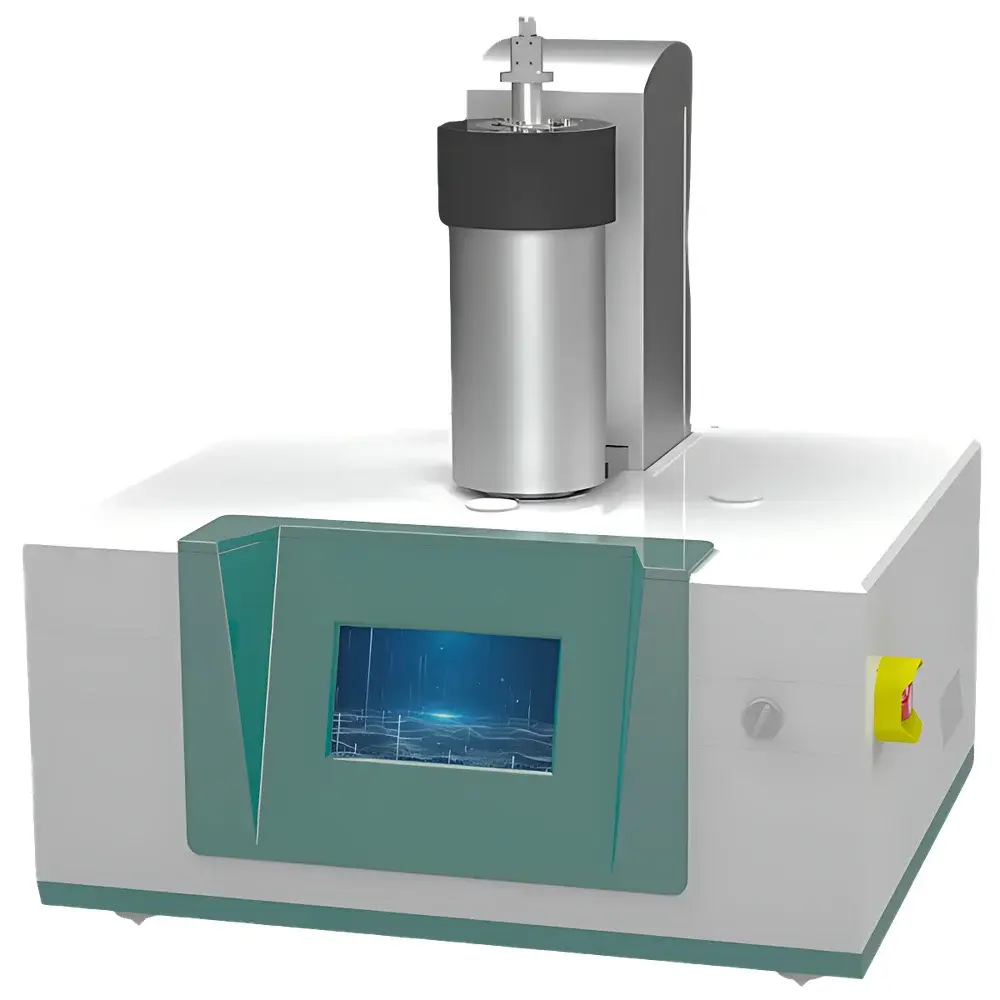
Henven HSDR-1 Laser Flash Thermal Conductivity Analyzer
| Brand | Henven |
|---|---|
| Origin | Beijing, China |
| Manufacturer Type | Direct Manufacturer |
| Instrument Type | Laser Flash Method |
| Sample Capacity | Single or 6-position auto-rotating sample holder (configurable) |
| Operating Environment | High-Temperature, Controlled Atmosphere |
| Thermal Conductivity Range | 0.1 – 2000 W/(m·K) |
| Accuracy | ±2.4% (thermal diffusivity) |
| Repeatability | ±1.9% (thermal diffusivity) |
| Laser Source | Nd:YAG, 1064 nm, 25 J/pulse, Class 1 safety |
| Pulse Width | 0.05–5 ms (software-adjustable) |
| Temperature Range | RT to 1600 °C |
| Atmosphere Options | Inert, oxidizing, reducing, dynamic/static gas, vacuum (down to 10⁻² mbar) |
| Sample Forms | Solid bulk, thin film, fiber, powder, composite, and liquid media |
| Standard Sample Dimensions | Ø6–25.4 mm discs or 6×6–10×10 mm squares |
| Detector | Liquid-nitrogen-cooled InSb or MCT |
| Data Interface | USB & TCP/IP |
| Cooling | Dual-mode — closed-loop water + forced-air |
| Compliance | ASTM E1461, ISO 22007-4, DIN 30905, GB/T 22588, GJB 1201.1-91 |
Overview
The Henven HSDR-1 Laser Flash Thermal Conductivity Analyzer is a high-precision, transient thermophysical property measurement system engineered for the determination of thermal diffusivity (a), thermal conductivity (λ), and volumetric specific heat capacity (cp) using the standardized laser flash method (LFM). Based on the fundamental principle of transient heat conduction, the instrument delivers a short-duration, high-energy laser pulse (Nd:YAG, 1064 nm, up to 25 J/pulse) onto the front surface of a planar sample under controlled temperature and atmosphere. The resulting temperature rise on the rear surface is captured in real time by a high-speed, liquid-nitrogen-cooled infrared detector (InSb or MCT) with 2 MHz acquisition capability. Using Parker’s classical one-dimensional heat conduction model—augmented with Cowan, Clark, Taylor, and Dusza-type corrections for finite pulse duration, radial heat loss, and non-ideal boundary conditions—the system computes all three core thermal properties with traceable uncertainty quantification. Designed for materials R&D labs, quality control departments, and national metrology institutes, the HSDR-1 supports rigorous thermophysical characterization across extreme operating conditions—from ambient to 1600 °C, under vacuum, inert, oxidizing, or reducing atmospheres.
Key Features
- Non-contact excitation and detection architecture eliminates interfacial thermal resistance and mechanical damage, enabling reliable measurements on brittle ceramics, refractory metals, thin films, and soft composites.
- Modular furnace design with motorized vertical lift mechanism and automatic end-stop positioning ensures precise alignment and reproducible sample-to-detector geometry.
- 6-position rotating sample holder with engraved indexing (1–6) and programmable angular positioning enables unattended sequential analysis without manual intervention.
- Dual-stage cooling system—integrated closed-loop deionized water circulation plus auxiliary forced-air fans—maintains stable thermal management during extended high-temperature operation.
- Full-spectrum atmosphere control: compatible with static/dynamic gas flow (Ar, He, N₂, O₂, H₂, forming gas), vacuum down to 10⁻² mbar, and pressure-rated configurations upon request.
- Intuitive 7-inch industrial-grade touchscreen interface paired with Windows-based analytical software provides real-time curve visualization, multi-task data acquisition, and automated calibration workflows.
Sample Compatibility & Compliance
The HSDR-1 accommodates a broad spectrum of material classes—including structural ceramics, aerospace alloys, battery electrode composites, thermal barrier coatings, polymer nanocomposites, geological specimens, and high-temperature molten salts—within standardized geometries (Ø6–25.4 mm discs; 6×6–10×10 mm squares; thickness 0.1–6 mm) or custom dimensions. Optional accessories extend capability to anisotropic thermal transport (in-plane vs. cross-plane), fiber orientation effects, thin-film substrates, and liquid-phase measurements using encapsulated quartz cells. All hardware and firmware implementations conform to internationally recognized standards: ASTM E1461 (Standard Test Method for Thermal Diffusivity of Solids), ISO 22007-4 (Plastics—Determination of Thermal Conductivity and Thermal Diffusivity—Part 4: Laser Flash Method), DIN 30905 (Thermal Analysis—Laser Flash Method), GB/T 22588 (Chinese national standard for laser flash apparatus), and GJB 1201.1-91 (People’s Liberation Army standard for military-grade thermal property testing). System validation reports include as-received calibration certificates traceable to NIM (National Institute of Metrology, China).
Software & Data Management
The embedded Windows 10-based analysis suite features a fully graphical user interface with contextual online help, multi-language support (English/Chinese), and audit-trail-enabled operation logs compliant with GLP/GMP documentation requirements. Key software capabilities include synchronized real-time acquisition and post-processing, ASCII and Excel-compatible export formats, batch report generation, and built-in finite-element correction libraries for thermal loss compensation. Pulse shape modeling, baseline drift correction, and iterative curve fitting algorithms ensure robust parameter extraction even for low-diffusivity or highly scattering samples. Data security protocols support 21 CFR Part 11-compliant electronic signatures, user access levels, and immutable raw-data archiving. Remote monitoring and diagnostics are enabled via TCP/IP network interface, facilitating integration into centralized laboratory information management systems (LIMS).
Applications
The HSDR-1 serves critical roles across academia, industry, and regulatory domains. In advanced materials development, it quantifies thermal stability of next-generation battery separators, evaluates interfacial thermal resistance in multilayer semiconductor packaging, and validates thermal design parameters for hypersonic vehicle leading edges. In metallurgy and powder processing, it characterizes sintering-induced microstructural evolution through thermal diffusivity trends. In building science, it measures insulation performance of aerogels and phase-change composites under fire-resistance test conditions. In nuclear engineering, it supports fuel pellet qualification per ASTM C781 and IAEA TRS-458 guidelines. Routine QC applications span refractory brick certification, ceramic glaze optimization, and polymer additive dispersion verification—all traceable to primary reference materials and certified reference values.
FAQ
What standards does the HSDR-1 comply with?
ASTM E1461, ISO 22007-4, DIN 30905, GB/T 22588, and GJB 1201.1-91.
Can the system measure anisotropic thermal conductivity?
Yes—using optional directional heating fixtures and orthogonal sample mounting, combined with tensor-based data inversion modules.
Is vacuum operation supported?
Yes—base pressure down to 10⁻² mbar is achievable with standard configuration; higher vacuum or pressure-rated variants available on request.
What sample preparation is required?
Minimal: surfaces must be parallel, flat, and free of oxidation or contamination; coatings or reflective layers may require graphite spray application per ASTM E1461 Annex A3.
How is calibration performed?
Using NIST-traceable reference materials (e.g., NIST SRM 735a, Pyroceram 9606, copper) at multiple temperatures; full calibration matrix includes pulse energy, detector response, and furnace emissivity correction.
Does the system support automated reporting for regulatory submissions?
Yes—PDF/Excel reports include metadata, raw curves, fitted parameters, uncertainty budgets, and electronic signature fields aligned with FDA 21 CFR Part 11 and EU Annex 11 requirements.



