
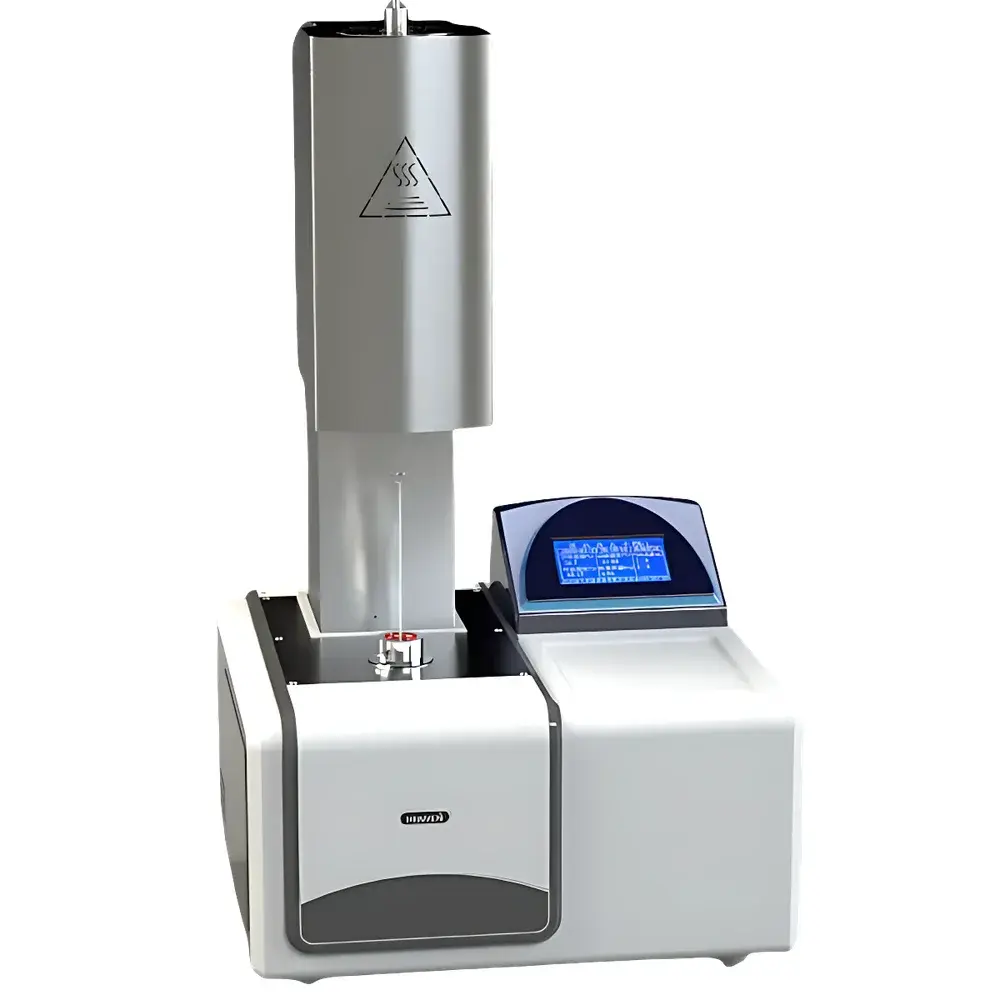
Henven HT-1700 High-Temperature Simultaneous Thermal Analyzer (TG-DSC)
| Brand | Henven |
|---|---|
| Origin | Beijing, China |
| Manufacturer Type | Direct Manufacturer |
| Product Category | Domestic |
| Model | HT-1700 |
| Configuration | TG-DSC Coupled System |
| Temperature Range | Ambient to 1700 °C |
| Heating/Cooling Rate | 0.1–200 °C/min |
| Temperature Stability | ±0.1 °C |
| Maximum Sample Mass | 200 mg (extendable to 5 g with optional support rods) |
| Balance Sensitivity | 0.1 µg |
| Thermogravimetric Noise | <0.1 µg |
| DSC Range | ±500 mW |
| DSC Precision | ±0.1 µW |
| DSC Response Ratio | >100 mW/K |
| Enthalpy Accuracy | ±0.1% (using In calibration) |
| DTA Range | ±2000 µV |
| DTA Resolution | 0.01 µV |
| Atmosphere Options | Oxidizing, Reducing, Inert, Vacuum, Steam |
| Standard Crucibles | Al₂O₃ (0.06 mL and 0.12 mL) |
| Optional Crucibles | Al, Graphite, Quartz, Pt |
| Vacuum & Gas Purge | Integrated automated vacuum/purge system with programmable gas switching |
| Temperature Calibration | Multi-point non-linear calibration using certified reference materials (In, Zn, Sn, Pb, Al, Cu) |
| Control Program | Up to 64 segments, 999 cycles, power-fail data retention |
| Data Export | ASCII, MS Excel-compatible CSV, real-time multi-curve overlay, differential analysis, kinetic modeling (e.g., Kissinger, Ozawa-Flynn-Wall) |
Overview
The Henven HT-1700 High-Temperature Simultaneous Thermal Analyzer is an engineered solution for quantitative thermoanalytical characterization under extreme thermal conditions. It integrates thermogravimetry (TG) and differential scanning calorimetry (DSC) — or optionally differential thermal analysis (DTA) — into a single, synchronized measurement platform. Based on the principle of simultaneous mass loss monitoring and heat flow detection under controlled temperature programs, the HT-1700 enables precise determination of phase transitions, decomposition kinetics, oxidation/reduction behavior, sintering onset, enthalpy changes, and activation energy parameters (via isoconversional methods such as Kissinger and Ozawa-Flynn-Wall). Its operational envelope spans ambient to 1700 °C, making it suitable for research and quality control in advanced ceramics, refractory metals, nuclear fuel matrices, aerospace superalloys, and high-temperature catalysts.
Key Features
- Dual-spiral graphite furnace architecture delivering stable, uniform heating up to 1700 °C with extended isothermal zone (>30 mm) and enhanced thermal longevity;
- Automated atmosphere management system supporting seamless transition between oxidizing (air/O₂), reducing (H₂/N₂/H₂–Ar), inert (Ar, N₂, He), vacuum (<10⁻² mbar), and steam environments;
- High-resolution microbalance with mechanical zero-position optical sensor, offering 0.1 µg sensitivity and sub-microgram noise floor (<0.1 µg RMS); modular support rods enable dynamic range extension from 1–200 mg to 0–5 g;
- Calibrated DSC/DTA sensors traceable to NIST-certified standards (In, Zn, Sn, Al, Cu), featuring non-linear multi-point correction and response ratio optimization (>100 mW/K);
- Integrated interface for evolved gas analysis (EGA), including heated transfer lines (up to 300 °C), constant-temperature connectors, and compatibility with quadrupole mass spectrometers (QMS) and FTIR systems;
- Robust software-controlled thermal program with up to 64 ramp/hold segments, 999 repeat cycles, and automatic power-interruption recovery preserving raw time-temperature-mass-heatflow datasets.
Sample Compatibility & Compliance
The HT-1700 accommodates diverse sample forms — powders, granules, thin films, fibers, and bulk fragments — within standard alumina crucibles (0.06 mL and 0.12 mL) or application-specific vessels including platinum, quartz, graphite, and aluminum. All crucible types are rigorously tested for thermal stability and chemical inertness across the full operating range. The instrument complies with core principles of GLP and GMP frameworks: audit-trail-enabled data acquisition, user-access controls, electronic signature support (aligned with FDA 21 CFR Part 11 readiness), and calibration documentation per ISO/IEC 17025 requirements. Measurement protocols adhere to ASTM E1131 (TG), ASTM E1269 (DSC), ISO 11357 (DSC), and ISO 7111 (DTA) standards.
Software & Data Management
Proprietary acquisition and analysis software provides real-time visualization of TG, DSC, and derivative (DTG) curves, with synchronized atmospheric status indicators and temperature ramp profiling. Advanced post-processing includes baseline correction, peak deconvolution, multi-curve alignment, kinetic parameter extraction (Ea, A, n), and model-free conversion analysis. Data export conforms to ASTM E1981 and ISO 22412 formats: ASCII-delimited files, Excel-ready CSV, and metadata-embedded binary archives. All datasets retain full traceability — including operator ID, calibration history, instrument configuration, and environmental logs — ensuring reproducibility and regulatory compliance in R&D, production QC, and third-party certification workflows.
Applications
- Thermal stability assessment of ceramic matrix composites (CMCs) and ultra-high-temperature ceramics (UHTCs) for hypersonic vehicle leading edges;
- Kinetic modeling of metal oxide reduction (e.g., Fe₂O₃ → Fe) and carbothermic reactions in metallurgical process development;
- Oxidation resistance evaluation of Ni-based superalloys under simulated turbine engine conditions;
- Decomposition pathway mapping of energetic materials and propellant binders;
- Sintering behavior analysis of additive-manufactured Ti-6Al-4V and Inconel 718 powders;
- Phase diagram validation for refractory intermetallic systems (e.g., Mo–Si–B, Nb–Si) via high-temperature DSC and invariant reaction identification.
FAQ
What is the maximum continuous operating temperature for long-term isothermal studies?
The HT-1700 is rated for continuous operation at 1700 °C with active furnace protection logic; extended dwell times (>10 h) at ≥1600 °C require optional reinforced graphite insulation and argon purge stabilization.
Can the system perform controlled-atmosphere DSC without mass loss interference?
Yes — dual-channel synchronization ensures independent thermal signal acquisition; mass drift compensation algorithms isolate pure heat flow contributions during reactive atmospheres (e.g., H₂ reduction).
Is the software compatible with LIMS and ELN integration?
Native API support enables bidirectional data exchange with laboratory information management systems (LIMS) and electronic lab notebooks (ELN) via secure RESTful endpoints and configurable metadata schemas.
How is temperature calibration verified across the full range?
Multi-point calibration uses six certified reference materials (In, Zn, Sn, Pb, Al, Cu) with documented enthalpies and transition temperatures; non-linear curve fitting corrects for sensor drift and furnace gradient effects.
Does the system support custom crucible mounting for irregular geometries?
Yes — the sample holder assembly accepts user-fabricated fixtures with standardized thermal anchoring interfaces; dimensional constraints and thermal mass limits are provided in the mechanical integration manual.



