
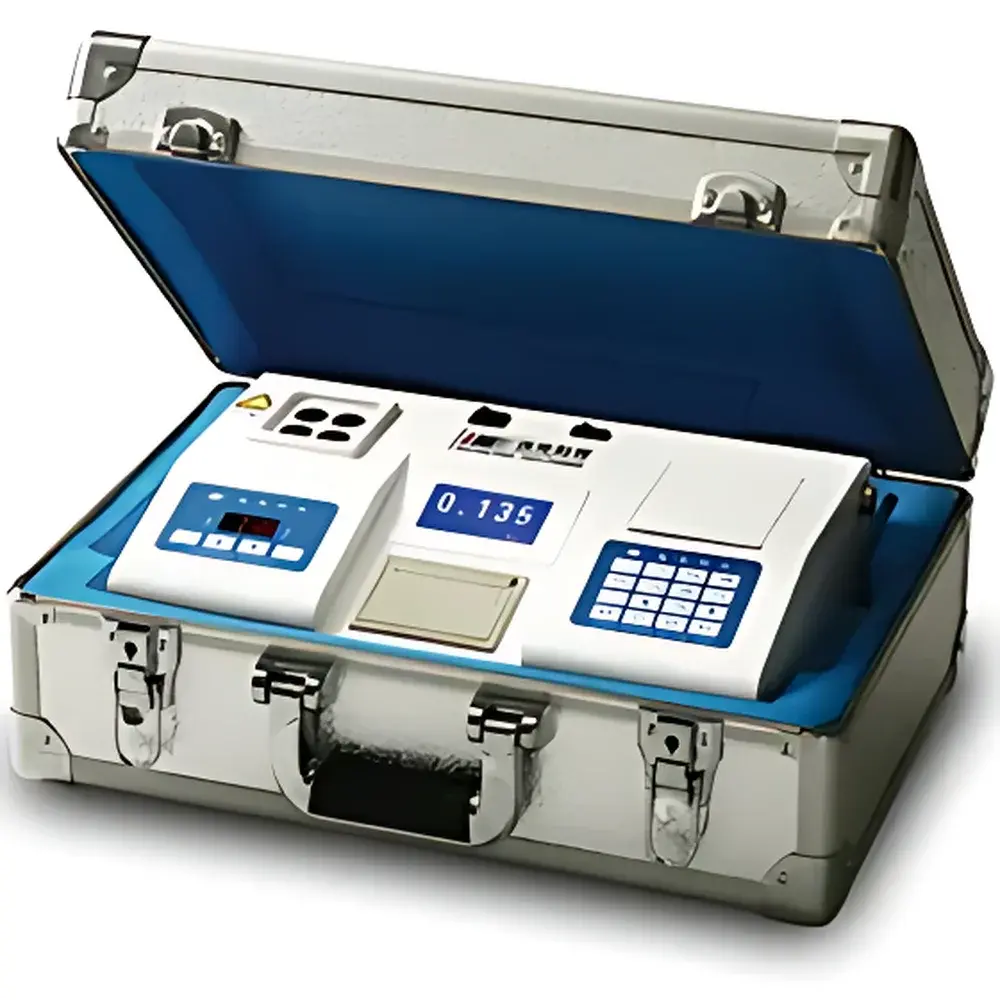
Hepu 5B-2C COD Rapid Analyzer
| Brand | Hepu (Jihepu) |
|---|---|
| Origin | Shandong, China |
| Model | 5B-2C |
| Detection Parameter | Chemical Oxygen Demand (COD) |
| Measurement Range | 10–2000 mg/L (segmented) |
| Accuracy | ≤±10% at 50 mg/L |
| Repeatability | ≤±5% |
| Measurement Time | 20 min per batch |
| Batch Capacity | 4 samples |
| Optical Stability | ≤0.001 A/5 min |
| Light Source Lifetime | 100,000 hours |
| Chloride Interference Tolerance | [Cl⁻] < 1000 mg/L (no correction required) |
| Data Storage | 1000 records (timestamp, parameters, result) |
| Calibration Curves | 20 preloaded + 60 user-editable |
| Display | LCD |
| Interface | RS232 |
| Power Supply | AC 220 V or DC 12 V (vehicle-compatible) |
Overview
The Hepu 5B-2C COD Rapid Analyzer is a fully integrated laboratory-grade water quality instrument engineered for precise, efficient, and standardized determination of Chemical Oxygen Demand (COD) in municipal wastewater, industrial effluents, surface water, and treated discharge streams. Based on the dichromate oxidation method (APHA Standard Methods 5220 B, ISO 6060, and HJ 828–2017), the system combines a microprocessor-controlled spectrophotometric analyzer with an embedded digestion module—eliminating external heating units and reducing procedural variability. Its optical architecture employs a long-life LED light source (100,000-hour rated lifetime) and fixed-wavelength photometry at 610 nm, ensuring high reproducibility and minimal drift (<0.001 A/5 min). The unit operates under ambient lab conditions without requiring climate-controlled environments or auxiliary gas supplies, making it suitable for routine QC/QA labs, environmental monitoring stations, and field-deployable mobile laboratories.
Key Features
- Fully integrated digestion and analysis platform: eliminates inter-unit calibration drift and reduces operator handling errors
- Preloaded and user-customizable calibration curves (20 factory curves + 60 editable slots), supporting both EPA-compliant and regional standard methods
- Auto-curve generation: instrument automatically calculates and stores regression equations using certified reference standards—no manual slope/intercept entry required
- Intelligent digestion control: real-time load-sensing power modulation maintains ±0.5 °C thermal stability across 4-sample batches during 20-minute reflux cycles
- Onboard data management: timestamped storage of 1000 complete measurement records—including sample ID (optional), digestion time, temperature profile, absorbance value, and final COD concentration
- Dual-power operation: compatible with standard 220 V AC mains and 12 V DC vehicle power—enabling deployment in remote sampling vehicles or emergency response units
- RS232 serial interface for bidirectional communication with LIMS or laboratory PCs; supports ASCII-formatted data export for traceability and audit compliance
- Auto-zero and auto-blank functions with cuvette recognition logic to minimize path-length error and solvent matrix effects
Sample Compatibility & Compliance
The 5B-2C accepts standard 16 mm round glass or quartz cuvettes and is validated for use with domestic and industrial wastewater matrices containing chloride concentrations up to 1000 mg/L without interference. For high-chloride samples (e.g., landfill leachate, seawater-influenced discharges), an optional chloride masking protocol—aligned with ASTM D1252–05 (Method B)—can extend reliable quantification to 4002 mg/L Cl⁻. All measurement protocols adhere to the fundamental principles of ISO 6060:1989 and China’s HJ 828–2017 standard for COD determination. While not FDA 21 CFR Part 11-certified out-of-the-box, the device supports GLP-aligned documentation practices via exported timestamped logs and uneditable raw absorbance values—facilitating internal validation and third-party audit readiness.
Software & Data Management
No proprietary software installation is required. The 5B-2C communicates directly via RS232 using industry-standard ASCII command sets (e.g., “READ”, “PRINT ALL”, “EXPORT DATA”). Raw output includes hexadecimal timestamps, measured absorbance (A), calculated COD (mg/L), digestion duration, and curve ID—structured for seamless ingestion into Excel, LabArchives, or custom LIMS platforms. Internal memory retains all 1000 records even during power loss. Printouts include full metrological metadata—compliant with ISO/IEC 17025 documentation requirements for accredited testing laboratories. Firmware updates are delivered via serial terminal and support version-controlled configuration backups.
Applications
- Routine compliance monitoring for municipal wastewater treatment plants (WWTPs) reporting to local environmental bureaus
- Industrial pretreatment verification under national discharge permits (e.g., China’s GB 8978–1996)
- Research-grade COD profiling in limnology and aquatic toxicology studies
- Field-based rapid screening during environmental incident response (e.g., chemical spills, sewage overflows)
- Educational use in university environmental engineering labs for method validation and student training
- Quality control of activated sludge processes via daily influent/effluent COD tracking
FAQ
Does the 5B-2C require external calibration standards for daily use?
No—preloaded curves cover common wastewater ranges; however, periodic verification using NIST-traceable COD standards (e.g., potassium hydrogen phthalate) is recommended per ISO/IEC 17025 clause 7.7.
Can the instrument store custom curve parameters for non-standard digestion protocols?
Yes—up to 60 user-defined curves may be entered manually or auto-generated from multi-point standard series; all retain independent slope, intercept, and R² metadata.
Is the digestion module compliant with reflux time requirements in ISO 6060?
Yes—the thermal control system maintains 150 °C ± 0.5 °C for precisely 120 minutes when configured for full-reflux mode (optional firmware setting), meeting Clause 6.2 of ISO 6060:1989.
What maintenance is required for long-term optical stability?
Annual verification of LED output intensity and cuvette holder alignment is advised; no lamp replacement is needed within the first 5 years of typical usage (≤200 tests/week).
How does the system handle turbid or colored samples?
The 610 nm wavelength minimizes interference from humic substances; for highly turbid samples, centrifugation or filtration (0.45 µm) prior to analysis is recommended per APHA 5220 B guidelines.







