
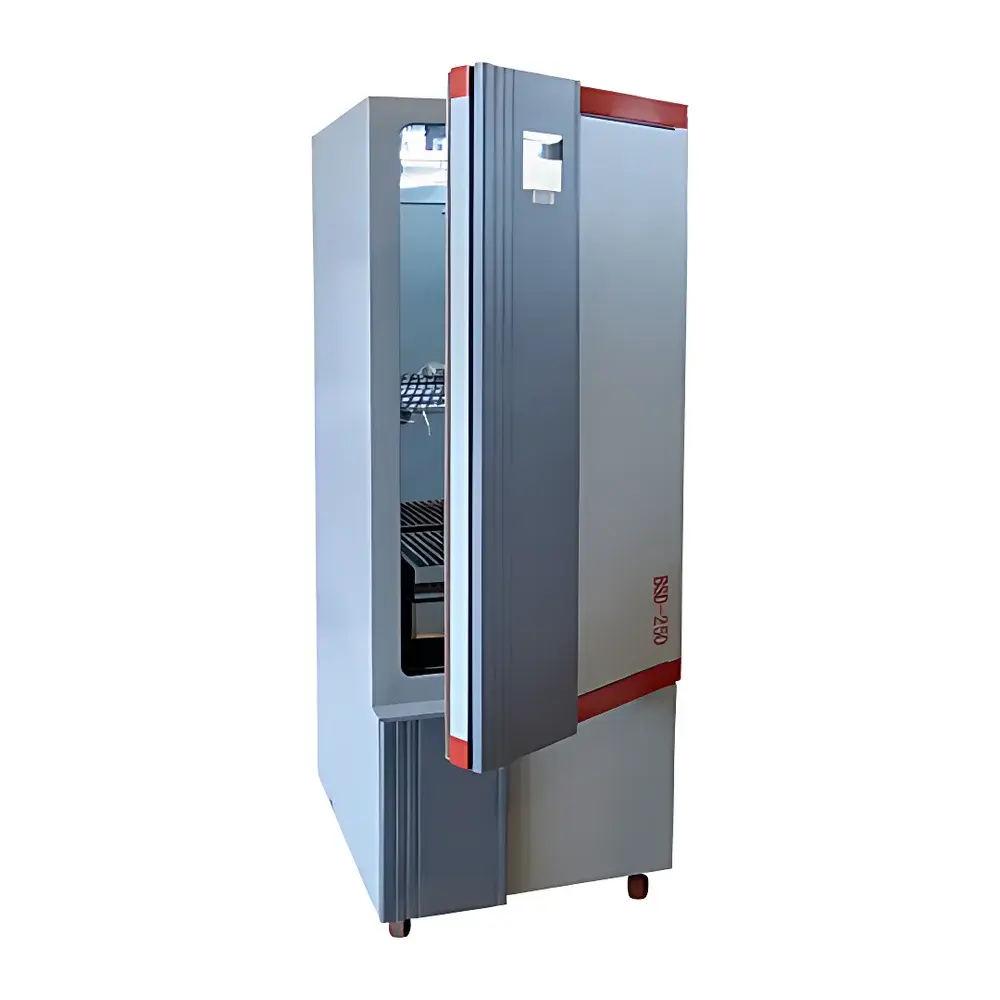
HePu BSD-150 Orbital & Reciprocating Shaking Incubator
| Brand | HePu (Jihepu) |
|---|---|
| Origin | Shandong, China |
| Model | BSD-150 |
| Temperature Range | 0–60 °C |
| Temperature Uniformity | ±1 °C |
| Temperature Fluctuation | ±0.5 °C |
| Resolution | 0.1 °C |
| Humidity Range | 20–90 %RH |
| Chamber Volume | 108 L |
| Internal Dimensions (W×D×H) | 510×390×760 mm |
| External Dimensions (W×D×H) | 650×680×1400 mm |
| Power Input | 1050 W |
| Timer Range | 0–9999 min |
| Shaking Modes | Orbital (0–220 rpm, 20 mm amplitude) / Reciprocating (0–300 cpm, 30 mm amplitude) |
| Shelf | 1 adjustable stainless steel tray |
| Interface | RS-485 |
| Programmability | 10 segments × 99 cycles |
| Defrosting | Auto-defrost (non-energy-consuming, compressor-integrated) |
Overview
The HePu BSD-150 Orbital & Reciprocating Shaking Incubator is an integrated environmental control system engineered for precise, reproducible cultivation of microbial, cellular, and botanical samples under simultaneous temperature regulation, humidity control, and mechanical agitation. It operates on a dual-mode shaking platform—supporting both orbital rotation and linear reciprocation—to accommodate diverse suspension-based culture requirements, including aerobic bacterial growth, fungal propagation, BOD incubation, algal enrichment, and seed germination studies. The chamber employs a hermetically sealed, double-glass observation door with independent inner/outer sash operation to minimize thermal disturbance during visual monitoring. A patented integrated refrigeration architecture—featuring a high-efficiency, R134a-free compressor and multi-layer safety interlocks—ensures stable low-temperature performance down to 0 °C while maintaining continuous operation over extended periods. Temperature uniformity of ±1 °C across the full 108 L working volume is achieved through a proprietary air circulation system incorporating centrifugal forced convection and optimized duct geometry, enabling consistent heat distribution without hot/cold zones.
Key Features
- Microprocessor-based PID temperature controller with 0.1 °C resolution, real-time digital display, and audible/visual over-temperature alarm
- Dual-mode shaking mechanism: selectable orbital (0–220 rpm, 20 mm diameter) or reciprocating (0–300 cpm, 30 mm stroke), both independently adjustable via front-panel interface
- Humidity control range of 20–90 %RH with dedicated fresh-air inlet valve for programmable gas exchange—critical for aerobic respiration and CO2-sensitive cultures
- Stainless steel mirror-finish interior (304 grade), cold-rolled steel exterior with epoxy electrostatic coating, and fully adjustable stainless steel shelf
- Energy-efficient auto-defrost cycle utilizing passive thermal-phase transition—eliminates compressor shutdown and preserves setpoint stability during defrost events
- RS-485 serial interface compliant with Modbus RTU protocol for integration into laboratory automation networks or third-party data loggers
- Power-fail recovery function with non-volatile memory retention for all operational parameters—including temperature setpoint, timer, shaking mode, and program sequence
Sample Compatibility & Compliance
The BSD-150 supports standard microbiological and biotechnological workflows aligned with ISO 22000, ASTM D5210 (BOD testing), USP /, and CLSI M22-A3 guidelines for microbial growth validation. Its 108 L chamber accommodates up to six 2 L Erlenmeyer flasks (with proper load balancing), multiple Petri dish stacks, or tissue culture roller bottles. The optional GPRS remote alert module enables SMS notification upon deviation from user-defined thresholds—facilitating 24/7 environmental oversight in unattended labs. All electrical components meet IEC 61010-1 safety standards; refrigerant complies with EU F-Gas Regulation (EU) No 517/2014. The unit is suitable for GLP-compliant environments when paired with audit-trail-capable software (via RS-485) and validated calibration protocols.
Software & Data Management
While the BSD-150 operates as a standalone instrument, its RS-485 port enables bidirectional communication with host PCs running custom SCADA applications or commercial lab management systems (e.g., LabVantage, Thermo Fisher SampleManager). Data logging—including temperature, humidity, shaking speed, and runtime—is supported at user-configurable intervals (1–60 min). Optional accessories include a thermal printer (for real-time curve output per ASTM E2913-13), GPRS-enabled remote diagnostics, and PC-based monitoring software with trend analysis, alarm history, and electronic signature support compatible with FDA 21 CFR Part 11 requirements when deployed with appropriate validation documentation.
Applications
- Biochemical Oxygen Demand (BOD) incubation per APHA Standard Methods 5210B
- Aerobic bacterial culture (e.g., E. coli, Pseudomonas) and yeast fermentation kinetics
- Mycological studies involving mold and filamentous fungi under controlled humidity
- Environmental water quality assessment—including coliform enumeration and nitrification assays
- Plant tissue culture initiation and callus proliferation under oscillatory stress
- Pharmaceutical stability testing of liquid formulations requiring agitation at elevated temperatures
- Algal biomass production trials with photoperiod-synchronized shaking regimens
FAQ
What is the maximum flask capacity for orbital shaking mode?
The 420 × 320 mm platform supports up to four 2 L baffled flasks (with 20–30 % fill volume) at 150 rpm while maintaining mechanical stability and thermal homogeneity.
Does the unit comply with GLP data integrity requirements?
Yes—when used with validated RS-485-connected software featuring electronic signatures, audit trails, and user access controls, the BSD-150 meets core ALCOA+ principles for raw data generation in regulated environments.
Can humidity be maintained independently of temperature setpoints?
Yes—the humidification system operates autonomously within the 20–90 %RH range regardless of selected temperature, enabling isothermal hygrometric experiments.
Is the shaking amplitude fixed or variable?
Both orbital and reciprocating amplitudes are factory-calibrated and non-adjustable; however, frequency (rpm or cpm) is continuously tunable across the full specified range.
What maintenance is required for long-term reliability?
Annual verification of temperature/humidity sensors against NIST-traceable references, biannual cleaning of condenser coils and fresh-air filter, and periodic inspection of door gasket integrity are recommended per manufacturer’s service schedule.
Related Products



