
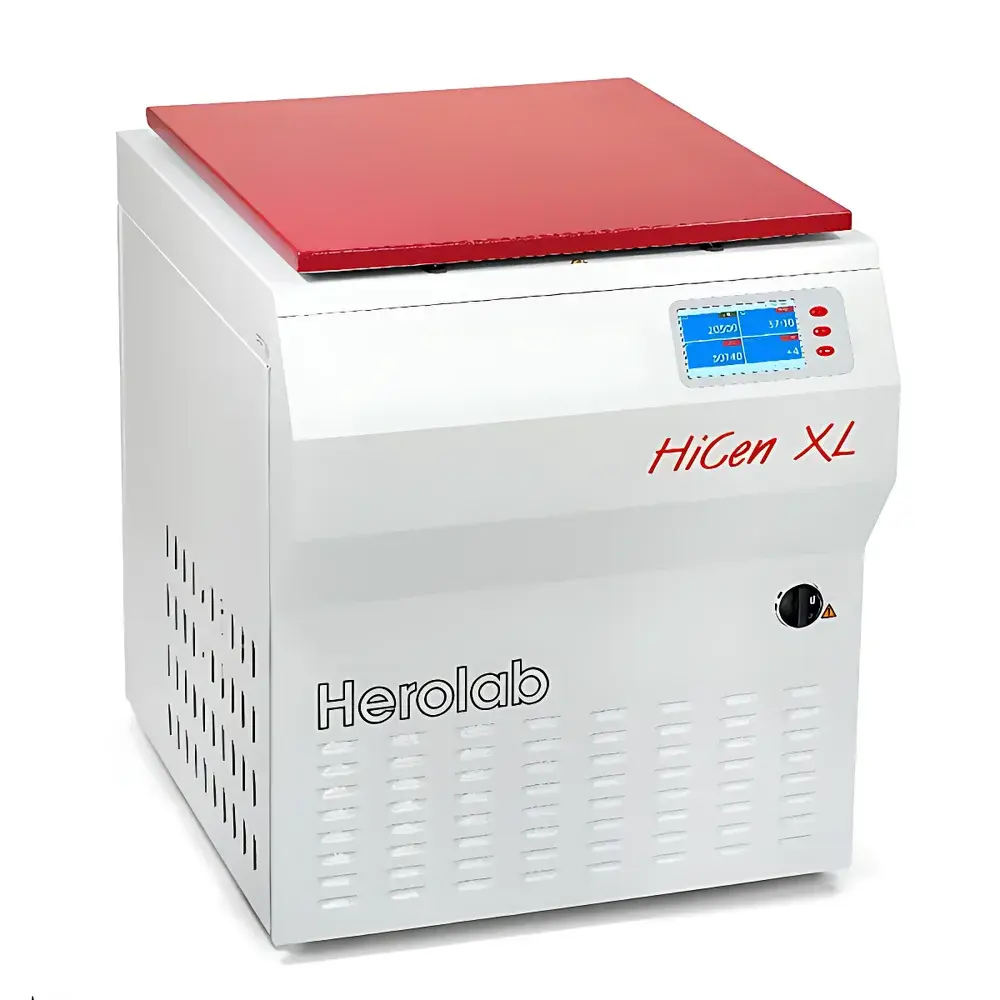
Herolab HiCen XL 6 L Floor-standing Refrigerated Centrifuge
| Brand | Herolab |
|---|---|
| Origin | Germany |
| Model | HiCen XL |
| Instrument Type | Floor-standing Refrigerated Centrifuge |
| Rotor Capacity | 6 × 1000 mL (horizontal), 6 × 1000 mL (angular) |
| Max Speed | 20,500 rpm (angular), 5,200 rpm (horizontal) |
| Max RCF | 50,743 × g (angular), 5,466 × g (horizontal) |
| Temperature Range | −20 °C to +40 °C (CFC-free refrigeration) |
| Dimensions (W×D×H) | 78.0 × 90.0 × 92.0 cm |
| Weight (net) | 420 kg |
| Drive System | Maintenance-free high-speed induction motor with auto-centering |
| Braking | Dynamic reverse magnetic resistance deceleration |
| Safety | Automatic rotor recognition, imbalance detection with auto-shutdown |
| Timer Mode | Speed/RCF-activated countdown |
| Power Supply | 400 V, 50–60 Hz, three-phase AC |
| Optional | Compressor water-cooling kit, nitrogen purge for centrifuge chamber, password-protected user access control |
Overview
The Herolab HiCen XL is a high-performance, floor-standing refrigerated centrifuge engineered for demanding industrial-scale and core facility applications requiring reproducible, high-capacity separation under precisely controlled thermal conditions. Designed and manufactured in Germany, the HiCen XL operates on proven centrifugal sedimentation principles—utilizing rotational force (RCF) to separate heterogeneous mixtures based on particle density, size, and shape. Its dual-rotor architecture supports both high-RCF angular configurations (up to 50,743 × g) for rapid pelleting of subcellular organelles or nanoparticles, and high-volume horizontal configurations (up to 6 L total capacity per run) for clinical batch processing, bioprocess harvest, or environmental sample concentration. The system integrates CFC-free refrigeration with continuous post-run cooling, enabling strict thermal management critical for thermolabile biomolecules, cell suspensions, and enzymatic preparations.
Key Features
- Maintenance-free high-speed induction motor with auto-centering capability ensures long-term rotational stability and minimizes mechanical wear across extended operational cycles.
- Fully flexible shaft transmission enables precise dynamic balancing during acceleration and deceleration, reducing vibration and extending rotor service life.
- Dynamic reverse magnetic resistance braking provides smooth, programmable deceleration profiles—critical for preserving pellet integrity in sensitive biological samples.
- Intelligent temperature regulation maintains setpoint accuracy within ±0.5 °C across the full range (−20 °C to +40 °C), with active chamber cooling sustained for up to 30 minutes after centrifugation ends.
- Comprehensive safety architecture includes automatic rotor identification via RFID-coded rotors, real-time imbalance monitoring, and immediate shutdown if tolerance thresholds are exceeded.
- Speed/RCF-activated timer initiates countdown only upon reaching target parameters—eliminating variability from ramp-up phase and ensuring inter-laboratory protocol reproducibility.
Sample Compatibility & Compliance
The HiCen XL accommodates 17 validated rotor configurations—including 4 horizontal and 13 angular variants—supporting tubes from 0.2 mL microcentrifuge tubes to 1000 mL bottles. Horizontal rotors enable scalable processing of blood bags, fermentation broths, or wastewater sludge; angular rotors deliver maximum RCF for nucleic acid isolation, exosome purification, or virus concentration. All rotors comply with ISO 13485 design standards and are certified for use under GLP and GMP environments. The system meets IEC 61010-1:2010 safety requirements for laboratory equipment and supports audit-ready documentation for FDA 21 CFR Part 11 compliance when paired with optional password-controlled user access and electronic log export.
Software & Data Management
The HiCen XL features an embedded touchscreen interface with intuitive parameter programming, multi-step method storage (≥100 protocols), and real-time display of RCF, speed, temperature, time, and energy consumption. All runs generate timestamped digital records including rotor ID, cycle parameters, deviation alerts, and thermal history. Export options include CSV and PDF formats via USB port. Optional firmware upgrades enable integration with LIMS platforms through RS-232 or Ethernet interfaces. Audit trail functionality logs all user actions—including parameter edits, rotor changes, and emergency stops—with immutable timestamps for regulatory review.
Applications
- Large-volume bioprocessing: Harvesting mammalian or microbial cells from 5–10 L bioreactor runs using 4 × 1000 mL horizontal buckets.
- Clinical diagnostics: High-throughput serum/plasma separation in central labs with automated batch handling and traceable run logs.
- Virology & gene therapy: Ultracentrifugal purification of lentiviral vectors or AAV particles using fixed-angle rotors at >45,000 × g.
- Environmental analysis: Sedimentation of suspended solids from municipal wastewater or soil leachates under controlled low-temperature conditions.
- Pharmaceutical QC: Stability testing of emulsions, liposomes, or nanoparticle suspensions requiring repeated cold-cycle centrifugation with minimal thermal drift.
FAQ
What rotor types are supported, and how is rotor compatibility ensured?
The HiCen XL accepts 17 factory-validated rotors (13 angular, 4 horizontal), each equipped with RFID tags for automatic identification and speed/RCF limit enforcement.
Does the system support operation in explosion-hazard environments?
Yes—optional nitrogen purge integration eliminates oxygen from the centrifuge chamber, enabling safe processing of volatile organic solvents or flammable suspensions per ATEX Directive 2014/34/EU guidelines.
Can the refrigeration system maintain temperature during extended idle periods?
The compressor remains active in standby mode to hold chamber temperature within ±1.0 °C for up to 2 hours without rotor rotation, supporting pre-chill workflows.
Is remote monitoring or control possible?
While native Ethernet connectivity is not standard, optional communication modules enable SNMP-based status polling and alarm forwarding to centralized lab infrastructure systems.
How does the system handle power fluctuations or brownouts?
The three-phase 400 V input includes integrated voltage regulation and surge suppression; unexpected power loss triggers safe rotor coast-down with residual heat dissipation management.



