
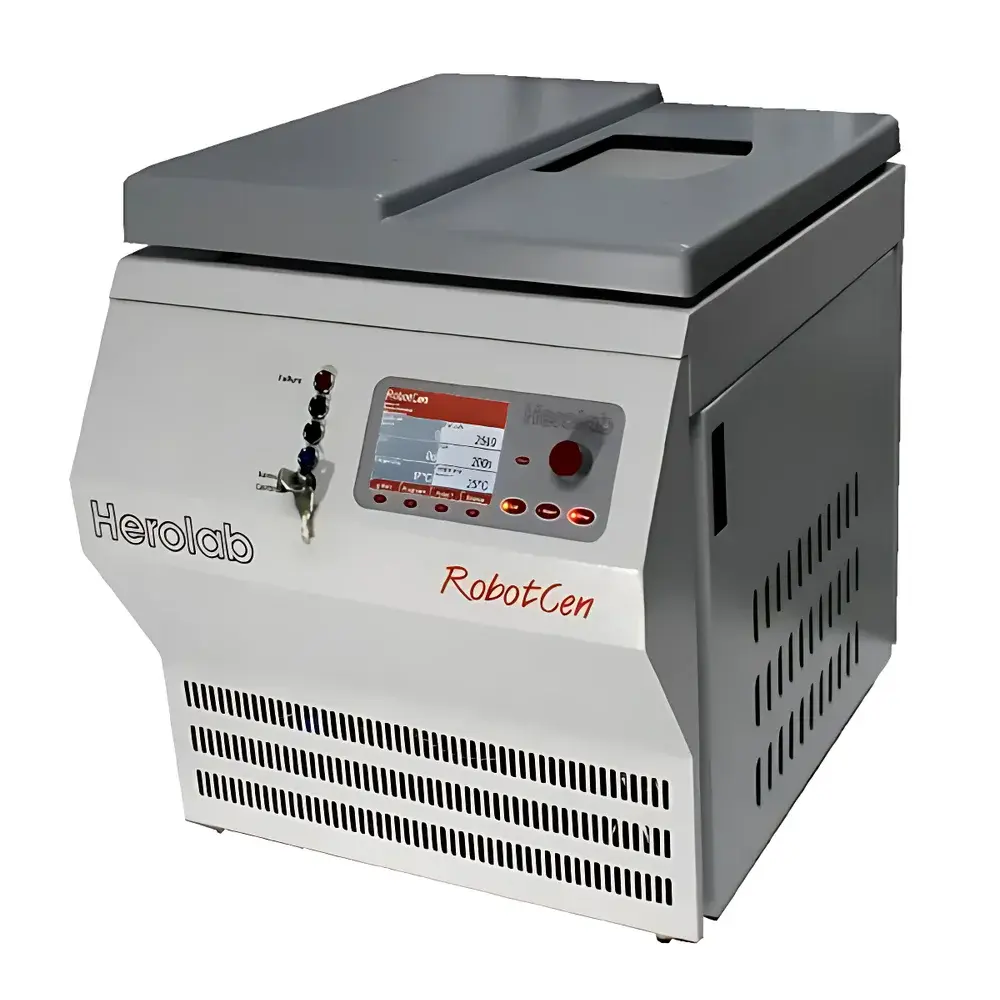
Herolab RobotCen Automated Centrifuge
| Brand | Herolab |
|---|---|
| Origin | Germany |
| Type | Floor-standing Refrigerated Centrifuge |
| Automation Interface | RS-232/RS-485 Serial Control |
| Rotor Compatibility | Horizontal & Fixed-Angle Rotors |
| Sample Vessel Support | Microtubes, Conical Tubes, Centrifuge Bottles (up to 6 × 1000 mL), Microplates, Culture Plates |
| Customization Options | Dual-port or oversized single-port lid, refrigerated or non-refrigerated configuration |
| Compliance | Designed for integration into ISO 13485 and GLP-compliant automated laboratory workflows |
Overview
The Herolab RobotCen Automated Centrifuge is an engineered solution for high-throughput, unattended sample processing in modern automated laboratories. Built upon Herolab’s proven high-capacity “Red Line” centrifuge platform, the RobotCen series integrates precision mechanical design with industrial-grade automation interfaces to support robotic integration in walk-away workflows. It operates on the principle of sedimentation-based separation under controlled gravitational forces (RCF), delivering consistent and reproducible pelleting, phase separation, and particle concentration across diverse biological and chemical sample matrices. Unlike conventional benchtop or standalone centrifuges, the RobotCen is purpose-built for integration into robotic liquid handling ecosystems—enabling seamless coordination with collaborative robots (cobots) and gantry-based automation platforms. Its robust floor-standing architecture ensures mechanical stability during extended operation at high rotational speeds, while its refrigerated variant maintains precise temperature control (typically –9 °C to +40 °C) throughout centrifugation cycles—critical for thermolabile biomolecules, cell suspensions, and clinical specimens.
Key Features
- Industrial-grade serial communication interface (RS-232/RS-485) for bidirectional command execution and status feedback—compatible with common lab automation middleware (e.g., Hamilton VENUS, Tecan Fluent, Opentrons API)
- Programmable rotor positioning system ensuring repeatable alignment with robotic end-effectors; enables precise tube/pallet engagement without manual intervention
- Modular lid configuration: dual-access ports for dual-arm robotic systems or a single oversized port optimized for large-format carriers and microplate handlers
- Universal rotor mounting system supporting both swing-out horizontal rotors and high-speed fixed-angle rotors—validated for use with ISO-standardized centrifuge vessels
- Refrigerated and non-refrigerated variants available; refrigerated model features compressor-based cooling with real-time temperature monitoring and PID-controlled stabilization
- Structural reinforcement for continuous-duty operation at rated speeds up to 6,000 rpm (model-dependent), with vibration-dampened base and reinforced chamber housing
Sample Compatibility & Compliance
The RobotCen accommodates a broad spectrum of standard laboratory consumables without adapter modification—including 0.2–50 mL microcentrifuge tubes, 15–1000 mL conical centrifuge bottles, 96-well and 384-well microplates, and T75/T175 cell culture flasks (when used with appropriate carriers). Maximum payload capacity extends to 6 × 1000 mL bottles or 4 × 500 mL bottles per run, depending on rotor selection. All configurations adhere to IEC 61010-1 safety standards for laboratory equipment and are designed to meet mechanical and thermal requirements outlined in ISO 22870 (in vitro diagnostic medical devices) and EU Directive 2014/30/EU (EMC). When deployed in regulated environments, the system supports audit-trail generation via external logging software and can be validated for use under GLP and GMP frameworks—including documentation of run parameters, temperature logs, rotor identification, and door interlock status.
Software & Data Management
The RobotCen does not include proprietary PC software but provides a documented ASCII-based command protocol for integration into existing LIMS, ELN, or MES platforms. Each command packet includes checksum verification and response acknowledgment, ensuring deterministic behavior in mission-critical sequences. Time-stamped operational data—including start/stop timestamps, RCF values, temperature setpoints, actual chamber temperature, rotor ID, and cycle completion status—can be streamed to external databases via serial-to-TCP gateways. For FDA-regulated applications, optional 21 CFR Part 11 compliance is achievable through third-party electronic signature and audit-trail modules deployed at the orchestration layer—not within the centrifuge firmware itself—ensuring flexibility and regulatory traceability without compromising device-level simplicity.
Applications
- High-volume biobanking: automated processing of peripheral blood mononuclear cells (PBMCs), plasma, and serum across thousands of samples per week
- Diagnostic assay preparation: pre-analytical processing for molecular diagnostics, including cfDNA isolation, exosome enrichment, and viral load quantification
- Cell therapy manufacturing: closed-system centrifugation steps in CAR-T and MSC workflows compliant with Annex 1 (EU GMP) requirements
- Pharmaceutical QC labs: batch-wise clarification of protein formulations, nanoparticle suspensions, and emulsion stability testing
- Academic core facilities: shared-resource automation nodes supporting multi-user scheduling and remote job submission via web APIs
FAQ
Does the RobotCen support third-party rotor brands?
Yes—provided they conform to DIN 61615 mechanical interface specifications and have been validated for dynamic balance at maximum rated speed.
Can the centrifuge be integrated with a Beckhoff TwinCAT or Siemens S7 PLC?
Yes—its RS-485 interface supports Modbus RTU protocol mapping, enabling direct integration with industrial PLCs used in centralized lab automation infrastructure.
Is remote firmware update capability available?
No—firmware updates require local physical access and must be performed by authorized Herolab service personnel to maintain calibration integrity and safety certification.
What is the typical lead time for custom rotor or lid configurations?
Standard customization requests (e.g., dual-port lid, refrigerated upgrade) ship within 8–10 weeks from order confirmation; fully bespoke rotor designs require engineering review and may extend lead time to 16+ weeks.
How is mechanical safety ensured during robotic interaction?
The RobotCen incorporates hardware-enforced interlocks: motor disable on lid open, emergency stop signal propagation to connected robots, and torque-limiting clutch engagement if abnormal resistance is detected during robotic loading/unloading.



