
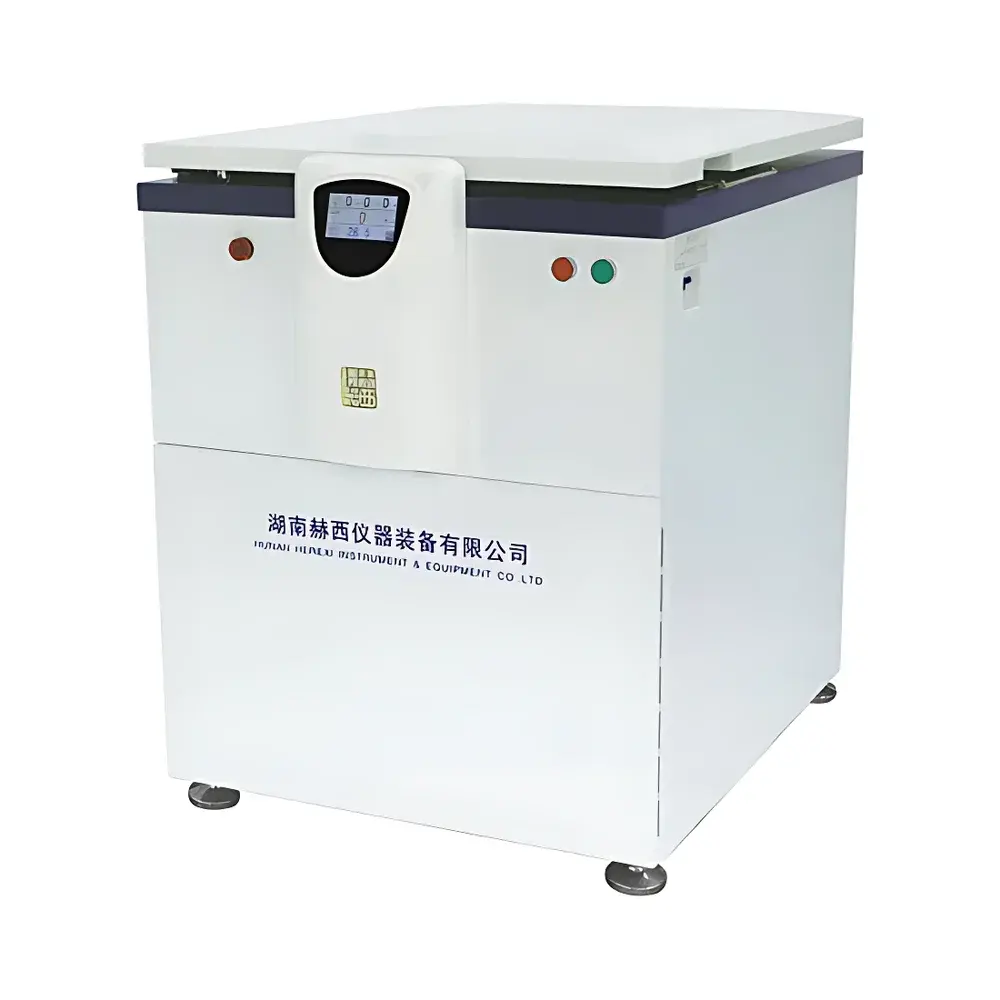
Hershey HR21M Floor-standing High-speed Refrigerated Centrifuge
| Brand | Hershey |
|---|---|
| Origin | Hunan, China |
| Model | HR21M |
| Instrument Type | Floor-standing centrifuge |
| Speed Range | 10,000–30,000 rpm (max 21,000 rpm) |
| Refrigerated | Yes |
| Configuration | Horizontal rotor compatible |
| Max Capacity | 4 × 1000 mL |
| Max RCF | 53,741 × g |
| Dimensions | 820 × 710 × 950 mm |
| Temperature Range | −20 °C to +40 °C |
| Temp. Accuracy | ±1 °C |
| Acceleration/Deceleration | 10-step control |
| Programs | 16 user-defined |
| Noise Level | ≤65 dB(A) |
| Power | 4.0 kW |
| Weight | 240 kg |
| Compliance | ISO 9001:2015, ISO 13485:2016, CFDA registered |
| Safety | RoHS-compliant silicone sealing, NEMA4-rated HMI, CE/EMC (2014/30/EU), IEC 61131-2:2007, mechanical door lock, triple-damping suspension |
Overview
The Hershey HR21M is a floor-standing high-speed refrigerated centrifuge engineered for precision separation of biological and clinical samples under controlled thermal conditions. It operates on the principle of sedimentation acceleration via high angular velocity—generating up to 53,741 × g at 21,000 rpm—to resolve heterogeneous mixtures based on particle density, size, and shape. Designed for routine and demanding applications in biobanking, blood banking, vaccine development, and quality-controlled manufacturing environments, the HR21M delivers reproducible pelleting, layering, and concentration outcomes across large-volume formats (up to 4 × 1000 mL). Its integrated refrigeration system maintains precise temperature stability during extended runs, mitigating thermal denaturation of thermolabile biomolecules such as enzymes, nucleic acids, and monoclonal antibodies.
Key Features
- High-torque AC frequency-controlled motor with microprocessor-based speed regulation ensures stable rotational dynamics and low mechanical drift (<±50 rpm accuracy).
- Imported fluorine-free refrigeration unit using R404a refrigerant enables rapid pre-cooling and continuous temperature maintenance between −20 °C and +40 °C, with real-time monitoring and adjustable setpoints during operation.
- Triple-stage damping system—including mechanical counterbalance, elastomeric suspension mounts, and optimized rotor shaft support—minimizes vibration transmission and prevents sample resuspension.
- CE- and EMC-compliant control architecture featuring Mitsubishi PLC (IEC 61131-2:2007) and Weinview HMI (NEMA4 ingress protection) supports intuitive multi-language interface (English, Chinese) and full parameter logging.
- Biocontainment-certified angular rotors with one-piece RoHS 2015/863-compliant silicone gaskets provide aerosol-tight sealing during high-speed operation—critical for BSL-2 and BSL-3 workflows.
- Robust safety framework includes mechanical lid interlock, imbalance detection, overspeed cutoff, overtemperature alarm, voltage fluctuation compensation, and automatic defrost heating cycle.
- Flexible deceleration/acceleration profiles (10 programmable steps), 16 customizable run protocols, and graphical display of real-time RCF, temperature, and time-integrated centrifugation curves.
Sample Compatibility & Compliance
The HR21M accommodates a broad range of primary containers—from 1.5 mL microtubes to 1000 mL bottles—via optional aerospace-grade aluminum angle rotors and polyamide fiber adapters. Horizontal rotor configurations support swing-bucket applications for density gradient separations (e.g., Ficoll-Paque™, Percoll®), while fixed-angle rotors optimize pelleting efficiency for cell lysates or viral particles. All structural components—including stainless-steel chamber, powder-coated steel chassis, and triple-layer reinforced front panel—meet ISO 13485:2016 requirements for medical device manufacturing. The system holds CFDA registration and complies with ISO 9001:2015 quality management standards. While not explicitly FDA 21 CFR Part 11 validated out-of-box, its audit-trail-capable software architecture supports configuration for GLP/GMP environments upon site-specific validation.
Software & Data Management
The embedded control firmware logs timestamped operational metadata—including actual vs. target speed, chamber temperature, elapsed time, rotor ID, and error codes—for each run. Exportable CSV files facilitate integration into LIMS or ELN platforms. User access levels can be defined to restrict parameter modification, ensuring procedural consistency across shifts. Firmware updates are performed via USB interface with version rollback capability. No cloud connectivity is included by default; all data remains local unless interfaced externally via RS-232 or optional Ethernet module (sold separately). Audit trail functionality meets minimum ALCOA+ principles when deployed with documented SOPs and administrator oversight.
Applications
- Plasma and serum fractionation in clinical diagnostics and transfusion medicine
- Large-scale isolation of exosomes, extracellular vesicles, and subcellular organelles
- Viral vector purification and concentration in gene therapy process development
- Downstream processing of recombinant proteins and therapeutic antibodies
- Soil and food matrix extraction for pathogen enrichment (e.g., Salmonella, Listeria)
- Preparative ultracentrifugation support for cryo-EM sample preparation (with compatible rotors)
- Stability testing of biopharmaceutical formulations under accelerated thermal stress
FAQ
What is the maximum RCF achievable with the HR21M, and at what rotor radius is this value calculated?
The maximum relative centrifugal force is 53,741 × g, specified at the maximum rotational speed of 21,000 rpm and the outermost radius of the standard 4 × 1000 mL horizontal rotor (Rmax = 225 mm). Actual RCF varies with rotor geometry and tube fill level.
Does the HR21M support continuous operation mode, and what is the maximum runtime per cycle?
Yes—the instrument supports both timed (1 min to 99 h 59 min) and continuous centrifugation modes. Continuous operation is limited only by thermal load and ambient cooling capacity; typical duty cycles do not exceed 8 hours without maintenance interval.
Is rotor identification automated, or must users manually select rotor type before starting a protocol?
Rotor identification is manual. Users must select the appropriate rotor model from the HMI menu prior to initiating a program to ensure correct RCF calculation and safety interlock activation.
Can the HR21M be integrated into a laboratory automation system via digital I/O or network protocol?
Standard configuration includes RS-232 serial port for basic command-and-control. Optional Ethernet module (part no. HR-ETH-01) enables Modbus TCP communication for integration with SCADA or central lab management systems.
What documentation is provided for IQ/OQ/PQ validation support?
Factory-supplied documentation includes electrical schematics, mechanical drawings, calibration certificates for temperature and speed sensors, and a URS-aligned test protocol template compliant with ISO/IEC 17025 and Annex 11 expectations. Full validation services are available through Hershey’s certified field engineers.



