
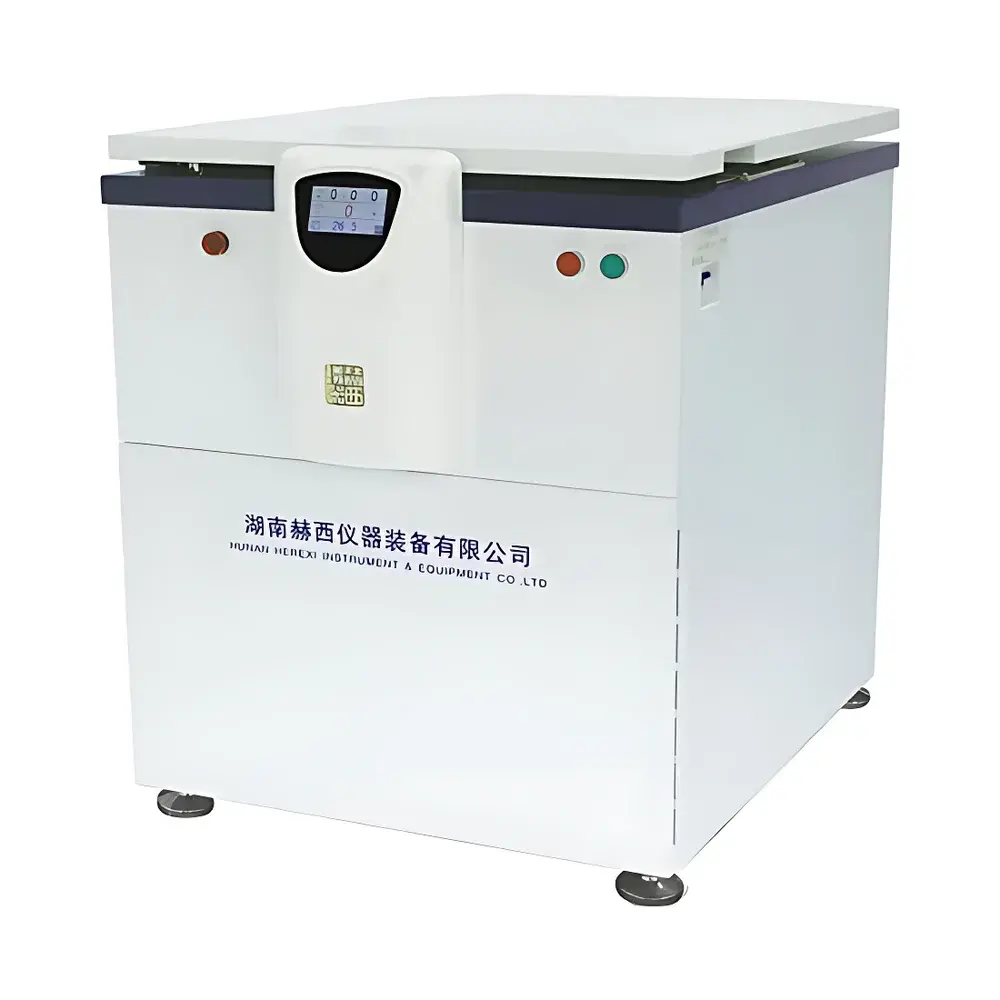
Herxi LRM-12L-1 Ultra-High-Capacity Low-Speed Refrigerated Centrifuge
| Brand | Herxi |
|---|---|
| Origin | Hunan, China |
| Model | LRM-12L-1 |
| Instrument Type | Floor-Standing Centrifuge |
| Speed Range | 0–4000 rpm |
| Max RCF | 5680 ×g |
| Max Capacity | 6 × 2400 mL |
| Temperature Range | −20 °C to +40 °C |
| Temp. Accuracy | ±1 °C |
| Acceleration/Deceleration | 10-step programmable |
| Noise Level | <65 dB(A) |
| Dimensions (W×D×H) | 860 × 960 × 1200 mm |
| Weight | 450 kg |
| Power Supply | AC 220 V, 50 Hz |
| Total Power | 6.0 kW |
| Compliance | ISO 9001:2015, ISO 13485:2016, CFDA Registered |
| Refrigerant | R404a (non-CFC) |
| Control System | Mitsubishi PLC + Weinview HMI |
| Drive | High-torque AC frequency-converter motor |
| Rotor Configuration | Horizontal swing-out rotor |
Overview
The Herxi LRM-12L-1 Ultra-High-Capacity Low-Speed Refrigerated Centrifuge is an engineered solution for large-volume batch separation under precise thermal control. Designed for applications requiring gentle yet robust sedimentation of sensitive biological and industrial suspensions—such as whole blood fractionation, cell pellet harvesting, dairy cream separation, or polymer precipitation—the instrument operates on the principle of sedimentation centrifugation in horizontal swing-out rotors. Its low-speed operational envelope (up to 4000 rpm, 5680 ×g) ensures minimal shear stress on fragile particulates while maintaining high reproducibility across multi-liter sample loads. The unit integrates a closed-loop refrigeration system with R404a refrigerant—compliant with global ozone-depletion potential (ODP) and global-warming potential (GWP) regulations—and delivers stable temperature maintenance from −20 °C to +40 °C during active rotation, enabling cold-sensitive workflows such as plasma-derived product processing or enzyme-stable precipitate recovery.
Key Features
- High-torque AC frequency-converter motor coupled with Mitsubishi PLC-based motion control (IEC 61131-2:2007 compliant) and Weintek HMI touchscreen interface (NEMA 4/IP65 rated), ensuring stable speed regulation (±50 rpm) and low acoustic emission (<65 dB[A])
- Refrigeration architecture featuring dual-stage compressors and eco-friendly R404a refrigerant, supporting pre-cooling, hold-at-temperature standby mode, and automatic defrost with heating elements
- Triple-stage damping system—including mechanical isolation mounts, composite shock-absorbing pads, and dynamic rotor balancing algorithms—to suppress vibration transmission and prevent sample resuspension
- TFT-LCD color display with multilingual UI (English, Chinese), real-time graphical overlay of speed ramping profiles, cumulative centrifugal time integration, and temperature trajectory logging
- Austenitic 304 stainless steel centrifuge chamber, powder-coated carbon steel housing, reinforced triple-layer safety shroud, and patented carbon-fiber rotor hood for structural integrity and mass reduction
- Mechanical interlocked lid with auto-engaging latch mechanism—certified for operation in humid, dusty, or chemically exposed environments per CE and RoHS directives
- Programmable acceleration/deceleration (10-step each), 16 user-defined protocol storage, and editable rotor-specific parameter sets including g-force limits, dwell times, and thermal setpoints
- Integrated leveling system with adjustable carbon-steel leveling feet and swivel casters for safe repositioning and floor-load distribution on standard laboratory flooring
Sample Compatibility & Compliance
The LRM-12L-1 accommodates standard clinical and industrial containers—including 2400 mL polypropylene bottles, 1000 mL conical tubes, and custom-form factor vessels—within its horizontally configured rotor assembly. It supports routine use in GLP-compliant blood banking, biopharmaceutical downstream processing, and food-grade emulsion separation where regulatory traceability is required. The system carries CFDA registration and manufacturing certification, and conforms to ISO 9001:2015 (Quality Management) and ISO 13485:2016 (Medical Device QMS). Electromagnetic compatibility meets EU Directive 2014/30/EU; electrical safety complies with IEC 61010-1:2010. All firmware logic and audit trails are structured to support future alignment with FDA 21 CFR Part 11 requirements for electronic records and signatures.
Software & Data Management
Control firmware enables timestamped parameter logging (speed, RCF, temperature, elapsed time) to internal non-volatile memory, exportable via USB interface in CSV format. No proprietary software installation is required—data files are natively readable in Excel, LabChart, or LIMS platforms. Each run generates a unique session ID linked to operator ID, rotor serial number, and environmental metadata. While not cloud-connected, the architecture permits integration into local networked lab infrastructure via RS-485 or optional Ethernet module (sold separately), facilitating centralized monitoring in multi-instrument facilities.
Applications
- Hematology & transfusion medicine: Large-batch red blood cell washing, platelet-rich plasma (PRP) preparation, cryoprecipitate isolation
- Vaccine & biologics manufacturing: Clarification of microbial lysates, harvest of recombinant protein aggregates, virus-like particle (VLP) concentration
- Food & dairy R&D: Skim milk standardization, butterfat separation, whey protein fractionation
- Environmental & agricultural testing: Soil suspension clarification, algal biomass harvesting, pesticide residue extraction
- Industrial chemistry: Precipitation of metal hydroxides, polymer latex coagulation, catalyst recovery from reaction slurries
FAQ
What is the maximum permissible imbalance tolerance for the LRM-12L-1 horizontal rotor?
The system detects load asymmetry exceeding 50 g per bucket pair and halts acceleration prior to reaching operational speed.
Can the LRM-12L-1 maintain −20 °C during continuous 24-hour operation?
Yes—ambient temperature ≤25 °C and relative humidity ≤60% are recommended for sustained sub-zero performance; compressor duty cycle adjusts dynamically to thermal load.
Is rotor calibration traceable to national metrology standards?
Each rotor is supplied with individual calibration certificate referencing ISO/IEC 17025-accredited torque and dimensional verification.
Does the unit support remote diagnostics or service access?
Local diagnostic mode is accessible via service port; remote support requires on-site technician authorization and encrypted connection protocol.
Are replacement rotors available with validated cleaning validation protocols?
Yes—sterilization-compatible rotors include documented autoclave cycles (121 °C, 20 min) and chemical resistance data per USP and ISO 15883 guidelines.



