
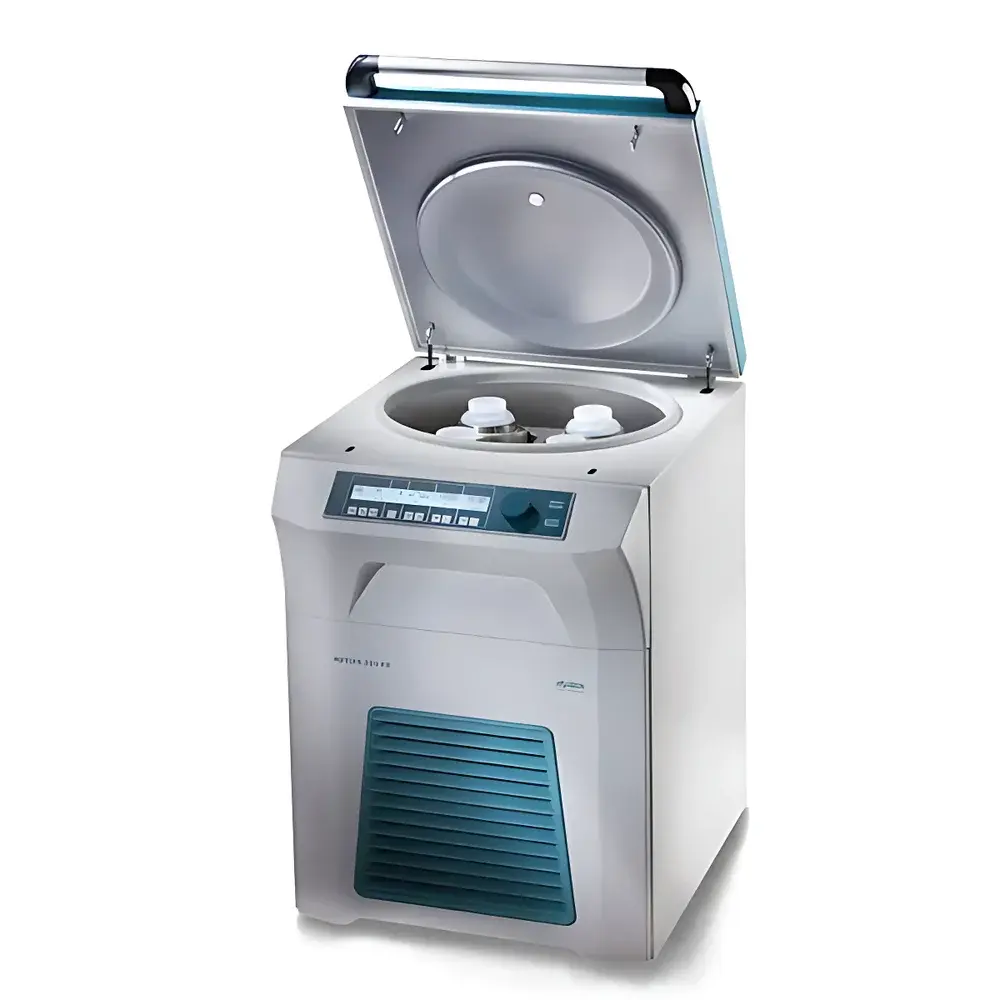
Hettich ROTIXA 500 RS Floor-standing Refrigerated Centrifuge
| Brand | Hettich |
|---|---|
| Origin | Germany |
| Model | ROTIXA 500 RS |
| Type | Floor-standing Refrigerated Centrifuge |
| Max Speed | 11,500 rpm |
| Max RCF | 18,038 × g |
| Max Capacity | 4 × 1000 mL (horizontal rotor) |
| Temperature Range | −20 °C to +40 °C |
| Dimensions (W×D×H) | 650 × 814 × 973 mm |
| Weight | ~219 kg |
| Noise Level | 58 dB(A) |
| Power Supply | 230–240 V, 1~ |
| Power Consumption | 3,800 VA |
| EMC Compliance | EN/IEC 61326-1, Class B |
Overview
The Hettich ROTIXA 500 RS is a high-performance floor-standing refrigerated centrifuge engineered for demanding laboratory environments requiring robust separation capacity, precise temperature control, and operational reliability. Designed and manufactured in Germany, this instrument employs fixed-angle and horizontal rotor configurations to support both high-speed pelleting and gentle density-gradient separations. Its core operating principle relies on controlled application of centrifugal force—generated via a maintenance-free brushless motor—to accelerate sedimentation of suspended particles based on differences in mass, density, and shape. With a maximum rotational speed of 11,500 rpm and a peak relative centrifugal force (RCF) of 18,038 × g, the ROTIXA 500 RS delivers reproducible results across large-volume applications, including clinical sample processing, bioprocessing scale-up, and industrial quality control workflows. Integrated refrigeration maintains sample integrity during extended runs, while its rigid stainless-steel chamber and vibration-damped base ensure mechanical stability under full-load conditions.
Key Features
- Refrigerated operation with precise temperature control from −20 °C to +40 °C, enabling heat-sensitive sample handling (e.g., enzymes, plasma, cell lysates)
- Intelligent rotor recognition system automatically detects installed rotor type and enforces corresponding speed and safety limits
- Brushless drive motor ensures low maintenance, high torque delivery, and long-term rotational stability
- Electric lid lock with one-hand operation and emergency manual release mechanism compliant with IEC 61010-2-020 safety standards
- Stainless-steel centrifuge chamber and corrosion-resistant interior surfaces facilitate decontamination and meet ISO 13485 requirements for medical device manufacturing environments
- Large-capacity horizontal rotor support up to 4 × 1000 mL bottles or equivalent tube configurations, optimized for blood bank, bioreactor harvest, and wastewater analysis applications
- 99 programmable methods with up to 19 individually adjustable acceleration and deceleration phases for gradient-sensitive protocols
- Dual-unit temperature display (°C/°F), real-time error diagnostics, and automatic imbalance shutdown per EN 61000-6-4
Sample Compatibility & Compliance
The ROTIXA 500 RS accommodates a broad range of primary and secondary containment formats—including polypropylene and polycarbonate bottles, swing-out buckets, and fixed-angle rotors—supporting compliance with common regulatory frameworks. Its design conforms to the essential requirements of Directive 93/42/EEC (Medical Devices Directive), and CE marking verifies conformity with EU Machinery Directive 2006/42/EC and Electromagnetic Compatibility Directive 2014/30/EU. Electrical safety certification aligns with EN 61010-1:2010 and EN 61010-2-020. For laboratories operating under GLP or GMP conditions, the instrument supports audit-ready operation through persistent method storage, timestamped run logs, and traceable parameter configuration—facilitating alignment with FDA 21 CFR Part 11 when integrated with validated LIMS or ELN platforms.
Software & Data Management
While the ROTIXA 500 RS operates via an intuitive rotary-knob-and-button interface without onboard touchscreen or network connectivity, it provides comprehensive local data governance. All 89 stored programs retain full parameter sets—including time, speed, temperature, ramp profiles, and brake settings—with non-volatile memory retention. Each run generates a timestamped record of actual RCF, elapsed time, final temperature, and any triggered safety events (e.g., imbalance detection, lid interlock breach). Export functionality is available via optional USB interface modules (sold separately), enabling transfer of run logs and method archives to external systems for documentation traceability. The firmware architecture supports future upgrades via certified service channels, ensuring long-term compatibility with evolving laboratory informatics infrastructure.
Applications
This centrifuge serves critical roles across multiple sectors: in clinical diagnostics, it enables high-throughput serum/plasma separation from whole blood in volume-intensive testing pipelines; in pharmaceutical development, it supports clarification of monoclonal antibody harvests and formulation stability studies under controlled thermal conditions; in environmental labs, it facilitates suspended solids quantification in wastewater effluent and sludge dewatering trials; and in academic research, its versatility supports subcellular fractionation, virus purification, and polymer precipitation protocols. Its large-volume capability makes it especially suitable for process development labs transitioning from benchtop to pilot-scale operations.
FAQ
Does the ROTIXA 500 RS support validation documentation packages for GMP environments?
Yes—Hettich provides IQ/OQ documentation templates and factory calibration certificates upon request, compatible with user-defined PQ protocols.
Can third-party rotors be used with this centrifuge?
No—only Hettich-certified rotors are recognized by the auto-identification system; use of non-approved rotors voids safety certification and warranty.
What is the minimum ambient temperature required for continuous refrigerated operation?
The unit requires ambient temperatures between +15 °C and +32 °C for stable −20 °C chamber performance; operation below +15 °C may impair compressor efficiency.
Is remote monitoring or Ethernet connectivity available?
Not natively—the system lacks built-in network interfaces, but external PLC integration is possible via dry-contact I/O terminals for facility-wide status monitoring.
How often does the refrigeration system require maintenance?
Under normal use, the sealed refrigerant circuit requires no scheduled servicing; annual inspection of condenser coils and door gasket integrity is recommended.



