
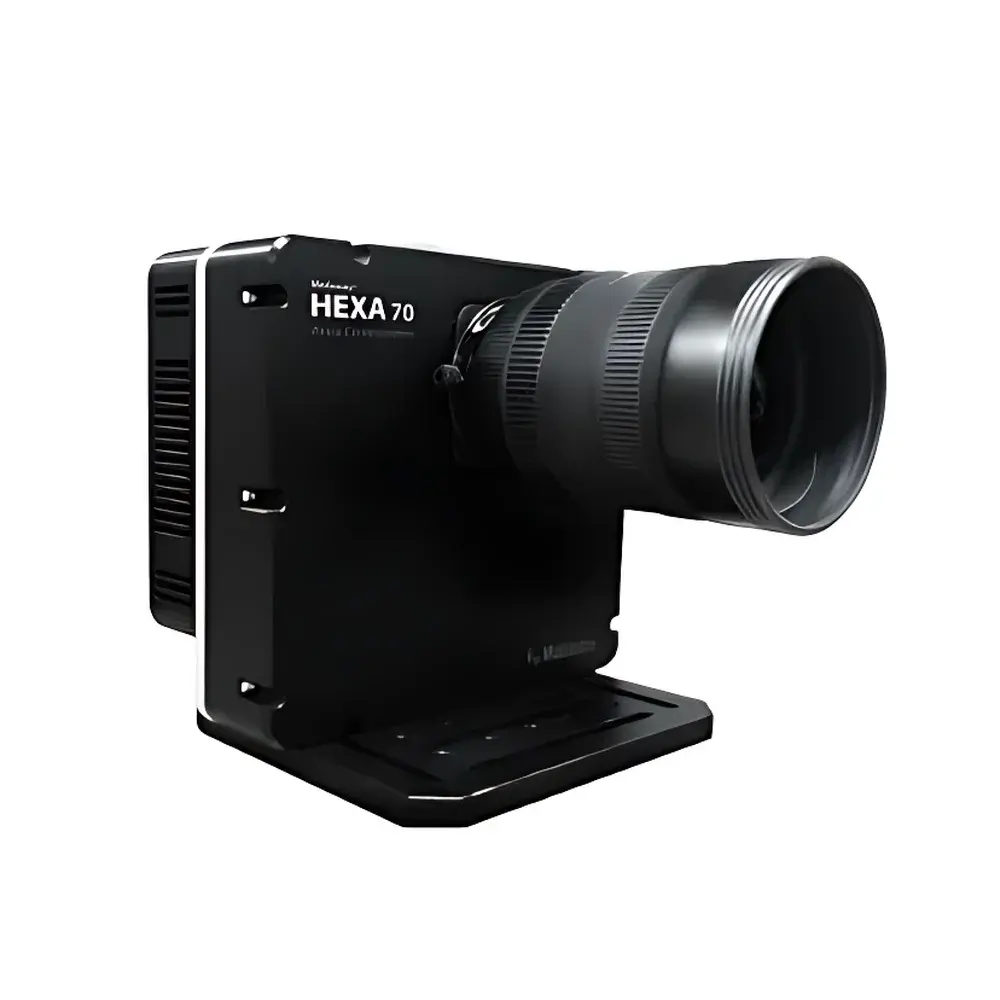
HEXA 70 Colorimeter by McScience
| Brand | McScience |
|---|---|
| Origin | South Korea |
| Model | HEXA 70 |
| Type | Portable Dual-Mode (Tristimulus & Spectral) Colorimeter |
| Communication | Bluetooth 5.0 & USB-C |
| Interface Compatibility | Windows 10/11, Android 8.0+, SCPI-compliant test instrumentation |
| Compliance | ISO/CIE 15:2018, CIE 179:2015, ASTM E308-22 |
Overview
The HEXA 70 Colorimeter is a precision-engineered optical measurement instrument designed for quantitative colorimetric and spectral characterization of reflective, transmissive, and emissive samples in R&D, quality control, and production environments. Operating on the principles of tristimulus colorimetry—based on CIE standard observer functions (2° and 10°)—and augmented by high-resolution spectral acquisition (380–780 nm, 10 nm FWHM), the HEXA 70 delivers traceable, repeatable color data in CIE XYZ, LAB, LCH, Yxy, and ΔE*ab/ΔE*00 formats. Its dual-mode architecture enables seamless switching between fast tristimulus evaluation (ideal for inline QC) and full spectral capture (required for metamerism analysis, spectral reflectance curve generation, and custom illuminant simulation). The device conforms to ISO/CIE 15:2018 for colorimetric instruments and supports NIST-traceable calibration via optional factory-certified reference tiles.
Key Features
- Adaptive optical head design with interchangeable apertures (Ø4 mm, Ø8 mm, Ø25 mm) and integrated cosine corrector for angular response compliance per CIE 179:2015
- Dual operational modes: Tristimulus mode (≤0.5 s measurement cycle) and spectral mode (3.2 s, 401-channel spectrum at 1 nm intervals)
- Integrated Bluetooth 5.0 + USB-C interface enabling real-time streaming to host systems without driver dependency
- Rugged aluminum-magnesium alloy housing (IP52 rated) with anti-reflective anodized finish, optimized for cleanroom and industrial lab use
- Onboard memory (2 GB) supporting ≥50,000 measurement records with timestamp, GPS (optional), and operator ID tagging
- Self-diagnostic firmware with automatic dark-current compensation and LED source stability monitoring (drift <0.1% over 8 h)
Sample Compatibility & Compliance
The HEXA 70 accommodates flat, curved, textured, and semi-transparent samples—including painted panels, LCD/OLED displays, plastic films, textiles, and coated glass—via configurable test fixtures (sold separately). Its optical geometry supports both 0°/d (diffuse illumination, normal viewing) and d/0° (diffuse viewing, normal illumination) configurations per ISO 27677:2022. All measurement algorithms adhere to ASTM E308-22 for color computation and are validated against CIE Publication 179 for color rendering index (CRI) and TM-30 metrics. Device firmware includes built-in audit trail logging compliant with GLP requirements, and raw spectral data export meets FDA 21 CFR Part 11 criteria when used with McScience’s certified software suite.
Software & Data Management
The HEXA 70 operates natively with McScience’s ColorLab Suite v4.2—a platform-agnostic application supporting Windows (x64), Android (ARM64), and Linux-based parameter testers via SCPI command set. The software provides batch analysis, tolerance mapping (ellipsoidal or rectangular ΔE zones), spectral comparison overlays, and automated report generation (PDF/CSV/XLSX) with embedded metadata (instrument ID, calibration date, operator, environmental conditions). All data files include embedded EXIF-like headers containing spectral irradiance reference, integration time, and white calibration status. For enterprise integration, RESTful API endpoints support direct ingestion into LIMS and MES platforms; audit logs retain full change history with digital signature verification.
Applications
- Display manufacturing: OLED/LCD chromaticity uniformity mapping, backlight CCT verification, and aging drift quantification
- Automotive coatings: Batch-to-batch color matching across metallic and pearlescent finishes under multiple illuminants (D65, A, F2)
- Pharmaceutical packaging: Verification of printed label color fidelity per USP analytical instrument qualification guidelines
- Textile and printing QA: Spectral match prediction using Kubelka-Munk theory and G7 grayscale calibration workflows
- Academic research: Spectral power distribution modeling, color appearance modeling (CAM16), and cross-device gamut analysis
FAQ
Does the HEXA 70 require annual recalibration?
Yes. McScience recommends factory recalibration every 12 months or after 10,000 measurements, using NIST-traceable ceramic standards. Field verification kits (SRM 2036, SRM 2037) are available for daily zero-checks.
Can it measure self-luminous sources such as LEDs or micro-LED arrays?
Yes. The HEXA 70 includes luminance mode (0.001–10,000 cd/m² range) with automatic exposure control and flicker index calculation per IEC TR 61000-4-15.
Is spectral data export compatible with third-party analysis tools like MATLAB or Python?
Yes. Raw ASCII spectra (.csv) and binary .spc files include wavelength-indexed intensity values with header metadata, fully importable into SciPy, Pandas, or commercial optical modeling packages.
What is the uncertainty budget for ΔE*00 measurements under D65 illumination?
At 23 °C ±2 °C and 50% RH ±5%, the expanded uncertainty (k=2) is ±0.18 ΔE*00 for reflectance samples with L* >30 and chroma >5, per ISO/IEC 17025-accredited validation reports.
Does the device support user-defined illuminants and observers?
Yes. Up to 16 custom illuminants (spectral or CIE tabulated) and two custom observer functions (2° or 10°, user-supplied CMFs) can be loaded via ColorLab Suite.




