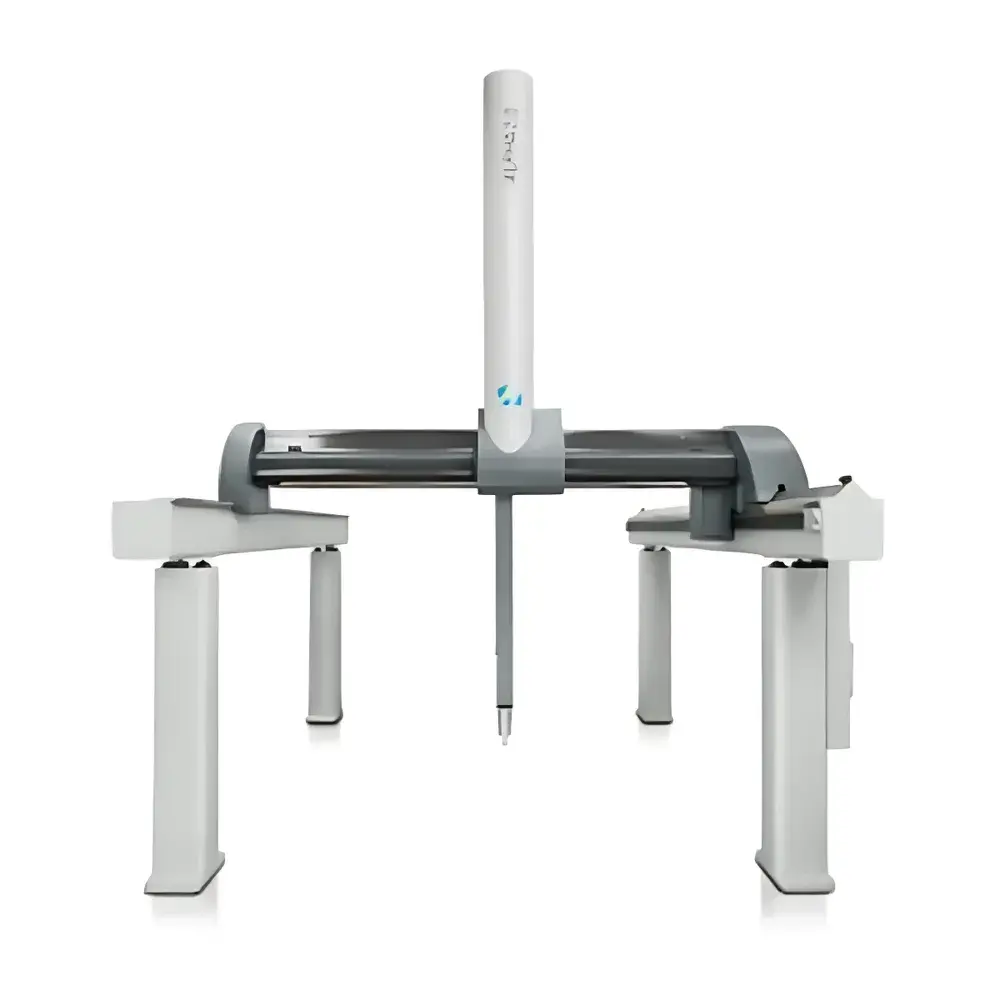
Hexagon DEA ALPHA 2.0 Bridge Coordinate Measuring Machine
| Brand | Hexagon |
|---|---|
| Type | Bridge CMM |
| Structural Design | 龙门式 (Bridge-type) |
| Measurement Volume Range | 2000×3300×1000 mm to 2500×5000×2000 mm |
| Z-Axis Material | Ceramic |
| Y-Axis Technology | Inclined Bridge Structure |
| Drive System | DC Servo Motors on All Axes |
| Encoder System | Dual Read-Head / Dual Scale (ALPHA 2.0 Performance) |
| Dynamic Accuracy (E0) | Starting from 3.5 µm |
| Compliance | ISO 10360-2, ISO 10360-8, VDI/VDE 2617 |
| Enclosure Options | Bellows Covers & Full Environmental Enclosures |
| Multi-Sensor Capability | Yes (Touch-trigger, Scanning, Optical, Laser Line Probes) |
Overview
The Hexagon DEA ALPHA 2.0 Bridge Coordinate Measuring Machine is an industrial-grade metrology platform engineered for high-accuracy geometric measurement of large and heavy components in demanding production and quality assurance environments. Based on the proven bridge architecture — optimized for stability, thermal robustness, and dynamic performance — the ALPHA 2.0 series delivers traceable dimensional verification across volumetric workspaces ranging from 2,000 × 3,300 × 1,000 mm up to 2,500 × 5,000 × 2,000 mm. Its design adheres to fundamental principles of coordinate metrology: orthogonal axis alignment, minimal Abbe error through optimized encoder placement, and thermally stable structural materials including aluminum alloy frames and a high-rigidity ceramic Z-axis. The system operates under ISO 10360-2 (length measurement error) and ISO 10360-8 (scanning probing error) compliance, supporting calibration traceability to national standards bodies (e.g., NIST, PTB, NPL). It serves as a primary or secondary reference instrument in automotive body-in-white inspection, aerospace structural component verification, heavy machinery casting validation, and satellite subsystem dimensional control.
Key Features
- Aluminum alloy structural framework providing optimal stiffness-to-weight ratio and inherent damping characteristics for vibration suppression during high-speed scanning.
- Inclined bridge (‘slanted girder’) Y-axis design enhancing torsional rigidity and minimizing deflection under load — critical for maintaining probe tip accuracy across full travel.
- Ceramic Z-axis with low coefficient of thermal expansion (CTE ≈ 0.5 × 10⁻⁶/K), delivering long-term thermal stability and reduced drift during extended measurement cycles in non-climate-controlled shop floors.
- Dual read-head / dual optical scale system (standard on ALPHA 2.0 Performance) compensating for angular errors (pitch/yaw) and reducing Abbe offset-induced uncertainty by >40% compared to single-scale configurations.
- DC servo motor drive on all three axes ensuring smooth acceleration/deceleration profiles, consistent repeatability (<0.5 µm), and compatibility with high-duty-cycle automated inspection routines.
- Modular probe interface supporting tactile trigger, analog scanning, optical fringe projection, and laser line sensors — enabling seamless transition between discrete point capture and dense surface digitization (up to 2 million points/second with compatible scanning heads).
Sample Compatibility & Compliance
The ALPHA 2.0 accommodates parts weighing up to 3,000 kg (depending on configuration and floor mounting integrity), including cast iron engine blocks, aluminum aircraft wing ribs, composite satellite panels, and large-scale tooling fixtures. Its open bridge layout permits unobstructed access for overhead cranes, AGV-integrated part loading, and integration with conveyor-based part transfer systems. All variants meet ISO 10360-2 MPEP specifications per declared volume, with E₀ volumetric accuracy starting at 3.5 µm (as verified per ISO 10360-2 Annex B using calibrated step gauges and ball bars). Optional environmental enclosures conform to IP54 ingress protection and support operation in ambient temperatures from 15–25 °C ±1 °C/hour drift, satisfying requirements for GLP-compliant dimensional release testing in regulated manufacturing (e.g., AS9100 Rev D, IATF 16949).
Software & Data Management
Controlled via PC-DMIS Metrology Software (v2023R2 or later), the ALPHA 2.0 supports full GD&T evaluation per ASME Y14.5-2018 and ISO 1101:2017, including profile, position, runout, and composite tolerance analysis. Audit-trail functionality complies with FDA 21 CFR Part 11 requirements when deployed in pharmaceutical or medical device manufacturing settings. Measurement programs are version-controlled, digitally signed, and exportable in standard formats (XML, STEP AP242, QIF). Raw point cloud data is natively compatible with third-party reverse engineering platforms (e.g., Geomagic Design X, PolyWorks Inspector) and statistical process control (SPC) dashboards via OPC UA or RESTful API interfaces.
Applications
- Automotive: Body-in-white dimensional audit, powertrain housing Cpk validation, stamping die verification.
- Aerospace: Wing spar straightness assessment, turbine blade root geometry certification, composite layup tooling inspection.
- Energy: Wind turbine gearbox casing alignment, nuclear valve body concentricity checks.
- Heavy Industry: Mining equipment frame squareness, railcar bogie dimensional conformance, shipbuilding segment assembly verification.
- Tool & Die: Injection mold cavity surface fidelity analysis, progressive die strip progression validation.
FAQ
What is the standard volumetric accuracy specification for the ALPHA 2.0 Classic model?
The ALPHA 2.0 Classic achieves a base volumetric accuracy (E₀) of ≤4.5 µm per ISO 10360-2, scalable downward with optional high-precision scale upgrades and environmental stabilization.
Can the ALPHA 2.0 be integrated into an automated factory cell?
Yes — it supports Ethernet/IP, PROFINET, and OPC UA protocols for PLC synchronization, robotic part handling coordination, and MES-level data exchange.
Is thermal compensation available as a factory option?
The ALPHA 2.0 Performance variant includes a multi-sensor temperature monitoring system (12-point ambient + structural sensing) feeding real-time corrections to the motion controller — fully compliant with ISO 10360-8 Annex C.
What certifications apply to its software validation package?
PC-DMIS IQ-RM (IQ-Risk Management) documentation supports IQ/OQ/PQ execution per GAMP 5 guidelines, with full 21 CFR Part 11 electronic signature and audit trail validation kits available upon request.
Does Hexagon provide on-site installation and acceptance testing?
All ALPHA 2.0 systems include factory pre-acceptance, certified site survey, foundation verification, laser tracker-assisted geometric calibration (per VDI/VDE 2617 Blatt 1 & 2), and final ISO 10360-2 verification conducted by Hexagon-certified metrologists.