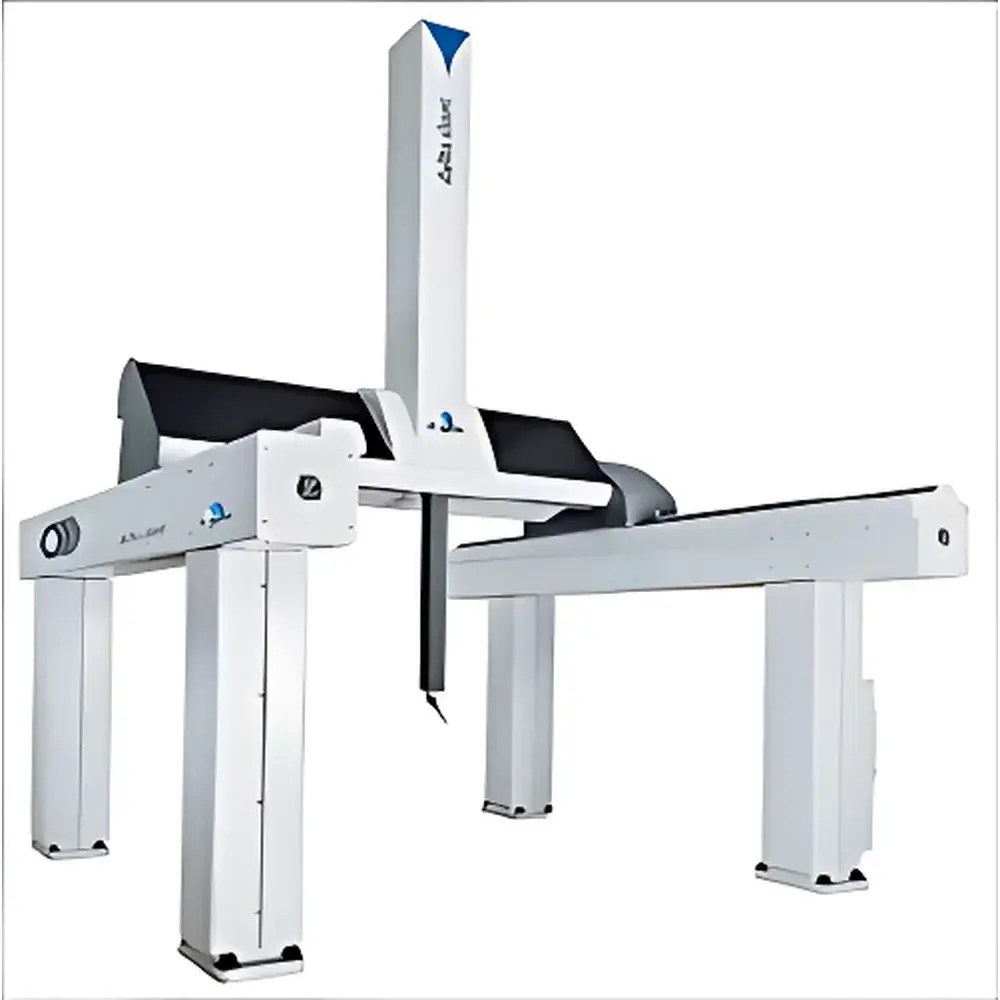
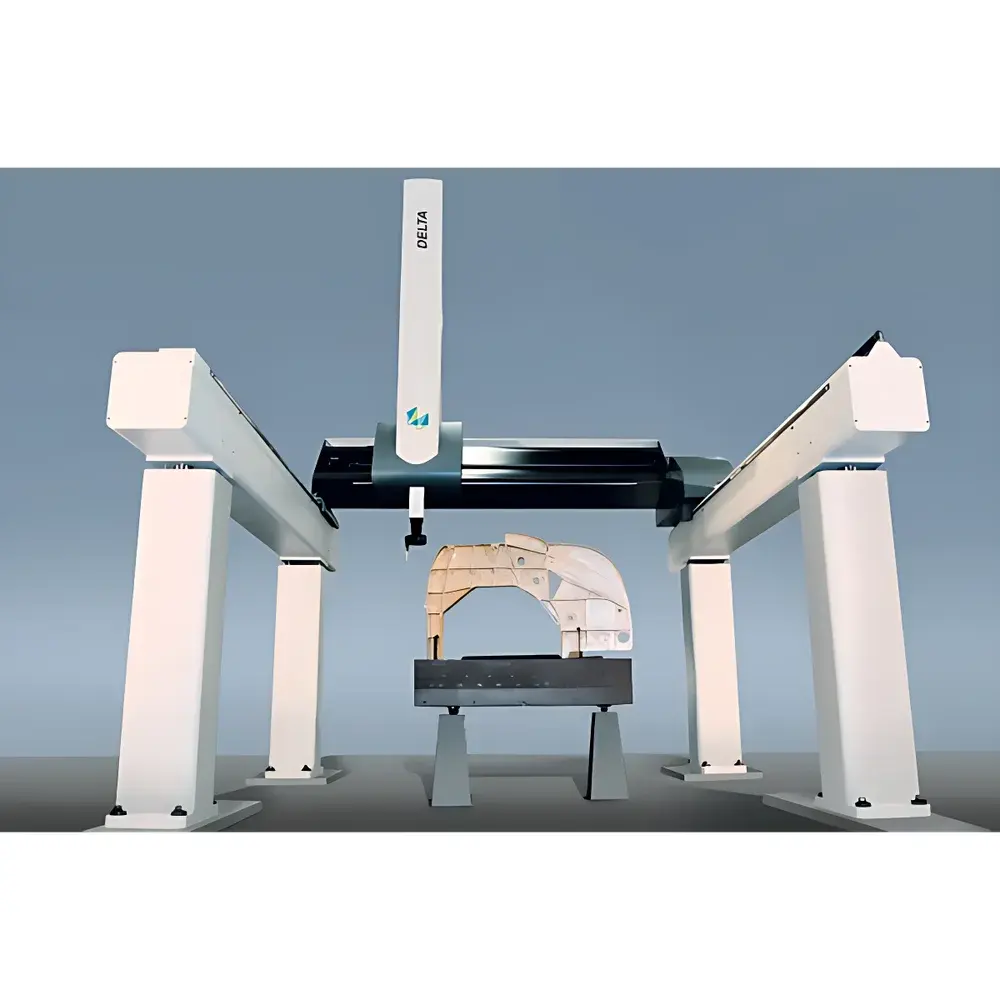
Hexagon Metrology DELTA SLANT High-Precision Gantry Coordinate Measuring Machine
| Brand | Hexagon |
|---|---|
| Origin | Italy |
| Model | DELTA SLANT |
| Configuration | Gantry (Vertical) |
| Operation | Automatic |
| Structural Type | Bridge-style gantry |
| Measurement Volume | ≥2500 × 3300 × 2000 mm |
| Volumetric Accuracy | Starting from 3.5 μm |
| Core Technology | Dual-encoder Y-axis bridge, SiC Z-axis (Performance variant), Certified high-resolution optical encoder system, 26-parameter geometric error compensation |
| Environmental Tolerance | Shop-floor capable (16–26 °C) with optional Shop Floor Kit |
| Compliance | ISO 10360-2, ISO 15530-3, VDI/VDE 2617, ASME B89.4.1 |
Overview
The Hexagon Metrology DELTA SLANT is a high-precision, vertically oriented gantry coordinate measuring machine (CMM) engineered for dimensional metrology of large-scale industrial components. Based on the proven gantry architecture—optimized over four decades for automotive body-in-white, aerospace structural assemblies, heavy transport frames, and satellite subsystems—the DELTA SLANT delivers metrological integrity at scale. Its measurement principle relies on calibrated, traceable displacement sensing across three orthogonal axes (X, Y, Z), where position data is acquired via certified high-resolution optical encoders and processed using advanced kinematic modeling. Unlike conventional bridge CMMs, the DELTA SLANT employs a slanted Y-axis bridge (“slant” geometry), which enhances structural stiffness while minimizing dynamic deflection during high-speed probing. This design, combined with dual read-heads on the primary Y-axis guideway and a lightweight, high-modulus silicon carbide (SiC) Z-axis in the Performance variant, ensures long-term stability, thermal robustness, and sub-micron repeatability across volumetric workspaces exceeding 2.5 m × 3.3 m × 2.0 m.
Key Features
- Slanted Y-axis bridge architecture—provides superior rigidity-to-mass ratio and reduced inertial loading during motion
- Dual optical encoder read-heads on the Y-axis—eliminates Abbe error and improves pitch/yaw compensation fidelity
- Silicon carbide (SiC) Z-axis column (Performance models)—offers exceptional thermal stability, low coefficient of thermal expansion (CTE ≈ 4.5 × 10⁻⁶ /°C), and high elastic modulus (>400 GPa)
- 26-parameter real-time geometric error compensation—applies calibrated corrections for squareness, straightness, roll/pitch/yaw, and scale errors per ISO 10360-2 Annex D
- Shop Floor Kit option—enables operation in non-climate-controlled environments (16–26 °C) with active temperature monitoring and adaptive compensation
- DC servo motor drive system across all axes—ensures smooth acceleration profiles, low vibration, and precise velocity control for scanning and point-based measurement
- Integrated bellows and full enclosure—protects guideways and encoders from dust, coolant mist, and particulate contamination in production-floor settings
Sample Compatibility & Compliance
The DELTA SLANT accommodates parts ranging from monolithic airframe sections and turbine casings to welded chassis assemblies and composite satellite panels. Its open gantry layout supports integration with automated loading systems—including overhead cranes, AGVs, and pallet changers—without requiring structural modifications to the facility floor. The machine conforms to international metrological standards including ISO 10360-2 (CMM acceptance and reverification tests), ISO 15530-3 (calibration using calibrated workpieces), VDI/VDE 2617 Parts 2 and 9 (volumetric accuracy and probing performance), and ASME B89.4.1-2019. All delivered systems include factory calibration certificates traceable to national metrology institutes (NMI), and optional GLP/GMP-compliant audit trails are available via PC-DMIS Enterprise Edition with 21 CFR Part 11 electronic signature support.
Software & Data Management
Controlled by Hexagon’s PC-DMIS platform, the DELTA SLANT supports both offline programming and real-time adaptive measurement strategies. PC-DMIS provides full GD&T evaluation per ISO 1101 and ASME Y14.5, statistical process control (SPC) reporting, and cloud-enabled data synchronization via Hexagon’s SmartLine ecosystem. Measurement programs can be validated using digital twin simulation prior to physical execution, reducing risk of collision and optimizing path efficiency. Raw point cloud data is stored in standardized formats (e.g., ASCII I++ DME, STEP AP242), ensuring interoperability with CAD/CAM platforms such as Siemens NX, CATIA, and PTC Creo. Audit logs—including operator ID, timestamp, probe calibration history, environmental readings, and parameter changes—are retained for regulatory review cycles.
Applications
- Aerospace: Dimensional verification of wing spars, fuselage frames, and engine nacelles against CAD nominal geometry
- Automotive: First-article inspection of stamping dies, body-in-white fixtures, and battery module housings
- Energy: Geometric validation of wind turbine blade root joints and nuclear containment flange interfaces
- Rail & Heavy Transport: Alignment assessment of bogie frames, coupler assemblies, and modular carbody sections
- Defense & Space: Metrology of radar reflector surfaces, antenna support structures, and launch vehicle fairings
FAQ
What is the minimum certified volumetric accuracy achievable on the DELTA SLANT?
The base accuracy specification starts at 3.5 µm + L/250 (where L is measured in mm), verified per ISO 10360-2 using calibrated step gauges and sphere artifacts.
Can the DELTA SLANT operate without climate control?
Yes—when equipped with the optional Shop Floor Kit, it maintains compliance within 16–26 °C ambient range using real-time temperature gradient mapping and multi-point thermal compensation algorithms.
Is the SiC Z-axis standard or optional?
Silicon carbide construction is exclusive to the DELTA SLANT Performance configuration; Classic models use high-grade granite-reinforced aluminum alloy.
Does the system support automated probe changing?
Yes—it integrates seamlessly with Hexagon’s MCR20 or PH20 multi-sensor heads and supports up to 20 probe configurations via automatic rack changers.
How is traceability maintained across calibration cycles?
Each delivery includes NIST-traceable calibration reports, and annual reverification follows ISO 17025-accredited procedures performed by Hexagon-certified service engineers.