
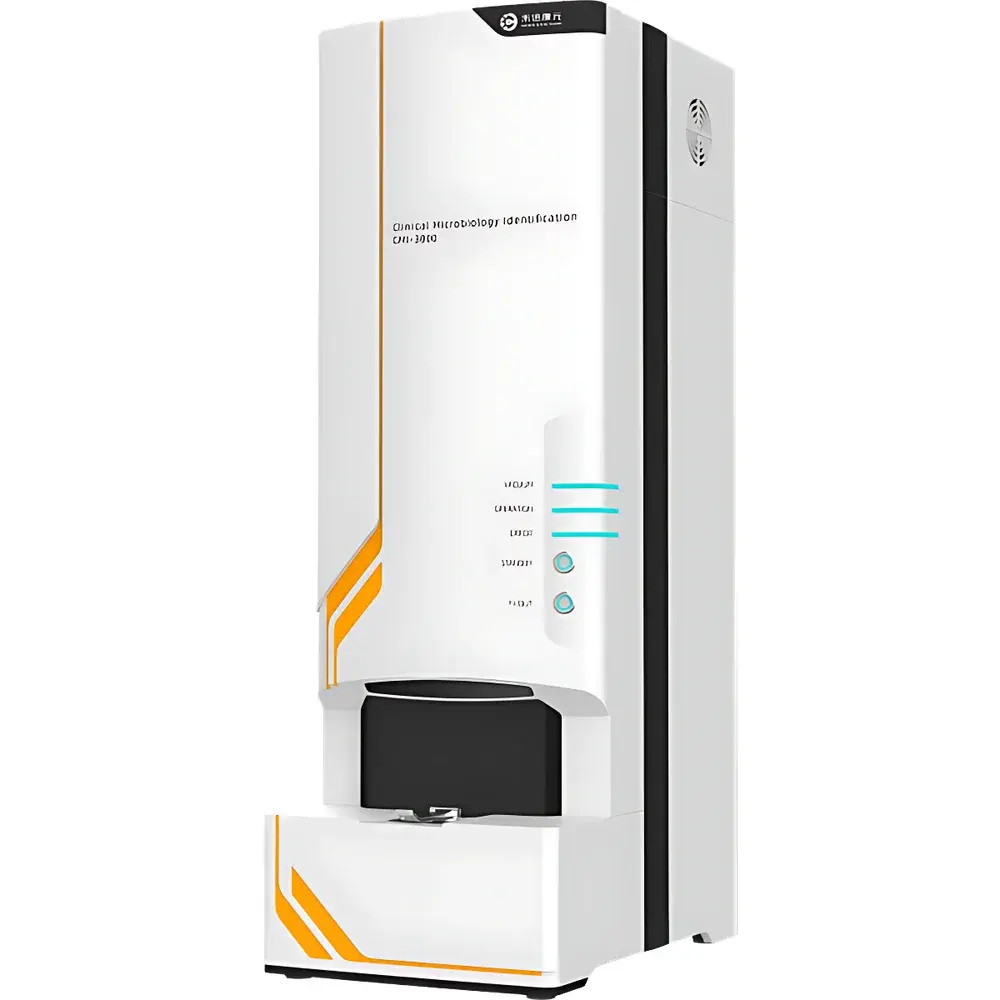
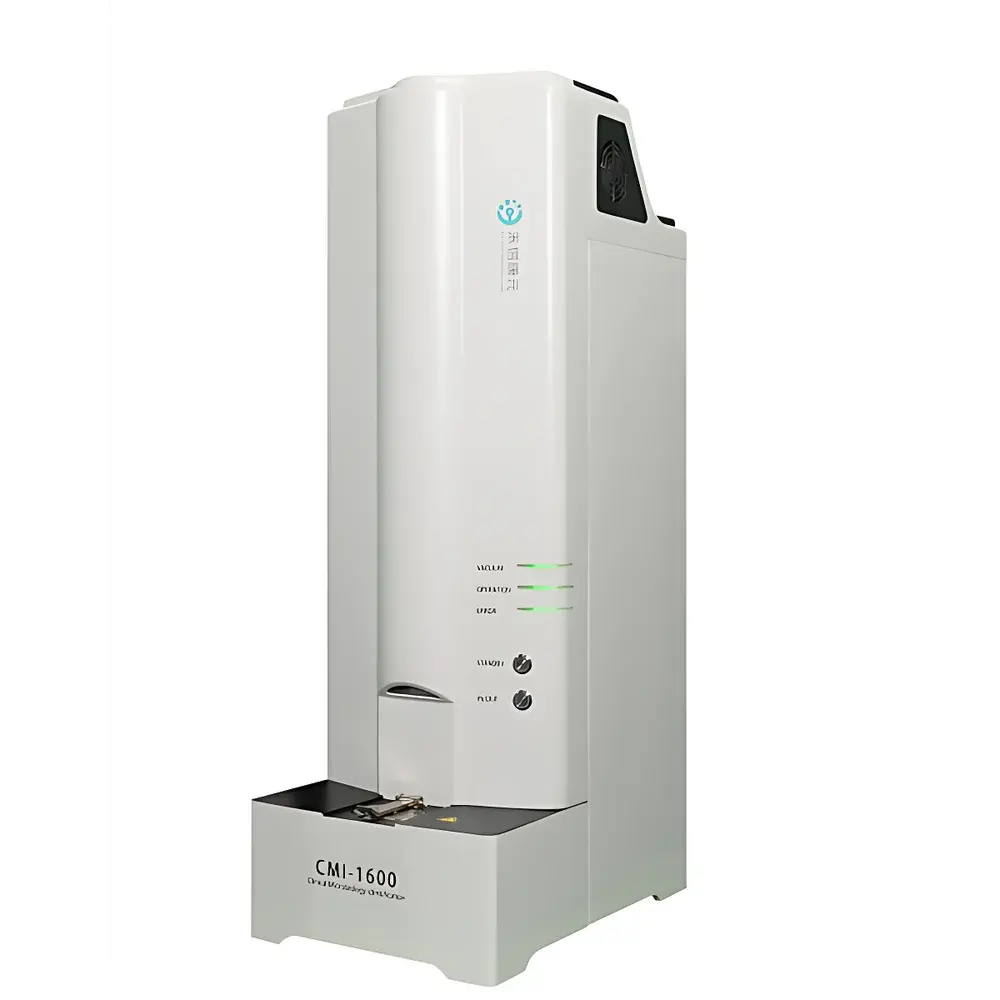
HEXIN KANGYUAN CMl-1600 / CMl-3800 Automated Microbial Mass Spectrometry System
| Brand | HEXIN KANGYUAN |
|---|---|
| Origin | Guangdong, China |
| Manufacturer Type | Authorized Distributor |
| Instrument Type | Time-of-Flight (TOF) Mass Spectrometer |
| Application Domain | Medical Device Testing & Clinical Microbiology |
| Model | CMl-1600 / CMl-3800 |
| Laser Source | 2000 Hz Solid-State Laser |
| Ionization Method | Matrix-Assisted Laser Desorption/Ionization (MALDI) |
| Database Capacity | >68,000 Strain Spectra Across 3,500+ Microbial Species |
| Vacuum System | Integrated High-Speed Turbomolecular Pumping Architecture |
| Software | MALDI Biotyper–Compatible Control & Analysis Suite with Custom Library Builder |
Overview
The HEXIN KANGYUAN CMl-1600 and CMl-3800 Automated Microbial Mass Spectrometry Systems are benchtop time-of-flight (TOF) mass spectrometers engineered for rapid, high-confidence identification of microorganisms in clinical, regulatory, and industrial microbiology laboratories. Based on matrix-assisted laser desorption/ionization (MALDI) principles, the system ionizes intact microbial cells directly from colony material deposited on a target plate, generating characteristic peptide-mass fingerprint spectra within seconds per sample. Unlike conventional biochemical or nucleic acid–based identification methods—which require extended incubation, reagent kits, or sequencing workflows—the CMl series delivers species-level identification in under 5 minutes post-sample preparation, with analytical throughput exceeding 100 samples per hour. The instrument’s core architecture adheres to fundamental MALDI-TOF performance requirements defined in ISO/IEC 17025–accredited microbiology testing environments and aligns with FDA guidance for MALDI-based pathogen identification in medical device sterility assurance programs.
Key Features
- 2000 Hz solid-state laser source with >109 shot lifetime—eliminates consumable nitrogen laser replacement and ensures long-term signal stability across daily clinical operation.
- Patented dual-pulse delayed ion extraction technology enhances mass resolution across the full m/z range (1,000–20,000 Da), particularly critical for distinguishing closely related species such as Streptococcus pneumoniae vs. S. mitis or Escherichia coli vs. Shigella spp.
- Optimized optical path design featuring sub-5° laser incidence angle minimizes initial ion spatial dispersion, improving both peak shape fidelity and signal-to-noise ratio at low-abundance biomarkers.
- Modular vacuum architecture integrates a high-speed turbomolecular pump and oil-free backing pump, enabling automatic pressure stabilization and immediate spectral acquisition upon target insertion—no manual venting or pump-down delays.
- Adjustable laser fluence and spot size control allow fine-tuned energy delivery for diverse sample types (e.g., Gram-positive cocci, filamentous fungi, or biofilm-derived isolates), preserving spectral reproducibility without matrix over-saturation.
Sample Compatibility & Compliance
The CMl series supports direct analysis of isolated colonies grown on standard non-selective media (e.g., blood agar, chocolate agar, Mueller-Hinton), including fastidious organisms requiring CO2-enriched conditions. It is validated for use with common MALDI matrices (e.g., α-cyano-4-hydroxycinnamic acid) and compatible with automated colony picking interfaces for integration into LIMS-driven workflows. Regulatory documentation includes conformity with IEC 61010-1 (Safety Requirements for Electrical Equipment) and electromagnetic compatibility (EMC) compliance per CISPR 11. While not CE-IVD marked, the system meets technical prerequisites for inclusion in ISO 15189–accredited clinical microbiology laboratories when operated under documented SOPs aligned with CLSI MM19-A and EUCAST guidelines. Data integrity safeguards support audit readiness for GLP/GMP environments, including user access controls and electronic signature capability.
Software & Data Management
The integrated software suite provides end-to-end workflow management—from instrument calibration and spectral acquisition to database matching and report generation. It incorporates an authorized, CDC-curated reference library containing >68,000 strain-specific spectra across 3,500+ bacterial, fungal, and yeast taxa—validated against ATCC and NCTC type strains. Users may create, edit, and version-control custom libraries using the built-in Library Builder module, enabling lab-specific expansion with in-house isolates (e.g., environmental monitoring strains or device-associated biofilm variants). Offline analysis tools support peak annotation, spectral subtraction, and hierarchical clustering for strain-level differentiation. All data files adhere to mzML open format standards, ensuring interoperability with third-party bioinformatics platforms. Audit trails record every user action—including spectrum acquisition parameters, database search settings, and library modifications—in accordance with 21 CFR Part 11 requirements for electronic records.
Applications
- Routine identification of aerobic and anaerobic bacteria, yeasts, and molds in clinical diagnostic laboratories.
- Microbial characterization in medical device bioburden testing and sterilization validation studies per ISO 11737-1.
- Environmental monitoring of cleanrooms and aseptic processing facilities (ISO 14644-1 Class 5–8).
- Antimicrobial resistance (AMR) marker screening via detection of modified ribosomal proteins or acquired resistance peptides (e.g., vancomycin resistance in enterococci).
- Strain typing and outbreak investigation through spectral pattern comparison and principal component analysis (PCA).
FAQ
Does the CMl system support FDA 21 CFR Part 11 compliance?
Yes—the software implements role-based user authentication, electronic signatures, and immutable audit trails for all analytical and administrative actions.
Can the system be integrated with laboratory information management systems (LIMS)?
Yes—via HL7 v2.x or ASTM E1384-compliant interfaces for bidirectional result transfer and sample tracking.
Is the reference database updated regularly?
Database updates are issued quarterly by HEXIN KANGYUAN, incorporating newly validated spectra from CDC collaborations and peer-reviewed taxonomic revisions.
What maintenance is required beyond routine cleaning?
No laser replacement is needed; annual calibration verification and vacuum pump oil change (if applicable) constitute the primary scheduled maintenance.
How does the system handle mixed or contaminated cultures?
Advanced deconvolution algorithms enable detection and separation of dominant and subdominant peaks, though pure isolation remains the recommended pre-analytical standard per CLSI guidelines.
Related Products





