
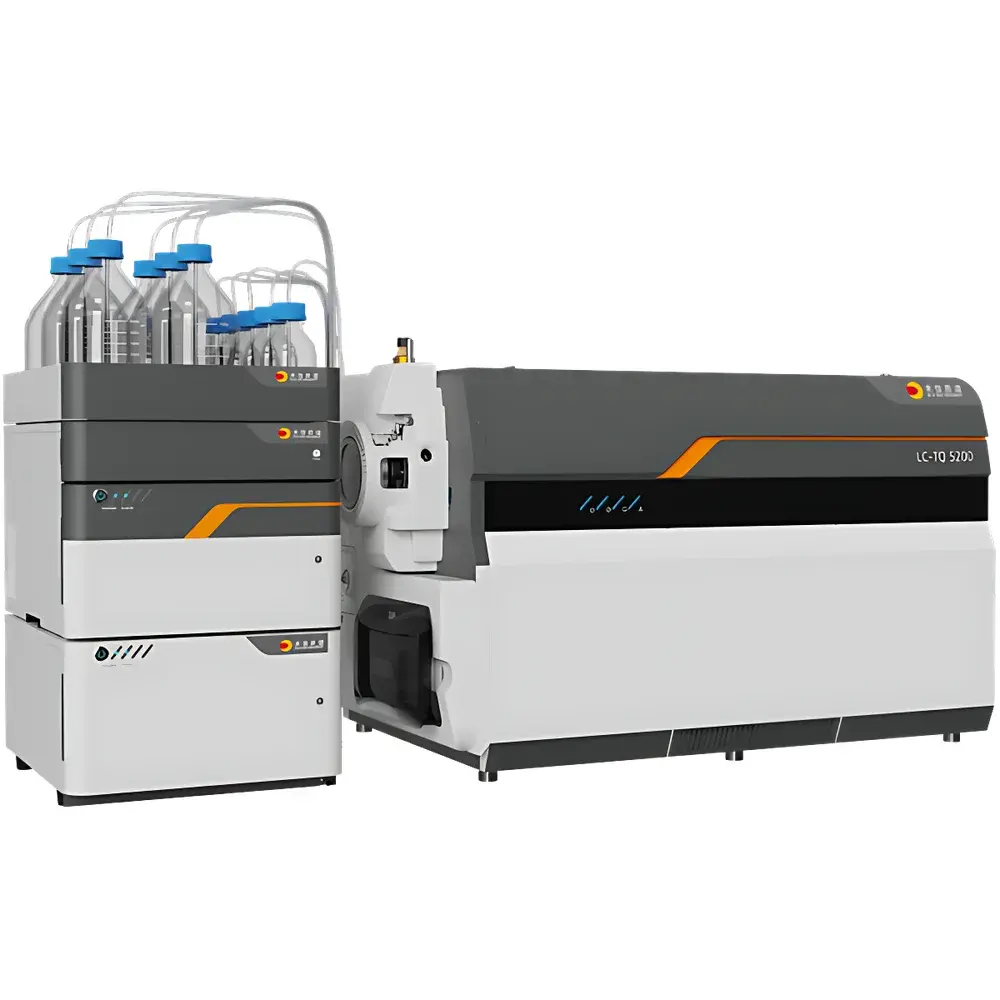
HEXIN MASS SPECTROMETRY LC-TQ 5200 Triple Quadrupole Liquid Chromatography–Mass Spectrometer
| Brand | HEXIN MASS SPECTROMETRY |
|---|---|
| Origin | Guangdong, China |
| Manufacturer Type | Authorized Distributor |
| Product Category | Domestic |
| Model | LC-TQ 5200 |
| Instrument Type | Triple Quadrupole (Tandem Quadrupole) |
| Application Scope | General-Purpose |
| Mass Range | Available upon request |
| Sensitivity | Available upon request |
| Resolution | Available upon request |
| Mass Accuracy | Available upon request |
| Operating Pressure Range | Available upon request |
Overview
The HEXIN MASS SPECTROMETRY LC-TQ 5200 is a fully domestic triple quadrupole liquid chromatography–mass spectrometry (LC-MS/MS) system engineered for high-performance quantitative and confirmatory analysis of organic compounds in complex matrices. Built on a robust tandem quadrupole architecture, the instrument operates on the principle of selected reaction monitoring (SRM) and multiple reaction monitoring (MRM), enabling exceptional specificity, dynamic range, and reproducibility in trace-level detection. Its design integrates fundamental advances in ion optics, vacuum engineering, and RF electronics—culminating in a production-ready platform where critical subsystems—including the electrospray ionization (ESI)/atmospheric pressure chemical ionization (APCI) source, triple quadrupole mass filter, and high-stability RF power supply—are independently developed and manufactured in China. The LC-TQ 5200 is intended for laboratories requiring regulatory-compliant, routine quantitative workflows across food safety, environmental monitoring, clinical toxicology, forensic science, and cosmetics testing.
Key Features
- Modular, Tool-Free Ion Source Switching: A proprietary source interface eliminates pneumatic or mechanical coupling between the LC system and ion source. ESI and APCI sources can be interchanged manually in under 2 minutes without breaking vacuum—minimizing instrument downtime and enhancing method flexibility.
- Three-Stage Differential Vacuum System: Combines a high-capacity rotary vane backing pump with long-life turbomolecular pumps to achieve operational vacuum (<1×10⁻⁵ mbar in Q0 region) within <15 minutes after cold start, ensuring stable ion transmission and consistent detector response.
- Optimized Ion Transmission Pathway: Incorporates curtain gas-assisted cone interface, multi-stage ion focusing optics, and linear acceleration collision cell design—collectively improving ion duty cycle and signal-to-noise ratio by up to two orders of magnitude relative to conventional configurations.
- Platinum-Gold Coated Quadrupole Rods: Q1 and Q3 feature precision-machined metal rods with electroplated platinum-gold surface finish and integrated pre-filters. This configuration enhances resistance to matrix-induced contamination, extends service intervals beyond 12 months under continuous operation, and maintains mass axis stability over extended calibration cycles.
- Integrated Nitrogen Gas Generation Architecture: Onboard nitrogen generator supplies all required gases—including nebulizer, heater, sheath, and collision gases—eliminating dependency on external high-pressure cylinders and reducing operational cost and logistical complexity.
- Intuitive Instrument Control Software: The LC-TQ 5200 workstation supports automated tuning, MRM method building, batch processing, and real-time data review. All software modules comply with audit trail requirements per FDA 21 CFR Part 11 when deployed in validated environments.
Sample Compatibility & Compliance
The LC-TQ 5200 accommodates standard reversed-phase, HILIC, and ion-pairing LC methods using C18, phenyl-hexyl, and pentafluorophenyl (PFP) columns (1.0–4.6 mm i.d., 50–250 mm length). It interfaces seamlessly with common UHPLC systems via standard analog/digital I/O and vendor-neutral API protocols. Method validation documentation aligns with ISO/IEC 17025:2017 principles and supports compliance with regulatory frameworks including USP <1225>, ICH Q2(R2), and GLP/GMP Annex 11. Instrument qualification packages include IQ/OQ/PQ protocols adaptable to laboratory-specific SOPs.
Software & Data Management
Data acquisition and processing are performed using HEXIN’s proprietary LC-MS/MS Workstation v3.x, which provides full control over LC gradient timing, MS scan functions, dwell time optimization, and post-run peak integration. Raw data files adhere to open mzML format for third-party compatibility. Audit trail functionality records user actions, parameter changes, and report generation events with immutable timestamps. Electronic signatures, role-based access control, and secure database backup options are configurable to meet FDA 21 CFR Part 11 and EU Annex 11 requirements.
Applications
The LC-TQ 5200 delivers validated performance across diverse application domains:
- Food Safety: Quantification of >50 pesticide residues in leafy vegetables per GB 23200.121–2021, achieving method quantitation limits (MQL) as low as 0.001 mg/kg—tenfold below regulatory thresholds.
- Environmental Analysis: Determination of perfluoroalkyl substances (PFAS) in aqueous matrices per DB32/T 4004–2021, with linearity (R² > 0.999), precision (RSD < 8%), and recovery (85–110%) meeting statutory criteria.
- Clinical & Forensic Toxicology: Simultaneous quantification of steroid hormones in cosmetic products per GB/T 34918–2017, demonstrating LODs between 0.25–15 µg/kg and inter-day RSDs ≤ 8.77%.
- Pharmaceutical & Biomedical Research: Therapeutic drug monitoring (TDM), vitamin D metabolite profiling, and amino acid panel analysis in serum and urine samples.
FAQ
Is the LC-TQ 5200 compliant with international regulatory standards?
Yes—the system supports 21 CFR Part 11-compliant data integrity practices when configured with appropriate IT infrastructure and procedural controls.
What LC systems are compatible with the LC-TQ 5200?
It interfaces with all major UHPLC platforms via analog voltage output, digital TTL triggers, and optional Ethernet-based remote control protocols.
Does the instrument support method transfer from other triple quadrupole platforms?
MRM transition lists, retention times, and collision energies can be imported directly; minor optimization of dwell times and declustering potentials may be required due to differences in ion transmission efficiency.
What maintenance intervals are recommended for routine operation?
Ion source cleaning every 2–4 weeks (depending on sample load), quadrupole calibration quarterly, and vacuum pump oil replacement every 6 months—per manufacturer-recommended PM schedule.
Can the LC-TQ 5200 perform qualitative screening in addition to quantitative analysis?
While optimized for SRM/MRM quantitation, it supports enhanced product ion scans and scheduled MRM with precursor ion selection for targeted identification workflows.




