
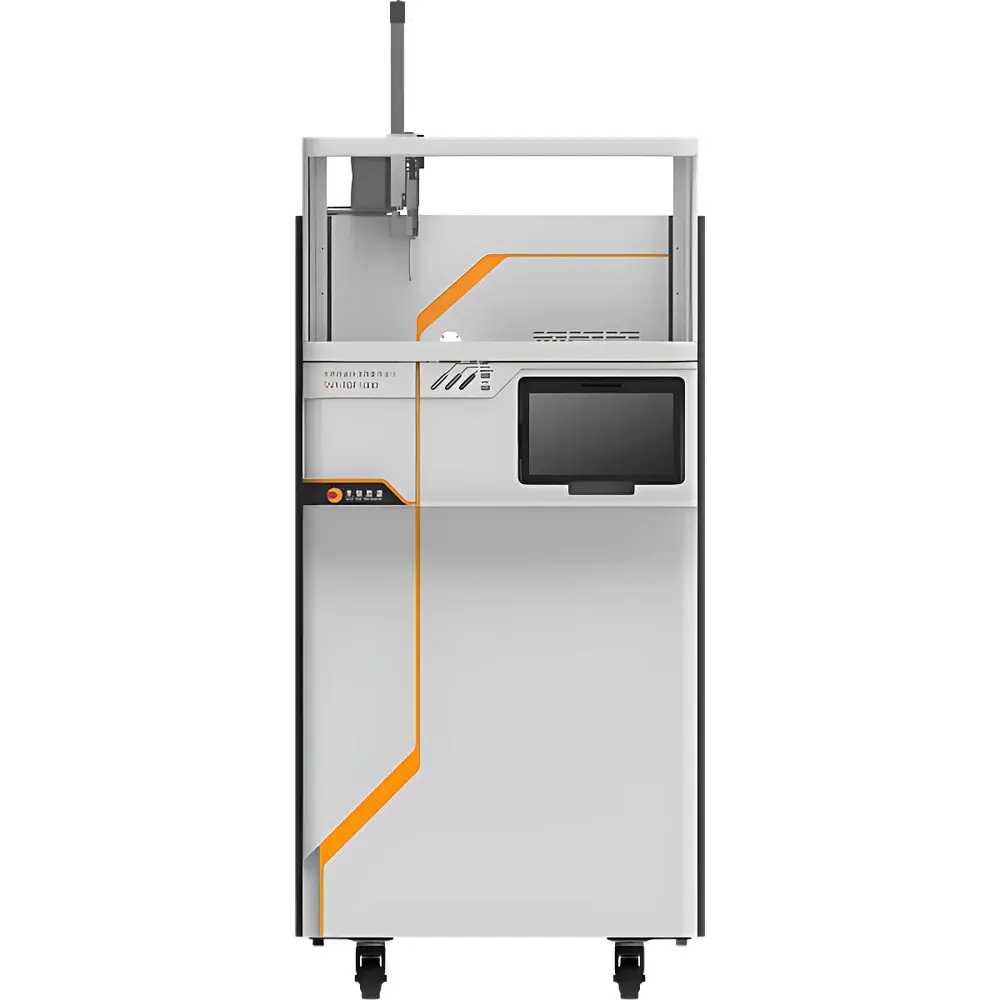
Hexin Mass Spectrometry TAPI-TOF 1000 Rapid Screening Time-of-Flight Mass Spectrometer
| Brand | Hexin Mass Spectrometry |
|---|---|
| Origin | Guangdong, China |
| Manufacturer Type | Authorized Distributor |
| Model | TAPI-TOF 1000 |
| Pricing | Available Upon Request |
| Detection Method | Thermal-Assisted Plasma Ionization (TAPI) coupled with Time-of-Flight Mass Spectrometry |
| Measurement Range | Customizable per pesticide analyte (validated per EU SANTE/11312/2021 & GB 2763-2021 guidelines) |
| Channel Capacity | High-throughput single-channel sequential analysis |
| Detection Channels | Single ionization source with multiplexed spectral acquisition |
| Measurement Uncertainty | Compliant with ISO/IEC 17025:2017 for qualitative screening |
| Limit of Detection (LOD) | Sub-ng/g level for >300 priority pesticides in matrix-matched calibration |
Overview
The Hexin Mass Spectrometry TAPI-TOF 1000 is a purpose-built rapid screening time-of-flight mass spectrometer engineered for regulatory-grade pesticide residue surveillance in food and agricultural commodities. It implements thermal-assisted plasma ionization (TAPI), a robust ambient desorption/ionization technique that enables direct, solvent-free analysis of solid and semi-solid samples—including raw fruits, leafy vegetables, dried herbs, and processed foods—without chromatographic separation or extensive sample preparation. Coupled with orthogonal acceleration time-of-flight (oa-TOF) mass analysis, the system delivers high mass resolution (>15,000 FWHM at m/z 200), accurate mass measurement (<3 ppm mass error), and sub-second spectral acquisition. Designed to meet the operational demands of national food safety monitoring programs, the TAPI-TOF 1000 supports tiered analytical workflows: primary screening (presence/absence), semi-quantitative estimation against matrix-matched standards, and confirmatory-level identification via exact mass and isotopic pattern matching.
Key Features
- Direct Ambient Ionization: TAPI source operates at atmospheric pressure with minimal thermal degradation; no derivatization, extraction, or LC/GC interfacing required.
- High-Throughput Workflow: Fully automated XYZ autosampler accommodates up to 96 vials; average cycle time ≤60 seconds per sample, enabling ≥50 analyses per hour under routine operation.
- Comprehensive Pesticide Library: Pre-loaded spectral database containing >320 reference spectra of EU Annex I, US EPA, and Chinese GB 2763-listed pesticides, curated using certified reference materials and validated in spiked food matrices.
- Robust Qualitative Engine: Proprietary algorithm integrates retention time-independent peak detection, isotope ratio validation (e.g., 37Cl/35Cl, 81Br/79Br), and mass defect filtering to achieve ≥95% positive predictive value in blind testing across 20+ fruit and vegetable matrices.
- Regulatory-Ready Architecture: Instrument control firmware and data acquisition software comply with ALCOA+ principles; audit trail, electronic signatures, and user role management support GLP and GMP-aligned laboratory practices.
Sample Compatibility & Compliance
The TAPI-TOF 1000 demonstrates validated performance on diverse food matrices including apples, tomatoes, lettuce, rice, wheat flour, honey, and infant formula. Method validation follows internationally accepted frameworks: quantitative recovery studies align with SANTE/11312/2021 criteria (70–120% recovery, RSD ≤20%), while screening sensitivity meets or exceeds MRL-based detection requirements specified in GB 2763-2021 and EU Regulation (EC) No 396/2005. The system has been deployed in provincial CDC laboratories and national food inspection centers participating in China’s National Food Safety Risk Monitoring Program (NFSP), where it serves as a Tier-1 triage tool preceding confirmatory LC-HRMS analysis. All hardware and software components are CE-marked and compliant with IEC 61010-1 for laboratory equipment safety.
Software & Data Management
Instrument operation and data evaluation are managed through Hexin’s proprietary MassAnalyzer Suite v4.2, a 21 CFR Part 11-compliant platform featuring secure user authentication, hierarchical permission levels, immutable audit trails, and encrypted raw data storage (.hdf5 format). The software includes integrated tools for spectral deconvolution, background subtraction, library matching (with customizable match thresholds), and batch reporting aligned with CNAS-CL01:2018 documentation requirements. Export options include PDF analytical reports, CSV peak tables, and mzML-compliant files for third-party reprocessing. Data integrity is preserved via SHA-256 hashing of all acquired spectra and automatic timestamping synchronized to NTP servers.
Applications
- Routine surveillance of pesticide residues in fresh produce per GB 2763-2021 compliance testing.
- Screening for unauthorized pharmaceutical adulterants in dietary supplements and traditional herbal products (e.g., sildenafil, gliclazide, captopril).
- Detection of veterinary drug residues—including β-agonists (clenbuterol, ractopamine, salbutamol) and NSAIDs (diclofenac)—in meat, milk, and aquaculture samples.
- Research applications in food authenticity, metabolite profiling, and small-molecule biomarker discovery under controlled laboratory conditions.
- Support for emergency response during foodborne outbreak investigations requiring rapid hazard identification.
FAQ
What regulatory standards does the TAPI-TOF 1000 support for pesticide screening?
It is validated per GB 2763-2021, SANTE/11312/2021, and ISO/IEC 17025:2017 for qualitative screening and semi-quantitative estimation.
Can the system quantify pesticide residues without calibration curves?
No—quantification requires matrix-matched calibration standards; however, the instrument provides reliable semi-quantitative ranking (e.g., “detected above/within/below MRL”) based on normalized ion intensity and library match confidence scores.
Is method transfer possible between different food matrices?
Yes—the TAPI ionization efficiency is matrix-tolerant; method adaptation typically requires only minor optimization of source temperature and collision energy, not full re-validation.
Does the system require daily tuning or frequent maintenance?
The oa-TOF analyzer employs solid-state reflectron optics and sealed detector vacuum; routine maintenance is limited to weekly source cleaning and quarterly mass calibration using perfluorotributylamine (PFTBA).
How is data integrity ensured during multi-user operation?
All user actions—including method edits, result approvals, and report exports—are logged with timestamps, IP addresses, and digital signatures in an encrypted audit trail compliant with 21 CFR Part 11 Subpart B.






