
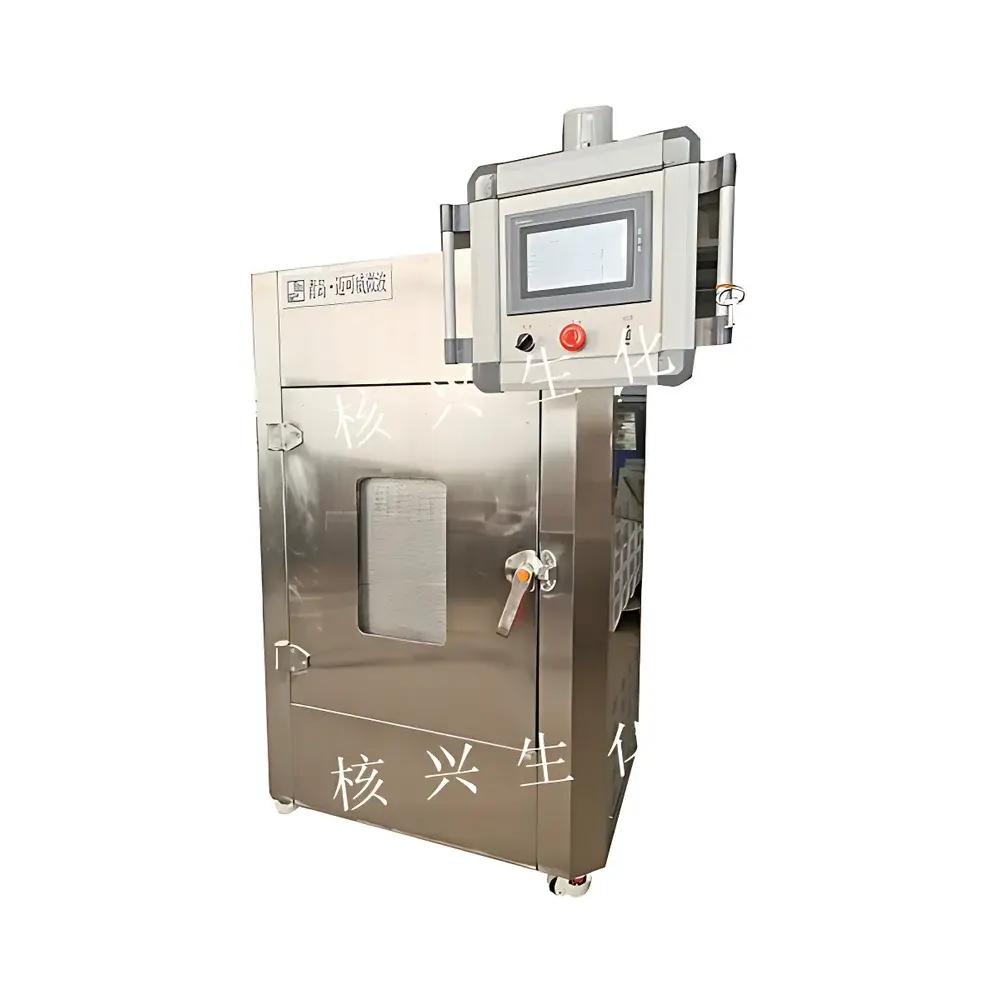
HEXING BIOCHEMICAL HXG-T225 Large-Volume Microwave-Assisted Drying Cabinet for Biological and Environmental Radioanalytical Samples
| Brand | HEXING BIOCHEMICAL |
|---|---|
| Origin | Shandong, China |
| Manufacturer Type | Authorized Distributor |
| Country of Origin | China |
| Model | HXG-T225 |
| Price Range | USD 14,000 – 42,500 |
| Microwave Power Output | 0–4800 W (continuously adjustable) |
| Operating Frequency | 2450 MHz |
| Cavity Volume | 225 L |
| Cavity Material | Seamless 304 Stainless Steel Welded Construction |
| Internal Configuration | 1–4 Removable Perforated Stainless Steel Trays |
| Temperature Measurement | Dual-mode — Thermocouple (0–1200 °C) + Infrared Pyrometer (0–500 °C) |
| Humidity Sensing | Integrated Capacitive RH Sensor |
| Airflow System | Forced Convection with Adjustable Flow Rate |
| Control System | PLC-based Intelligent Controller with 7″ Color Touchscreen |
| Data Management | Multi-step Program Storage, Real-time Temp/RH Curve Logging, USB Data Export |
| Safety Compliance | Microwave Leakage <5 mW/cm² (GB 10436-2008), Interlocked Door Switch, Overtemperature & Overpressure Protection, Explosion-Resistant Sealed Cavity, Corrosion-Resistant Enclosure |
| Dimensions (W×D×H) | 1500 × 750 × 1640 mm |
| Continuous Duty Rating | 24/7 Industrial Operation |
Overview
The HEXING BIOCHEMICAL HXG-T225 Large-Volume Microwave-Assisted Drying Cabinet is an engineered solution for rapid, controlled dehydration of biological and environmental matrices in radioanalytical laboratories. Unlike conventional conductive-heating ovens—whose thermal transfer relies on slow surface-to-core conduction—the HXG-T225 employs volumetric microwave energy absorption at 2450 MHz to excite water dipoles uniformly throughout the sample mass. This mechanism enables accelerated moisture removal while preserving radionuclide integrity and minimizing volatile loss of isotopes such as 3H, 14C, or 90Sr. Designed specifically for compliance with Chinese national standards for radiochemical analysis—including GB/T 14883.1–1994 (General Principles for Radioactivity Testing in Food) and GB 16145–1995 (γ-Spectrometric Analysis of Radionuclides in Biological Samples)—the system bridges a critical gap between sample receipt and analytical readiness. Its 225 L sealed cavity supports batch processing of heterogeneous field-collected specimens: soil cores, vegetation bundles, animal tissues, sediment slurries, and aqueous filters—all without compromising containment integrity or measurement reproducibility.
Key Features
- Volumetric microwave drying (0–4800 W, continuously adjustable) combined with programmable forced-air convection for synergistic moisture removal and uniform thermal distribution
- Seamless 304 stainless steel cavity construction with full gasketed sealing, rated for sustained micro-positive pressure operation and corrosion resistance in acidic or saline environments
- Dual-mode temperature monitoring: Type K thermocouples (0–1200 °C) for contact sensing and non-contact infrared pyrometry (0–500 °C) for real-time surface profiling
- Four-tier removable perforated stainless steel tray system—configurable for simultaneous multi-sample processing or segmented cavity zoning per matrix density or moisture content
- PLC-integrated intelligent control architecture with embedded logic for adaptive endpoint detection: automatic transition from high-power drying to low-power conditioning based on real-time RH decay rate
- Industrial-grade 24-hour continuous duty rating, validated for unattended overnight operation under GLP-aligned logging protocols
- Comprehensive safety architecture including door interlock circuitry, dual overtemperature cutoffs, microwave leakage shielding (<5 mW/cm² per GB 10436-2008), and explosion-resistant cavity design
Sample Compatibility & Compliance
The HXG-T225 accommodates diverse sample formats common in environmental radioecology and nuclear medicine support labs: wet plant tissues (e.g., moss, lichen, grass), homogenized animal organs, filter papers loaded with airborne particulates, centrifuged sludge pellets, and ion-exchange resins. Its sealed micro-positive pressure environment prevents cross-contamination and suppresses aerosol generation during desiccation—critical when handling alpha-emitting nuclides. The system meets functional requirements outlined in ISO/IEC 17025:2017 for method validation in accredited testing laboratories and aligns with operational expectations in USP (Radiopharmaceuticals) and IAEA Technical Reports Series No. 481 (Environmental Sample Preparation for Radionuclide Analysis). All control firmware logs are timestamped and user-identifiable, supporting audit trails required under GLP and GMP frameworks.
Software & Data Management
The 7-inch color touchscreen interface hosts a deterministic PLC runtime engine supporting up to 32 preloaded drying profiles, each configurable with up to 8 time-temperature-humidity segments. Real-time graphical display overlays temperature curves (thermocouple + IR), relative humidity decay, and microwave power modulation. Data export occurs via USB 2.0 in CSV format, retaining metadata including operator ID, start/stop timestamps, cavity pressure readings, and alarm event logs. No cloud connectivity or remote access is implemented—ensuring data sovereignty and compliance with institutional IT security policies governing radiological data handling.
Applications
- Rapid volume reduction of field-collected biosamples prior to gamma spectrometry or alpha/beta counting
- Pre-concentration of liquid effluents (e.g., wastewater filtrates, leachates) onto quartz fiber filters
- Stabilization of organic-rich sediments for subsequent acid digestion and ICP-MS analysis
- Drying of calibration standards containing 137Cs or 60Co in cellulose or resin matrices
- Conditioning of air sampling filters prior to gross alpha/beta screening per EPA Method 900
- Supporting QA/QC workflows in nuclear power plant environmental monitoring programs
FAQ
Does the HXG-T225 comply with international electromagnetic safety standards beyond Chinese GB specifications?
Yes—the microwave shielding design exceeds IEC 61000-4-3 immunity requirements and conforms to EN 50147-1 for industrial microwave equipment. Leakage testing follows CISPR 11 procedures.
Can the system be integrated into a laboratory’s existing LIMS or ELN infrastructure?
Direct API integration is not supported; however, exported CSV files contain structured columns compatible with common LIMS import modules (e.g., LabWare, Thermo Fisher SampleManager).
What maintenance intervals are recommended for the magnetron and waveguide assembly?
Magnetron service life is rated at ≥5000 hours under nominal load. Quarterly visual inspection of waveguide flanges and annual RF performance verification using calibrated leakage detector are advised.
Is the cavity suitable for ashing or calcination applications?
No—the HXG-T225 is optimized for moisture removal only. It lacks the insulation, refractory lining, and oxygen-controlled atmosphere required for high-temperature ashing. For combustion-based sample preparation, refer to dedicated muffle furnaces compliant with ASTM D3174.
How does the system handle samples with heterogeneous moisture distribution, such as root-soil composites?
The combination of volumetric microwave coupling and directional airflow ensures penetration depth sufficient for 5–8 cm stratified layers. Pre-treatment homogenization is still recommended for quantitative recovery studies.



