
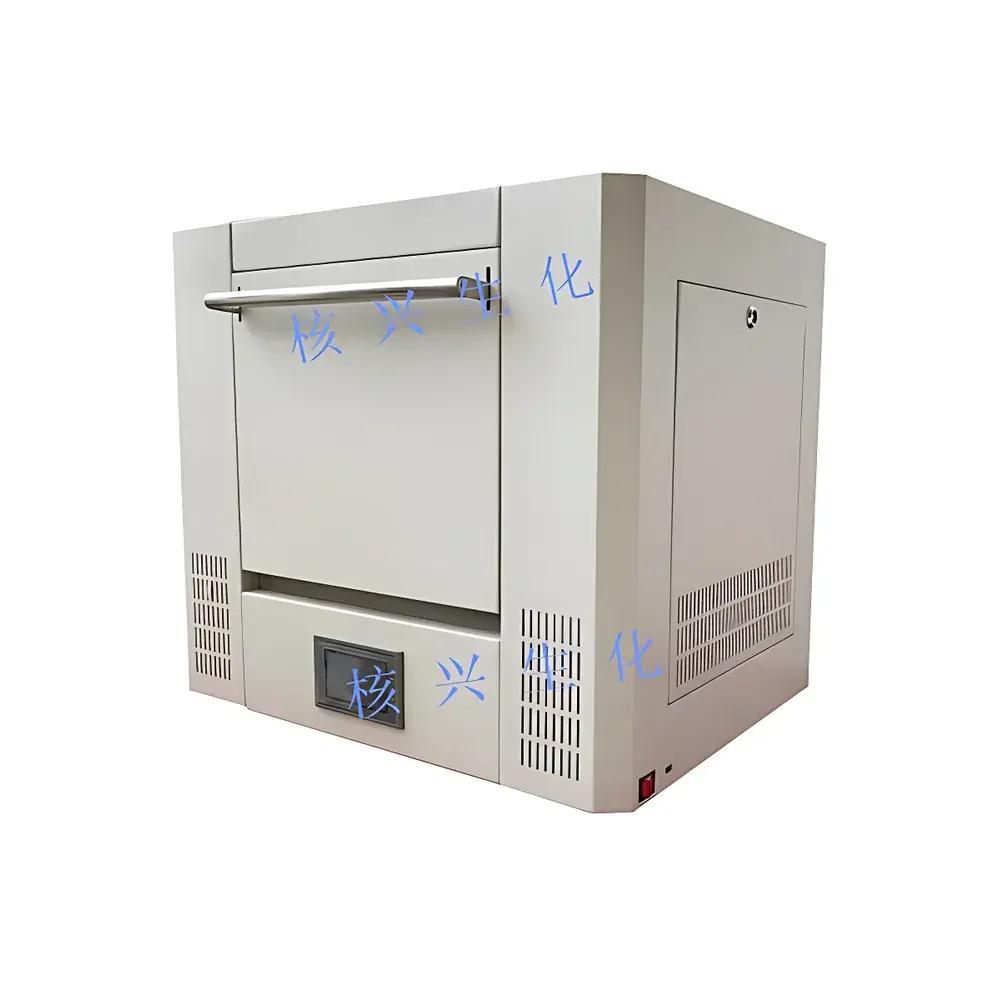
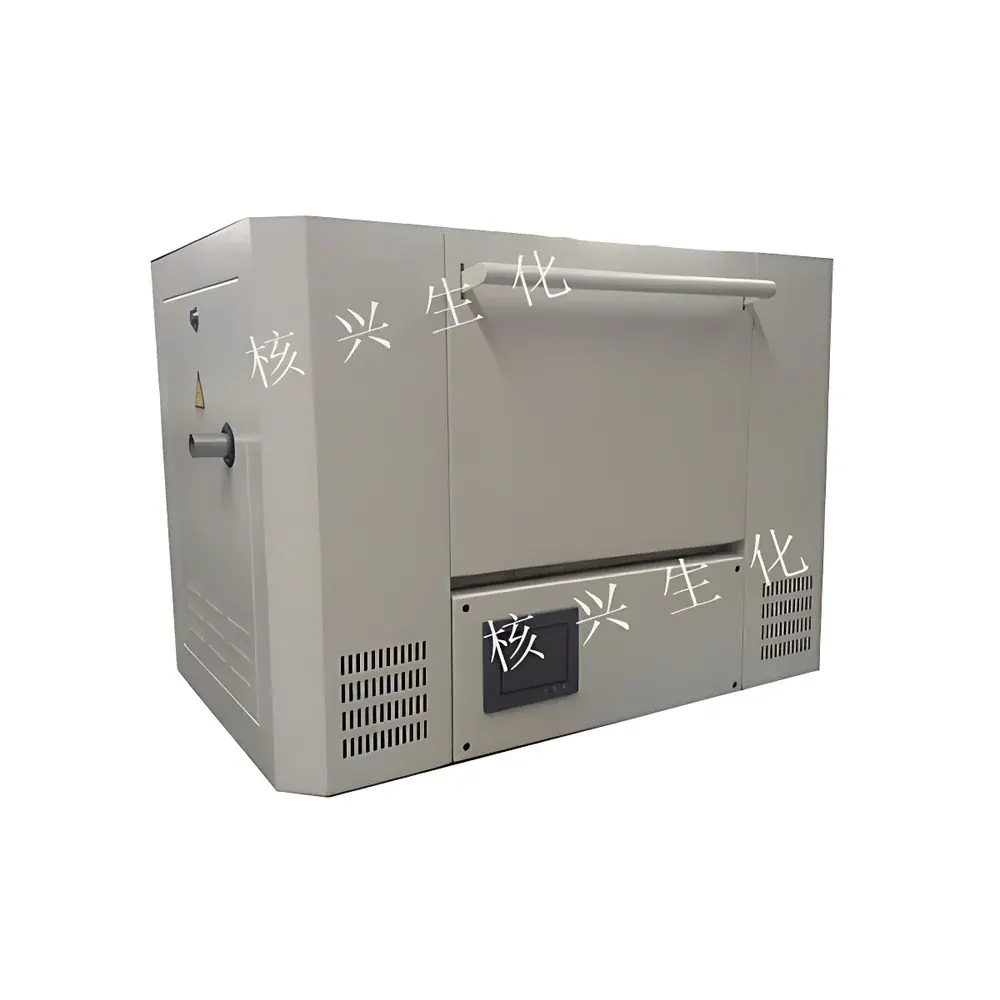
HEXING BIOCHEMICAL HXH-T Series High-Throughput Microwave Ashing System for Biological and Environmental Samples
| Brand | HEXING BIOCHEMICAL |
|---|---|
| Origin | Shandong, China |
| Model | HXH-T25 / HXH-T100 |
| Microwave Power | 0–3.2 kW (HXH-T25) / 0–10 kW (HXH-T100) |
| Frequency | 2450 MHz |
| Cavity Volume | 25–26 L |
| Max Operating Temperature | 900 °C (short-term up to 1200 °C) |
| Temperature Sensor | K-type thermocouple |
| Chamber Material | Industrial-grade stainless steel welded monoblock cavity with internal ceramic fiber insulation (optional quartz-lined cavity) |
| Airflow Control | Adjustable inlet + programmable negative-pressure exhaust system |
| Sample Capacity | Dual-layer 2 × 2 L ceramic crucibles (T100) or up to 84 × 15 mL / 40 × 30 mL / 12 × 150 mL crucibles (T25) |
| Control System | PLC-based touchscreen interface with real-time curve logging (time/temperature/power), multi-step program storage, and USB data export |
| Safety Compliance | Interlocked door, surface temperature <50 °C, microwave leakage <5 mW/cm² (GB 10436), over-temperature & over-pressure protection |
Overview
The HEXING BIOCHEMICAL HXH-T Series is a high-throughput microwave ashing system engineered specifically for the rapid, controlled, and residue-free mineralization of biological and environmental matrices. Unlike conventional muffle furnaces—whose reliance on conductive/convective heating results in prolonged cycle times (typically 4–12 hours), thermal gradients, and uncontrolled off-gassing—the HXH-T leverages volumetric microwave energy absorption to achieve uniform internal heating of heterogeneous organic samples. This enables complete organic matrix removal within minutes while preserving analyte integrity and minimizing volatile loss of radionuclides (e.g., 137Cs, 90Sr, 239Pu) and trace metals. The system operates on the principle of dielectric heating, where polar molecules (e.g., water, lipids, proteins) absorb 2450 MHz microwave energy, generating molecular friction and rapid thermal decomposition. Its design targets laboratories requiring high sample throughput under strict regulatory frameworks—including environmental radiation monitoring, nuclear safety oversight, food radioactivity testing, and GLP-compliant radiochemical analysis per GB/T 14883.1–1994 and GB 16145–1995.
Key Features
- Engineered microwave cavity with monolithic stainless steel construction and ceramic fiber insulation ensures mechanical robustness, thermal stability, and long-term microwave containment.
- Two configurable configurations: HXH-T25 (25 L single-layer flat-bed layout, optimized for standardized small-volume crucibles) and HXH-T100 (26 L dual-tier stacking chamber, enabling parallel processing of up to 4 L total sample volume per run).
- Non-pulsed, continuously variable microwave power control via closed-loop PID frequency modulation—eliminating thermal shock and enabling precise ramp/hold profiles critical for volatile element retention.
- Integrated forced-air circulation with adjustable inlet gas options (air, O2, N2) and programmable negative-pressure exhaust—effectively removing CO, NOx, SO2, and halogenated vapors through corrosion-resistant PTFE-coated ducting.
- Optional quartz-lined cavity variant provides ultra-low background contamination, inert surface chemistry, and simplified cleaning—essential for low-level radionuclide or ultratrace metal analysis.
- Real-time monitoring of time-temperature-power trajectories with automatic data logging; supports audit-ready CSV export compliant with FDA 21 CFR Part 11 requirements when paired with validated software protocols.
Sample Compatibility & Compliance
The HXH-T Series accommodates diverse biological and environmental specimens—including cereals, leafy vegetables, fish tissue, meat homogenates, soil extracts, and filter papers—without pre-carbonization. Its wide crucible compatibility (15 mL to 2 L) supports both regulatory batch processing (e.g., EPA Method 3050B adaptation) and research-scale optimization. The system meets national standards for radiological sample preparation: GB/T 14883.1–1994 (General Principles for Radioactivity Testing in Food) and GB 16145–1995 (γ-Spectrometric Analysis of Radionuclides in Biological Samples). Structural and operational safeguards—including interlocked access doors, surface temperature limitation (<50 °C), and verified microwave leakage (<5 mW/cm² per GB 10436)—ensure alignment with IEC 61000-4-3 EMC guidelines and occupational safety directives.
Software & Data Management
A color touchscreen HMI running embedded PLC firmware provides intuitive navigation across preset and user-defined methods. Up to 20 multi-segment programs (each with independent time/temperature/power setpoints) can be stored locally. All process variables—including actual cavity temperature, reflected power, and exhaust flow rate—are logged at 1-second intervals and exportable via USB to standard spreadsheet formats. Optional firmware upgrades support timestamped operator ID tagging, electronic signature capture, and audit trail generation—facilitating compliance with ISO/IEC 17025 and GMP documentation requirements.
Applications
- Radiological monitoring labs: Rapid ashing of food, feed, and environmental biosamples prior to γ-spectrometry or alpha/beta counting.
- Nuclear facility QA/QC: Volume reduction and stabilization of radioactive biological waste streams (e.g., lab animal carcasses, plant tissues) in accordance with ALARA principles.
- Environmental testing centers: High-volume processing of sediment, vegetation, and aquatic organism samples for heavy metal quantification (ICP-MS/OES).
- Research institutions: Controlled thermal decomposition studies of complex organics under varying atmospheres (oxidizing vs. inert) to assess elemental volatilization behavior.
- Reference material producers: Certified ash yield determination for CRM certification workflows per ISO Guide 35.
FAQ
Can the HXH-T system replace traditional muffle furnaces for radiochemical analysis?
Yes—when operated within validated temperature/time protocols, it delivers equivalent or superior ash purity and reproducibility while reducing cycle time by >90% and eliminating manual carbonization steps.
Is quartz cavity lining necessary for routine environmental sample ashing?
It is optional but recommended for sub-Bq/kg radionuclide analysis or when analyzing halogen-rich matrices (e.g., seaweed, marine biota) where silica contamination must be minimized.
How does the system handle high-moisture samples like fresh vegetables or fish tissue?
The combination of volumetric microwave heating and active negative-pressure exhaust rapidly evaporates water without spattering or crust formation—eliminating the need for pre-drying.
Does the HXH-T comply with international electromagnetic safety standards?
Yes—microwave leakage is certified to <5 mW/cm² at 5 cm distance (per GB 10436 and aligned with IEC 62233), and electrical safety conforms to GB 4793.1 (equivalent to IEC 61010-1).
Can process data be integrated into a laboratory information management system (LIMS)?
Raw CSV logs are LIMS-compatible; API integration is available upon request for customers deploying validated enterprise data infrastructure.



