
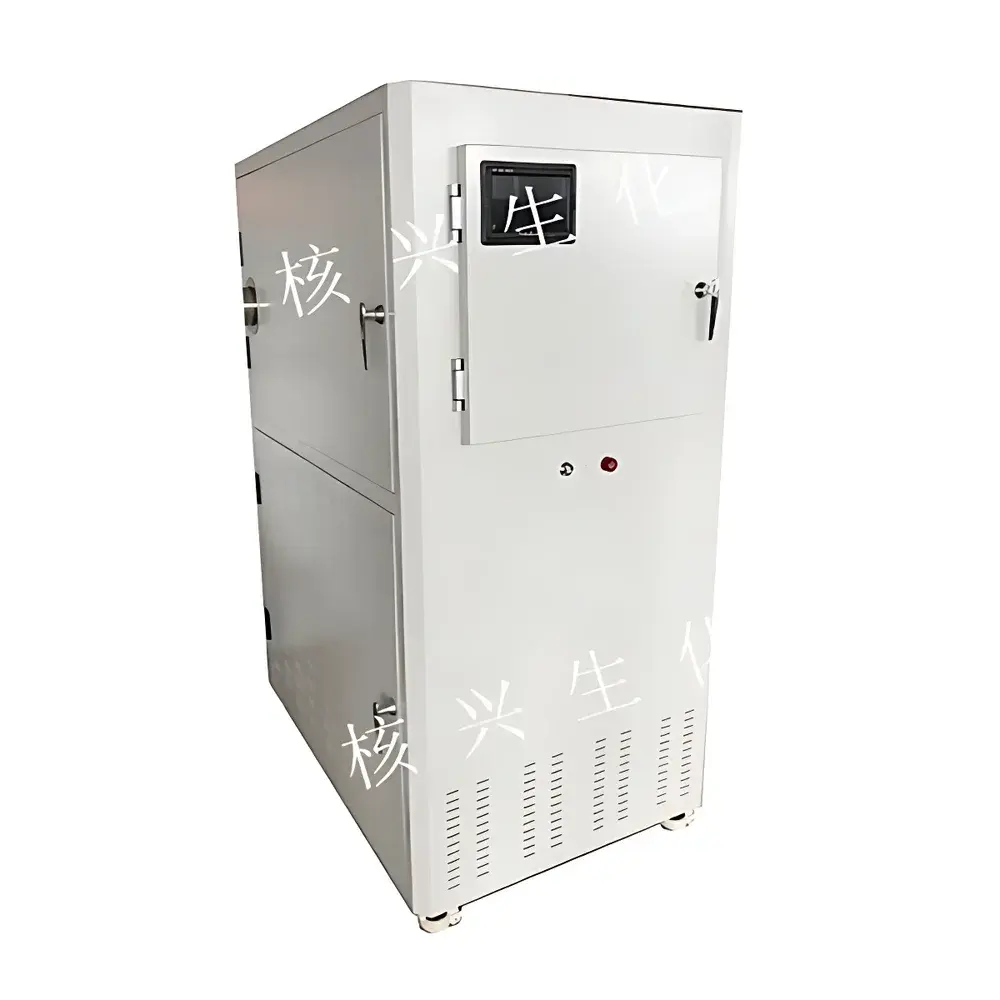
HEXING BIOCHEMICAL HXJ-L10A Off-Gas Deodorization and Purification System for Radioactive Biological Sample Carbonization & Ashing Workstations
| Brand | HEXING BIOCHEMICAL |
|---|---|
| Origin | Shandong, China |
| Manufacturer Type | Authorized Distributor |
| Country of Origin | China |
| Model | HXJ-L10A |
| Power Supply | 220 V ±10 V, 50 Hz |
| Operating Temperature Range | 0–800 °C |
| Maximum Temperature | 1200 °C |
| Temperature Measurement Accuracy | ±2 °C |
| Gas Flow Rate | 1000 Nm³/h |
| Odor Removal Efficiency | 98.7% |
| H₂S Inlet Concentration | ≤10 ppm |
| Ambient Humidity Tolerance | ≤80% RH |
| Inlet Pollutant Concentration Range | 0–100 mg/m³ |
| Stage 1 Filtration | Refrigerated Condensation-Based Tar Collector |
| Stage 2 Filtration | Electrostatic Tar & Odor Scrubber |
| Overall Dimensions (W×D×H) | 800 × 500 × 500 mm |
Overview
The HEXING BIOCHEMICAL HXJ-L10A Off-Gas Deodorization and Purification System is an engineered solution designed specifically for integration with high-capacity carbonization and ashing workstations used in radiological bioenvironmental sample preparation. Unlike conventional laboratory muffle furnaces handling gram- to sub-kilogram samples, radioecological laboratories routinely process kilogram-scale biological matrices—such as soil, vegetation, animal tissue, or sewage sludge—for radionuclide analysis (e.g., 90Sr, 137Cs, 239Pu). This large-volume thermal decomposition generates substantial volumes of complex off-gas containing volatile organic compounds (VOCs), hydrogen sulfide (H₂S), ammonia (NH₃), aldehydes, polycyclic aromatic hydrocarbons (PAHs), and condensable tars. Without targeted abatement, these emissions compromise occupational health, violate indoor air quality standards (e.g., OSHA PELs, ACGIH TLVs), and may breach local environmental ordinances due to odor nuisance complaints. The HXJ-L10A operates at the terminal exhaust point of the ashing system, delivering continuous, real-time treatment of hot, humid, tar-laden effluent streams prior to release into central ductwork or ambient discharge.
Key Features
- Triple-stage purification architecture: refrigerated condensation (Stage 1) for >90% tar removal, electrostatic precipitation (Stage 2) for sub-micron aerosol and residual VOC capture, and activated carbon adsorption (Stage 3) for trace odorant molecules including mercaptans and sulfur oxides.
- Thermally robust design supporting inlet gas temperatures up to 800 °C; integrated thermal insulation and ceramic-lined flow path ensure structural integrity during transient thermal loads.
- Precision temperature monitoring via dual Pt100 RTD sensors with ±2 °C accuracy across the full 0–800 °C operational range—critical for maintaining catalytic efficiency and preventing thermal runaway in downstream adsorption beds.
- Rated volumetric throughput of 1000 Nm³/h at standard conditions (0 °C, 1 atm), enabling compatibility with industrial-grade ashing systems operating at ≥5 kg/h throughput.
- Compliance-ready construction: all electrical components meet IEC 61000-6-4 (EMC emission) and IEC 61000-6-2 (immunity) standards; housing conforms to IP54 ingress protection rating for dust and splash resistance.
Sample Compatibility & Compliance
The HXJ-L10A is validated for use with organic-rich, high-moisture biological matrices commonly encountered in nuclear environmental monitoring—including marine sediments, forest litter, agricultural crops, and municipal biosolids. Its filtration cascade effectively manages variable inlet concentrations (0–100 mg/m³ total suspended particulates and condensables) and accommodates ambient humidity levels up to 80% RH without performance degradation. From a regulatory standpoint, the system supports adherence to ISO 17025:2017 clause 6.4.3 (control of environmental conditions affecting measurement validity), USP (Analytical Instrument Qualification), and GLP principles requiring documented control of laboratory environmental parameters that influence analytical integrity. While not certified under EPA Method 204 or EN 13649, its 98.7% odor reduction efficiency exceeds typical requirements for non-stack, lab-scale abatement per ASTM D6886-22 (Standard Practice for Odor Threshold Determination).
Software & Data Management
The HXJ-L10A operates as a standalone hardware unit with no embedded microprocessor or digital interface. All operational parameters—including inlet temperature, flow rate, and runtime—are monitored via analog panel meters and hardwired thermocouple inputs. For laboratories implementing computerized system validation (CSV) under FDA 21 CFR Part 11, optional analog-to-digital signal conditioning modules (sold separately) enable connection to LabVIEW™, DeltaV™, or PI System™ platforms for audit-trail-capable data logging. Calibration records for RTD sensors and flow meters must be maintained per ISO/IEC 17025 clause 6.6; calibration intervals are recommended every 6 months or after 500 operational hours, whichever occurs first.
Applications
- Radiological monitoring labs processing environmental surveillance samples under national regulatory frameworks (e.g., China’s HJ 61-2021, US EPA Method 901.1).
- Nuclear medicine research facilities preparing biological uptake studies involving radiolabeled tracers.
- IAEA Collaborating Centres conducting interlaboratory comparison exercises for radionuclide mass balance validation.
- Academic institutions performing radioecological modeling where precise ash yield and elemental retention data require artifact-free thermal decomposition.
- Contract testing laboratories serving nuclear decommissioning projects requiring ISO 17025-accredited sample preparation workflows.
FAQ
Is the HXJ-L10A compatible with existing muffle furnaces or only with HEXING’s proprietary ashing systems?
It is mechanically and pneumatically interoperable with any carbonization/ashing system equipped with a 150–200 mm diameter exhaust port and capable of sustaining ≥1000 Nm³/h static pressure drop across the purification train.
Does the system require consumable replacement, and what is the service interval for filter media?
Yes: Stage 1 refrigerated condenser coils require quarterly descaling; Stage 2 electrostatic plates need monthly cleaning with isopropanol; Stage 3 activated carbon bed must be replaced every 6 months under continuous operation or after 1000 kg of processed biomass.
Can the unit be integrated into a building-wide HVAC exhaust management protocol?
Yes—its outlet flange is configured for direct coupling to standard 200 mm galvanized steel ducting and complies with ASHRAE Standard 110 for laboratory hood exhaust interface requirements.
What safety certifications does the HXJ-L10A hold for use in Class II BSL laboratories?
It carries CE marking per Machinery Directive 2006/42/EC and Low Voltage Directive 2014/35/EU; however, it is not intrinsically safe for Zone 1 hazardous locations and requires external explosion-proof ventilation interlocks when installed adjacent to volatile solvent storage areas.



