
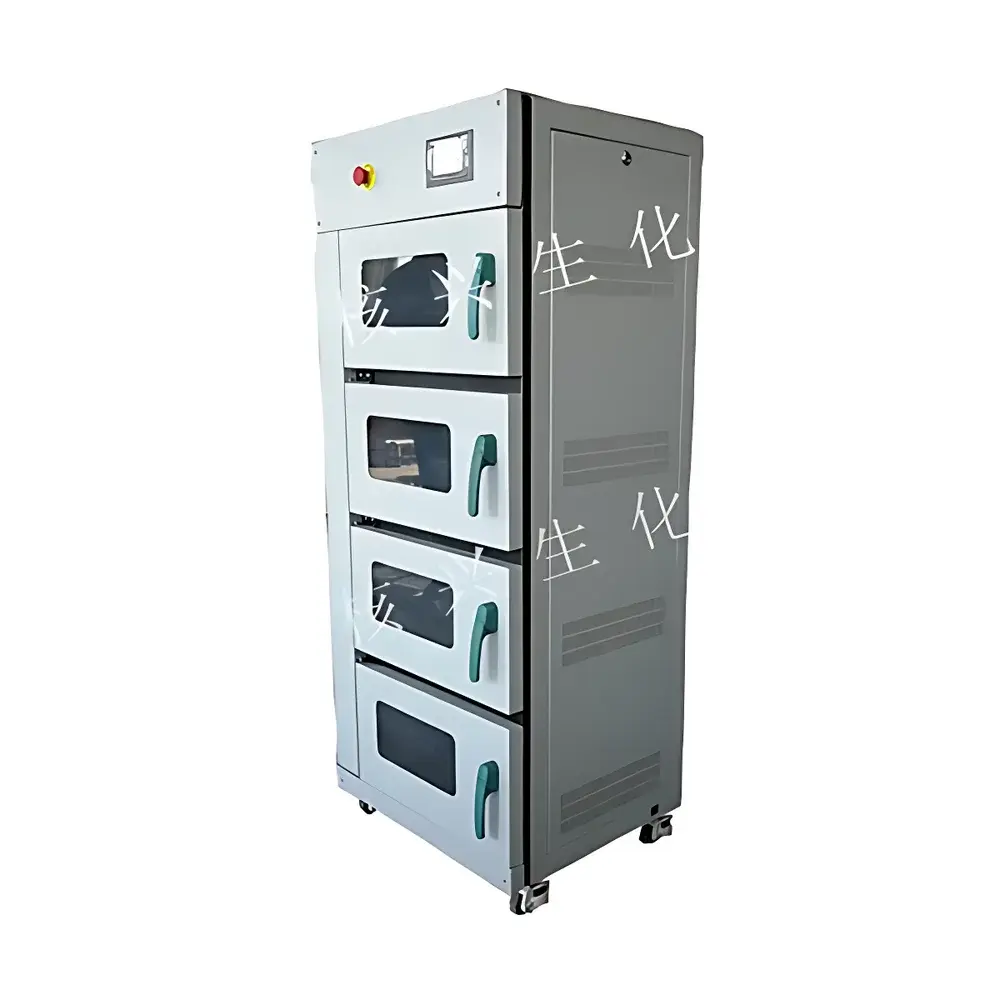
HEXING BIOCHEMICAL HXN-W20 Multi-Channel Microwave Liquid Concentrator for Alpha/Beta Radioactivity Sample Preparation
| Brand | HEXING BIOCHEMICAL |
|---|---|
| Origin | Shandong, China |
| Model | HXN-W20 Series (Dual-Channel HXN-W20Y-20 / Quad-Channel HXN-W20W-40) |
| Instrument Type | Automated Quantitative Microwave Concentrator |
| Temperature Range | 0–300 °C |
| Temperature Control Accuracy | ±0.1 °C |
| Total Sample Capacity | 4 × 24 L (Quad-Channel Configuration) |
| Microwave Power/Frequency | 1600 W / 2450 MHz (Dual) or 3200 W / 2450 MHz (Quad) |
| Cavity Material | Stainless Steel with PTFE Coating (Evaporation Mode) or Quartz Lining (Ashing Mode) |
| Evaporating Dish Standard | 4 × 2.9 L (Customizable up to 10 L) |
| Cooling/Exhaust | Low-Noise (<60 dB) Corrosion-Resistant Centrifugal Fan |
| Safety Compliance | GB 4706.21–2008, GB 5959.6–2008, Microwave Leakage <5 mW/cm² |
Overview
The HEXING BIOCHEMICAL HXN-W20 Multi-Channel Microwave Liquid Concentrator is an engineered solution for high-throughput, low-background alpha/beta radioactivity sample preparation in environmental and nuclear regulatory laboratories. Unlike conventional conductive heating methods—such as hot plates or sand baths—the HXN-W20 employs controlled 2450 MHz microwave energy to induce volumetric dielectric heating within aqueous samples. This mechanism enables rapid, uniform evaporation while minimizing thermal degradation of radionuclide species and reducing volatile loss of isotopes such as 210Po, 90Sr, and 241Am. Designed specifically to match the throughput requirements of low-background alpha/beta counting systems (e.g., gas-proportional counters with 1-, 2-, or 4-channel configurations), the HXN-W20 eliminates bottlenecks in pre-analytical processing by condensing multi-day evaporation cycles into hours. Its architecture supports compliance-driven workflows under ISO/IEC 17025, GLP, and nuclear regulatory frameworks requiring auditable, reproducible sample conditioning.
Key Features
- Patent-protected multi-channel microwave cavity design (ZL201621207488.6, ZL201730679772.7, ZL201730679211.7, ZL201721881518.6), enabling simultaneous, independent concentration of up to four 2.9 L acidified water samples.
- Industrial-grade PLC-based control system with color touchscreen interface; supports multi-step programmable protocols—including ramp-hold-cool sequences—with real-time monitoring of cavity temperature (infrared non-contact sensor), microwave power output, and elapsed time.
- Four vertically stacked, sealed 24 L resonant cavities constructed from welded stainless steel with interior PTFE coating for corrosion resistance against nitric, hydrochloric, and sulfuric acid vapors generated during EPA Method 900.0–compliant sample digestion.
- Integrated high-efficiency exhaust: corrosion-resistant centrifugal blower (≤60 dB(A)) with directional vapor extraction and condensate management, ensuring operator safety and lab air quality per OSHA 1910.1200 and IARC guidelines on acidic aerosols.
- Compliance-grade safety architecture: interlocked door mechanism, choke-sealed waveguide feed, and comb-type anti-leakage structure meeting national standard GB 4706.21–2008 and GB 5959.6–2008; measured microwave leakage <5 mW/cm² at 5 cm distance.
- 24/7 continuous-duty rating with industrial thermal management; validated for unattended operation over extended cycles in regulated environments including nuclear power plant QA labs and CDC-certified radiological testing facilities.
Sample Compatibility & Compliance
The HXN-W20 accommodates a broad range of environmental aqueous matrices: drinking water (GB 5749–2006), groundwater (GB/T 14848–2017), surface water, wastewater, precipitation, and atmospheric deposition samples. It is fully compatible with standardized radiochemical preparation workflows outlined in GB/T 5750.13–2006 (Standard Methods for Drinking Water—Radioactivity Parameters), including co-precipitation with Fe(OH)3, BaSO4, or MnO2, followed by microwave-assisted evaporation to ≤10 mL residue volume. The system’s temperature stability (±0.1 °C) and programmable power modulation ensure consistent residue geometry and minimal isotopic fractionation—critical for achieving counting efficiency reproducibility required under ISO 11929:2019 and ANSI N42.22–2022. Optional quartz-lined cavity variants support high-temperature ashing (up to 300 °C) of organic-rich effluents prior to alpha spectrometry.
Software & Data Management
The embedded control firmware records all operational parameters—including setpoints, actual cavity temperature profiles, power modulation curves, and cycle timestamps—in non-volatile memory. Data export is supported via USB 2.0 interface in CSV format for integration with LIMS platforms (e.g., LabWare, Thermo Fisher SampleManager) and statistical process control tools. Audit trails comply with FDA 21 CFR Part 11 requirements when used in GMP-regulated nuclear medicine or environmental contract laboratories. User-defined method libraries can be password-protected and version-controlled; up to 99 protocols may be stored onboard with descriptive naming and revision date stamping.
Applications
- Routine compliance monitoring of α-emitters (e.g., 234U, 238U, 230Th, 210Po) and β-emitters (e.g., 90Sr/90Y, 137Cs, 3H) in drinking water per WHO Guidelines and EU Directive 2013/51/EURATOM.
- High-volume screening of nuclear facility effluents, decommissioning site leachates, and uranium mining runoff under IAEA Safety Standards Series No. WS-G-2.3.
- Pre-concentration of large-volume (≥20 L) environmental samples prior to radiochemical separation and ICP-MS analysis of actinides.
- Research-scale development of novel radionuclide recovery protocols, including solvent extraction and ion-exchange eluate concentration.
- Validation studies supporting accreditation to CNAS-CL01:2018 (equivalent to ISO/IEC 17025:2017) for radiochemistry testing scopes.
FAQ
What regulatory standards does the HXN-W20 meet for radiation safety and electrical compliance?
It conforms to GB 4706.21–2008 (microwave appliance safety), GB 5959.6–2008 (industrial microwave equipment), and national limits for electromagnetic leakage (<5 mW/cm²). Its mechanical and interlock design satisfies IEC 61000-6-4 for EMC in laboratory environments.
Can the instrument handle strongly acidic digestates from EPA Method 900.0?
Yes—the PTFE-coated cavity and corrosion-resistant exhaust system are rated for continuous exposure to 6 M HNO3, 4 M HCl, and mixed acid vapors at temperatures up to 250 °C.
Is method validation support available for ISO/IEC 17025 accreditation?
HEXING provides documented IQ/OQ protocols, traceable calibration certificates for IR sensors, and performance verification data (evaporation rate linearity, temperature uniformity mapping, residue repeatability) upon request.
How is cross-contamination prevented between channels?
Each 24 L cavity operates independently with dedicated waveguide coupling, isolated exhaust ducting, and physical separation barriers—validated via blank spike recovery tests showing no inter-channel carryover (<0.05% signal transfer).
Does the system support remote monitoring or network integration?
While standalone operation is standard, optional RS-485 Modbus RTU interface enables integration with building management systems (BMS) or centralized lab automation controllers for status polling and alarm relay outputs.



