
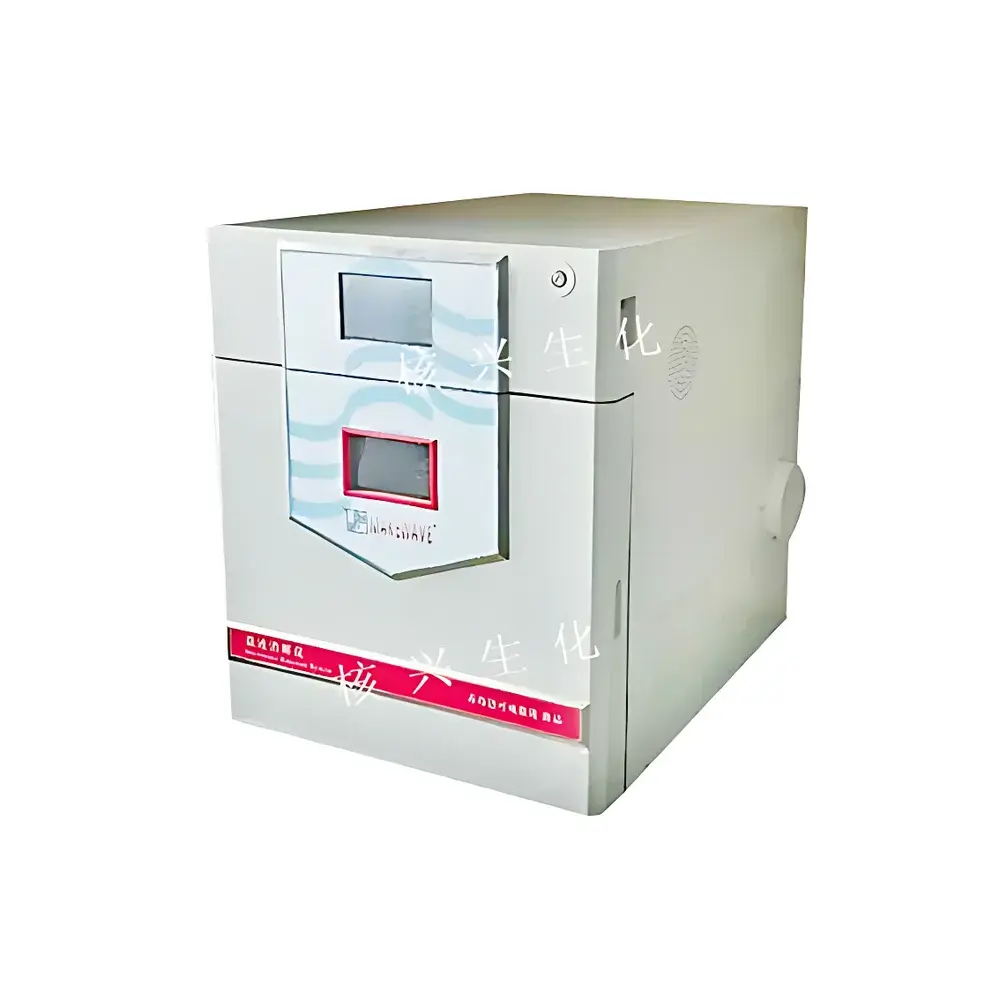
HEXING BIOCHEMICAL MKX-X1/X2 Series Microwave Digestion and Extraction System
| Brand | HEXING BIOCHEMICAL |
|---|---|
| Origin | Shandong, China |
| Manufacturer Type | Authorized Distributor |
| Country of Origin | China |
| Model | MKX-X1/X2 Series |
| Output Power | 0–800 W / 0–1800 W |
| Frequency | 2450 MHz |
| Cavity Volume | 20 L (MKX-X1) / 70 L (MKX-X2) |
| Temperature Range | 0–300 °C |
| Pressure Range | 0–3 MPa |
| Sample Capacity | 6 × 80 mL / 20 × 55 mL / 40 × 55 mL |
| Vessel Material | TFM (Perfluoroalkoxy alkane) |
| Vessel Sleeve Material | PEEK + GF (Glass-Filled Polyetheretherketone) |
| Cavity Construction | Industrial-grade stainless steel with multi-layer PFA coating |
| Temperature Sensing | Fiber-optic or infrared (single/dual point) |
| Pressure Monitoring | Real-time digital pressure transducer with overpressure alarm |
| Control System | PLC-based intelligent controller with color TFT touchscreen |
| Data Logging | Time-temperature-pressure-power dynamic curves, exportable via USB |
| Safety Compliance | <5 mW/cm² microwave leakage (GB 10436-2008), interlocked door, explosion-resistant vessel design, corrosion-resistant exhaust system, CE-marked electrical architecture |
Overview
The HEXING BIOCHEMICAL MKX-X1/X2 Series Microwave Digestion and Extraction System is a dual-function, laboratory-grade platform engineered for trace elemental analysis in regulated and research-intensive environments. Based on controlled microwave dielectric heating principles, the system delivers rapid, uniform energy coupling into sealed reaction vessels—enabling complete matrix decomposition of complex organic and inorganic samples under elevated temperature and pressure conditions. Designed to meet the rigorous demands of accredited environmental, food safety, pharmaceutical, and materials testing laboratories, the MKX-X1/X2 series supports standardized methodologies including EPA Method 3051A/3052, ISO 11466, GB/T 5009.12–2017, and ASTM D5511 for heavy metal quantification (e.g., Pb, Cd, Hg, As, Cr). Its modular architecture allows seamless transition between low-throughput method development (6-position MKX-X1G6A) and high-volume routine analysis (40-position MKX-X2G40A), maintaining thermal homogeneity and process reproducibility across all configurations.
Key Features
- Dual-mode operation: Simultaneous support for closed-vessel microwave-assisted digestion and microwave-enhanced solvent extraction—eliminating the need for separate instrumentation.
- Closed-loop PID-controlled microwave generation: Non-pulsed, continuously variable power output (0–800 W or 0–1800 W) ensures precise thermal ramping and hold profiles without overshoot or oscillation.
- Corrosion-resistant cavity: Fully welded 304 stainless steel chamber with triple-layer PFA (perfluoroalkoxy) lining—resistant to aggressive acids (HF, HNO₃/HCl mixtures) and sustained at 300 °C for >10,000 cycles.
- Redundant thermal monitoring: Optional fiber-optic probe (±0.5 °C accuracy) or dual-point infrared sensors (±1.5 °C) provide real-time, non-invasive temperature feedback independent of vessel orientation.
- Full-range pressure surveillance: Digital pressure transducers monitor each vessel’s internal pressure up to 3 MPa (435 psi), triggering automatic power cutoff and audible/visual alarms upon threshold breach.
- Engineered vessel containment: TFM digestion vessels (55 mL or 80 mL) housed within reinforced PEEK+GF protective sleeves—certified for repeated use under ISO 17025-compliant validation protocols.
- Integrated safety architecture: Electromechanical door interlock, RF-shielded viewing window (μ-wave attenuation >70 dB), low-noise (<60 dB(A)) centrifugal exhaust with acid-resistant impeller, and Class I laser-class LED illumination for reaction observation.
Sample Compatibility & Compliance
The MKX-X1/X2 accommodates solid, semi-solid, and liquid matrices—including soil, sludge, biological tissue, polymer composites, catalysts, and cosmetic emulsions—without pre-dilution or size reduction beyond standard lab practice. All vessel configurations comply with ISO/IEC 17025 requirements for uncertainty estimation in digestion efficiency, while the control firmware supports audit-ready data integrity per FDA 21 CFR Part 11 (electronic signatures, operator-level access control, immutable audit trails). The system meets national electromagnetic compatibility standards (GB/T 18268.1–2010) and carries CE marking for EMC and LVD directives. Optional IQ/OQ documentation packages are available for GLP and GMP-regulated facilities.
Software & Data Management
A dedicated PLC-based control interface provides intuitive parameter programming—including multi-segment time-temperature-pressure ramps, power modulation profiles, and hold stabilization criteria. All operational variables (microwave power, cavity temperature, vessel pressure, elapsed time) are displayed as synchronized dynamic curves during runs. Experimental logs—including timestamps, user IDs, method names, and raw sensor outputs—are stored internally and exportable via USB 2.0 to CSV or PDF formats. No proprietary software installation is required; exported datasets integrate natively with LIMS platforms and statistical analysis tools (e.g., JMP, Minitab) via standard delimiter formatting.
Applications
- Environmental testing: Total recoverable metals in EPA SW-846 Method 3052 digests (soil, sediment, fly ash); leachate analysis per TCLP (Method 1311).
- Food and feed safety: Quantification of toxic elements in infant formula (ISO 17294-2), seafood (AOAC 999.10), and edible oils (GB 5009.12–2017).
- Pharmaceutical QC: Residual catalyst screening in active pharmaceutical ingredients (USP <232>/<233>).
- Materials science: Dissolution of rare-earth oxides, battery cathode materials (LiCoO₂, NMC), and nanocomposites prior to ICP-MS/OES analysis.
- Forensic and clinical toxicology: Digestion of hair, nail, and tissue specimens for As/Pb/Bi speciation studies.
FAQ
What regulatory standards does the MKX-X1/X2 comply with for laboratory accreditation?
The system conforms to ISO/IEC 17025:2017 clause 6.4.10 (equipment verification), GB/T 27404–2008 (validation of digestion methods), and supports full traceability for GLP audits through timestamped, user-logged experimental records.
Can the MKX-X2G40A maintain uniform temperature across all 40 vessels during high-power digestion?
Yes—the rotating carousel combined with mode-stirred cavity design and dual IR sensing ensures ±3 °C uniformity (measured per ASTM E2500-17 Annex A2) across all positions at 1800 W output.
Is HF acid compatible with the TFM vessels and PFA-lined cavity?
TFM vessels are rated for continuous exposure to ≤40% HF at ≤220 °C; the PFA coating remains stable under identical conditions. Vessel sleeves must be inspected after each HF run per manufacturer’s maintenance schedule.
Does the system support remote monitoring or integration with laboratory information management systems (LIMS)?
While local USB export is standard, optional RS-485/Modbus RTU communication enables direct LIMS integration for automated result ingestion and instrument status polling.
What is the expected service life of the microwave magnetron under routine use?
Rated for ≥5,000 hours at nominal load; replacement intervals are tracked automatically in the system log and flagged 500 hours prior to end-of-life based on cumulative operating time and thermal cycling history.



