
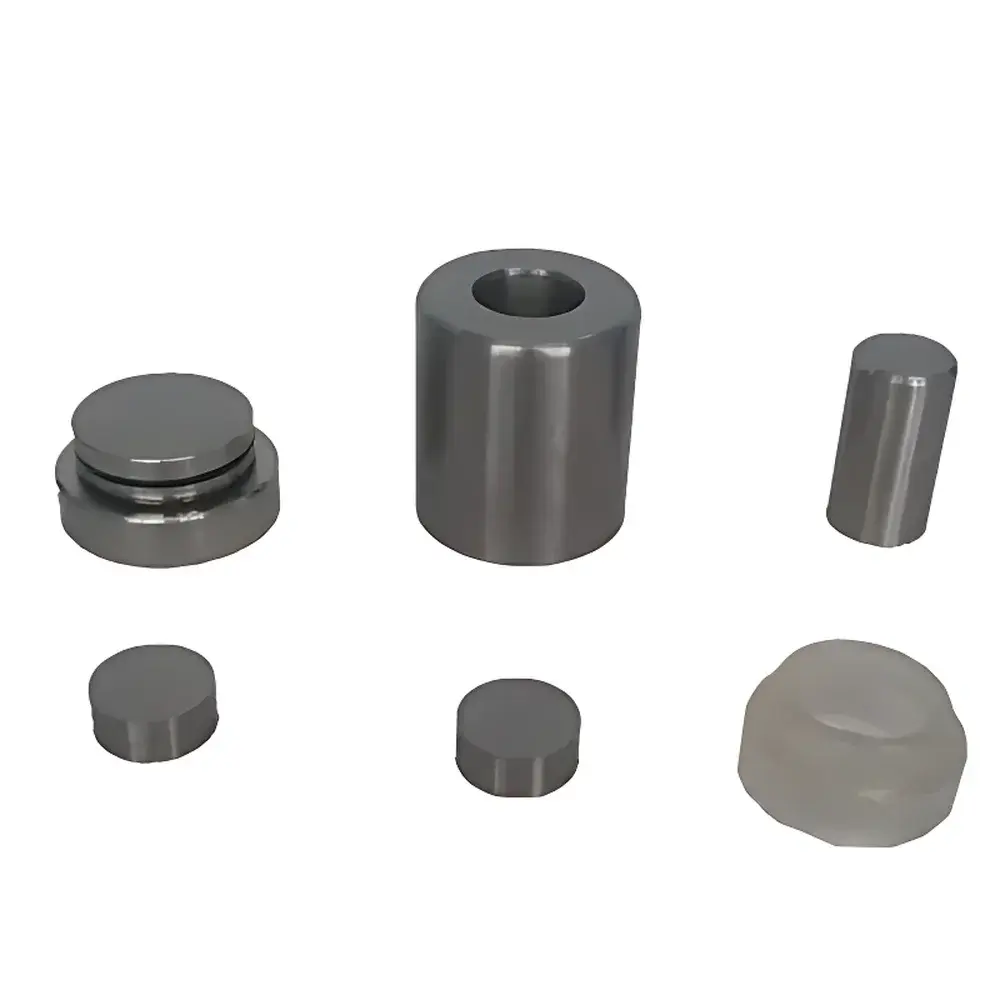
HF-2D Manual Pellet Press by Top Instrument
| Brand | Top Instrument |
|---|---|
| Origin | Tianjin, China |
| Manufacturer Type | Direct Manufacturer |
| Product Category | Domestic |
| Model | HF-2D |
| Instrument Type | Manual Pellet Press |
| Maximum Pressure Capacity | 15 t |
| Die Cavity Diameter | Φ20 mm |
| Ejection Mechanism | Integrated Manual Demolding System |
| Pricing | USD 198 (FOB Tianjin) |
Overview
The HF-2D Manual Pellet Press is a precision-engineered laboratory instrument designed for reproducible solid-sample preparation in analytical chemistry, materials science, and quality control laboratories. It operates on the principle of uniaxial mechanical compression—applying controlled, static load via a calibrated hydraulic or screw-driven mechanism—to consolidate powdered specimens into dense, dimensionally stable pellets. These pellets serve as standardized substrates for spectroscopic analysis (e.g., FTIR, XRF, XRD), elemental quantification, and physical property evaluation. Unlike automated or motorized systems, the HF-2D emphasizes operator control, tactile feedback, and minimal infrastructure requirements—making it ideal for low-throughput labs, teaching environments, and field-deployable sample prep workflows where electrical dependency or complex software integration is impractical.
Key Features
- Robust cast-iron frame with reinforced load-bearing columns, engineered to sustain repeated application of up to 15 metric tons (147 kN) of compressive force without plastic deformation or alignment drift.
- Interchangeable die set compatible with standard Φ20 mm pellet geometry—meets ASTM E1316 and ISO 13702 specifications for pellet diameter tolerance (±0.05 mm) and surface flatness (Ra ≤ 0.8 µm).
- Integrated manual demolding system featuring a coaxial ejection pin actuated via knurled handwheel; eliminates need for external punches or secondary tools during sample release.
- Calibrated pressure indication via analog gauge with dual-scale readout (ton-force and MPa), traceable to national metrology standards; optional digital load cell upgrade available for audit-ready force logging.
- Tool-free die cavity access and rapid cleaning design—stainless steel die components resist corrosion from acidic, alkaline, or halogenated sample matrices commonly encountered in geochemical or pharmaceutical digestion workflows.
Sample Compatibility & Compliance
The HF-2D accommodates a broad spectrum of powdered solids including but not limited to metal oxides, polymer blends, pharmaceutical APIs and excipients, geological powders (e.g., fused borate beads), and ceramic precursors. Its Φ20 mm die configuration aligns with routine FTIR transmission cell requirements (per ASTM E1252) and matches common XRF sample cup dimensions. All structural components comply with GB/T 19001–2016 (equivalent to ISO 9001:2015) manufacturing protocols. While the press itself does not require regulatory certification, its output pellets are routinely validated under GLP-compliant SOPs for use in USP , EP 2.2.24, and FDA 21 CFR Part 11–aligned analytical workflows—particularly when paired with documented calibration records and operator training logs.
Software & Data Management
As a manually operated instrument, the HF-2D does not incorporate embedded firmware or proprietary software. However, its mechanical design supports full traceability within digital lab ecosystems: pressure readings from the analog gauge may be manually logged into LIMS or ELN platforms (e.g., LabWare, Benchling) using standardized templates. For users requiring electronic data capture, the optional digital load sensor interface outputs RS-232 or USB-serial signals compatible with third-party data acquisition software (e.g., LabVIEW, MATLAB). Audit trails—including date/time stamps, operator ID, batch number, and applied pressure—are maintained externally per ALCOA+ principles when integrated into validated documentation practices.
Applications
- Preparation of KBr or polyethylene dispersion pellets for mid- and far-IR spectroscopy.
- Compaction of fused glass beads for wavelength-dispersive X-ray fluorescence (WDXRF) quantitative analysis.
- Formation of uniform tablets for hardness, disintegration, and dissolution testing in pharmaceutical development (per USP ).
- Routine consolidation of catalyst powders prior to BET surface area measurement or thermal gravimetric analysis (TGA).
- Teaching core concepts of powder rheology, compaction behavior, and green strength development in undergraduate materials engineering labs.
FAQ
What is the maximum recommended operating pressure for routine use?
For optimal die longevity and repeatability, sustained operation at ≤12 t (117.6 kN) is advised; 15 t represents ultimate mechanical limit and should be reserved for high-density refractory materials only.
Is the Φ20 mm die set interchangeable with other Top Instrument press models?
Yes—the HF-2D shares die interface specifications with the HF-1 and HF-3 series, enabling cross-platform accessory reuse under identical alignment tolerances.
Does the press include calibration documentation?
Each unit ships with a factory-issued Certificate of Conformance; NIST-traceable calibration certificates are available upon request at time of order.
Can corrosive samples (e.g., HF-treated silicates) be safely pressed?
Stainless steel die components resist mild corrosion, but prolonged exposure to hydrofluoric acid or molten fluxes requires post-use passivation and inspection per ASTM A967.
What maintenance schedule is recommended?
Lubrication of the lead screw and ejection mechanism every 200 cycles; annual verification of gauge linearity against dead-weight test standards.



