
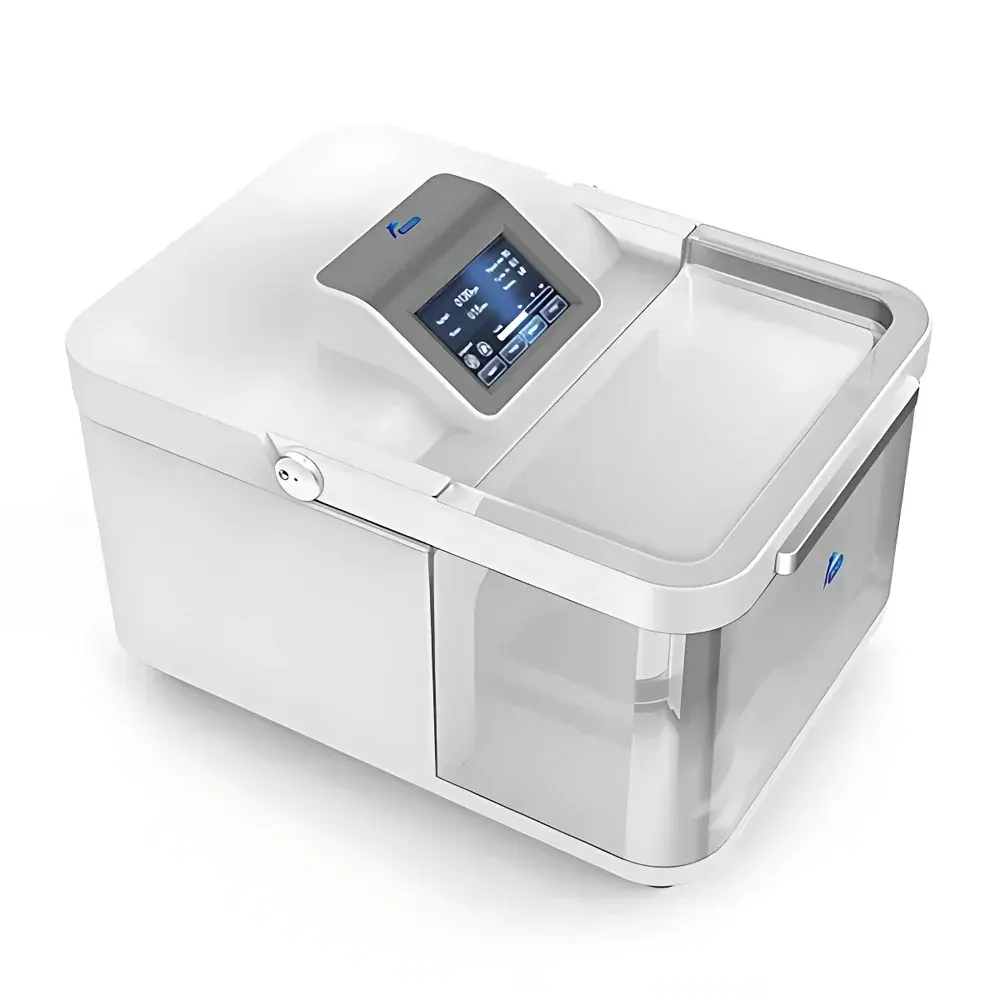
HF-Extract High-Throughput Ball Mill Grinder
| Brand | BIO-DL |
|---|---|
| Origin | Shanghai, China |
| Model | HF-Extract High-Throughput Ball Mill Grinder |
| Drive Mechanism | Horizontal Arcuate Radial Oscillation |
| Maximum Sample Throughput | Dual Platform (2 independent grinding stations) |
| Final Particle Size | < 5 µm |
| Control Interface | 5-inch LED Touchscreen with Program Storage |
| Grinding Modes | Dry, Wet, Cryogenic |
| Safety Features | Interlocked Lid, Motor Cut-off Switch, EasyClamp™ Vessel Securing System, Transparent Viewing Window |
| Compliance | Designed for GLP-compliant laboratories |
Overview
The HF-Extract High-Throughput Ball Mill Grinder is an engineered solution for rapid, reproducible sample homogenization and particle size reduction in analytical, pharmaceutical, and materials science laboratories. It operates on the principle of horizontal arcuate radial oscillation — a high-energy mechanical milling mechanism that induces controlled, multidirectional collisions between grinding media (e.g., stainless steel, tungsten carbide, or ceramic beads) and solid or frozen samples within sealed vessels. Unlike vertical shaker mills or planetary ball mills, this design minimizes shear-induced thermal buildup while maximizing impact frequency and kinetic energy transfer across dual independent platforms. The system achieves final particle sizes consistently below 5 µm, enabling downstream compatibility with X-ray diffraction (XRD), scanning electron microscopy (SEM), inductively coupled plasma mass spectrometry (ICP-MS), and dissolution testing protocols.
Key Features
- Dual-platform architecture supports parallel processing of two dissimilar sample types — for example, one cryogenic vial and one dry pulverization jar — without cross-contamination or mechanical interference.
- 5-inch LED touchscreen interface with intuitive icon-based navigation enables precise programming of oscillation frequency (range: 50–2000 rpm), cycle duration (1 s to 99 min), and pause intervals; up to 99 custom methods can be saved and recalled with timestamped metadata.
- EasyClamp™ mechanical locking system ensures rapid, tool-free vessel fixation with tactile and visual confirmation; integrated torque-sensing prevents under-tightening or over-torque damage to threaded adapters.
- Transparent polycarbonate lid provides real-time visual monitoring of grinding dynamics while maintaining full containment integrity — critical for volatile, toxic, or hygroscopic samples.
- Interlocked motor control circuitry halts all motion immediately upon lid opening, satisfying IEC 61000-6-2 electromagnetic compatibility and EN 60204-1 safety standards for laboratory equipment.
- Modular accessory ecosystem includes cryo-compatible stainless-steel vials (0.2–50 mL), silicone-sealed PTFE-lined jars, and adapter plates for standard 2-mL microcentrifuge tubes, 15-mL conical tubes, and 50-mL Falcon tubes.
Sample Compatibility & Compliance
The HF-Extract accommodates a broad spectrum of sample matrices: brittle ceramics, fibrous plant tissues, frozen animal tissues, polymer pellets, metal alloys, and pharmaceutical tablets. Its cryogenic capability — when used with liquid nitrogen-cooled vials — preserves thermolabile compounds and inhibits enzymatic degradation during disruption. All wet-grinding protocols are validated for use with aqueous buffers, organic solvents (e.g., ethanol, acetone), and surfactant solutions. The instrument’s mechanical design conforms to ISO 14001 environmental management principles (low-noise operation < 65 dB(A) at 1 m), and its firmware architecture supports audit-ready data export (CSV/Excel) with user authentication logs — meeting baseline requirements for GLP, GMP, and FDA 21 CFR Part 11 compliance when deployed with validated LIMS integration.
Software & Data Management
No proprietary software installation is required: method parameters, run history, and error codes are stored locally on the device’s non-volatile memory with automatic timestamping (YYYY-MM-DD HH:MM:SS). Exportable logs include operator ID, program name, actual vs. setpoint frequency/duration, peak acceleration (g-force), and thermal sensor readings from the baseplate. Optional RS-232 or USB-C connectivity enables automated synchronization with laboratory information management systems (LIMS) or electronic lab notebooks (ELN) via ASCII command protocol. All exported files retain SHA-256 checksums for data integrity verification during regulatory submissions.
Applications
- Routine preparation of homogenized reference materials for certified calibration standards (ISO/IEC 17034).
- Cell lysis and nucleic acid extraction optimization in genomics workflows where mechanical shearing must be balanced against DNA fragment length preservation.
- Particle size distribution analysis of active pharmaceutical ingredients (APIs) per USP <429> and Ph. Eur. 2.9.31.
- Mineralogical sample prep for geochemical assays requiring sub-10 µm liberation prior to fusion bead preparation.
- Recyclable material characterization (e.g., battery cathode powders, solar cell absorbers) where phase homogeneity directly influences electrochemical performance metrics.
FAQ
What is the maximum recommended operating temperature for the grinding chamber during extended runs?
The baseplate is rated for continuous operation up to 40 °C ambient; internal vessel temperature rise remains ≤12 °C above ambient under standard dry-grinding conditions (2000 rpm, 5-min cycle). Cryo-mode operation suppresses thermal drift entirely.
Can the HF-Extract be validated for regulated QC environments?
Yes — IQ/OQ documentation templates are available upon request; the system supports traceable calibration of oscillation frequency (±0.5% accuracy) and timebase (±100 ms/day deviation) using NIST-traceable instrumentation.
Is third-party grinding media certification supported?
The instrument accepts any ISO 8502-3 compliant grinding balls (diameters 0.5–10 mm); BIO-DL provides optional certified reference media sets with CoA specifying hardness (HV), density (g/cm³), and elemental impurity profiles (ICP-OES tested).



