
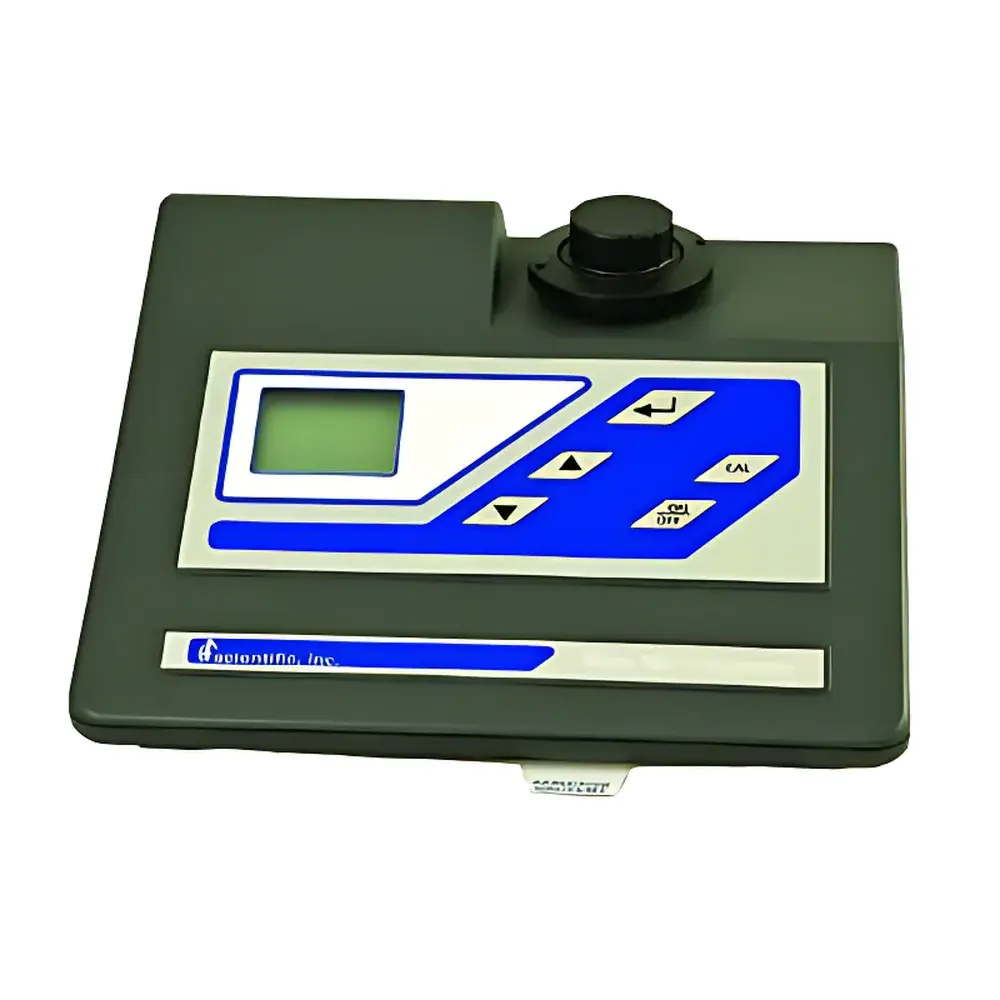
HF Scientific Micro 100 Desktop Turbidimeter
| Origin | USA |
|---|---|
| Manufacturer Type | Authorized Distributor |
| Origin Category | Imported |
| Model | Micro 100 |
| Pricing | Upon Request |
Overview
The HF Scientific Micro 100 Desktop Turbidimeter is a precision optical instrument engineered for reliable, ISO 7027-compliant turbidity measurement in laboratory, quality control, and field-deployable environments. Utilizing infrared (850 nm) nephelometric detection, the Micro 100 eliminates color interference and ensures high reproducibility across diverse sample matrices—including drinking water, wastewater effluents, pharmaceutical process streams, and industrial cooling fluids. Its optical architecture adheres strictly to the principles of 90° light scattering, as defined in ISO 7027 and EPA Method 180.1, delivering traceable, metrologically sound NTU (Nephelometric Turbidity Units) values. Designed for operational simplicity without compromising analytical integrity, the Micro 100 integrates automatic range selection, real-time calibration diagnostics, and robust thermal stability—enabling consistent performance from 0 °C to 50 °C ambient conditions.
Key Features
- Infrared 850 nm LED light source with matched photodetector for color-insensitive, ISO 7027–compliant measurements
- Automatic 0–1000 NTU range switching: dynamically selects optimal optical gain and signal amplification based on sample turbidity
- Intelligent calibration alert system: monitors sensor drift and calibration validity in real time; prompts user via on-screen indicator when recalibration is recommended
- One-button calibration initiation: supports rapid verification using primary standards (e.g., Formazin or AMCO AEPA polymer suspensions)
- Integrated flow-through cell design: enables rapid sample exchange with minimal residual carryover; typical measurement cycle completes within 6 seconds
- Rechargeable lithium-ion battery: provides up to 20 hours of continuous operation, supporting mobile lab use and unattended monitoring sessions
- RS-232 serial interface: facilitates direct connection to printers, data loggers, or LIMS systems for timestamped NTU output (date, time, value)
Sample Compatibility & Compliance
The Micro 100 accepts standard 30 mL sample volumes in reusable or disposable cuvettes, accommodating both clear and highly turbid liquids without dilution in most routine applications. Its optical path length and detector geometry are optimized for compliance with ISO 7027 (turbidity measurement using infrared light), ensuring equivalence with reference instruments used in regulatory testing laboratories. The device carries UL, CSA, and CE markings—certifying conformance with electrical safety (IEC 61010-1) and electromagnetic compatibility (IEC 61326-1) requirements. While not inherently 21 CFR Part 11–compliant, its RS-232 output supports integration into validated data acquisition systems meeting GLP/GMP audit trail requirements when paired with compliant software and procedural controls.
Software & Data Management
The Micro 100 operates autonomously without proprietary software; all configuration, calibration, and measurement functions are managed via front-panel controls and LCD interface. RS-232 output transmits ASCII-formatted data packets at 9600 baud, including date stamp (YYYY-MM-DD), time stamp (HH:MM:SS), and NTU reading with appropriate resolution (0.01/0.1/1.0 NTU depending on range). This native serial protocol enables seamless ingestion into third-party platforms—including LabVIEW, MATLAB, custom Python scripts, or enterprise LIMS—supporting automated report generation, trend analysis, and electronic record retention per ALCOA+ principles. No firmware updates or driver installation are required for basic data capture.
Applications
- Drinking water treatment: raw intake screening, filtration efficiency validation, and finished water compliance monitoring per WHO and EPA guidelines
- Pharmaceutical manufacturing: USP particulate matter testing support, clean-in-place (CIP) rinse water verification, and sterile process fluid clarity assessment
- Environmental laboratories: wastewater discharge monitoring, stormwater runoff characterization, and sediment transport studies
- Food & beverage QC: juice clarification endpoints, brewing yeast suspension consistency, and dairy processing line integrity checks
- Educational laboratories: undergraduate physical chemistry and environmental science curricula emphasizing optical metrology fundamentals
FAQ
Does the Micro 100 require annual factory recalibration?
No—routine user calibration with traceable standards (e.g., NIST-traceable Formazin or equivalent polymer standards) satisfies ISO/IEC 17025 requirements. Factory recalibration is only recommended if performance verification fails after proper user calibration.
Can the instrument measure samples below 0.01 NTU?
The stated resolution of 0.01 NTU applies only within the 0–9.99 NTU sub-range. For ultra-low-turbidity applications (<0.05 NTU), such as ultrapure water monitoring, a dedicated low-range turbidimeter with enhanced signal-to-noise ratio is recommended.
Is the flow-through cell compatible with aggressive solvents or high-pH caustic solutions?
The standard cell is constructed from optical-grade acrylic and stainless-steel fittings; it is chemically resistant to water, dilute acids/bases, and common disinfectants (e.g., chlorine, sodium hypochlorite). Prolonged exposure to strong organic solvents (e.g., acetone, THF) or >10% NaOH is not advised.
How is measurement repeatability verified?
Repeat analysis of a stable reference standard (e.g., 20 NTU AMCO AEPA) yields ≤±1.5% RSD over ten consecutive readings under controlled temperature conditions—meeting ISO 7027 precision criteria for laboratory-grade instruments.




