
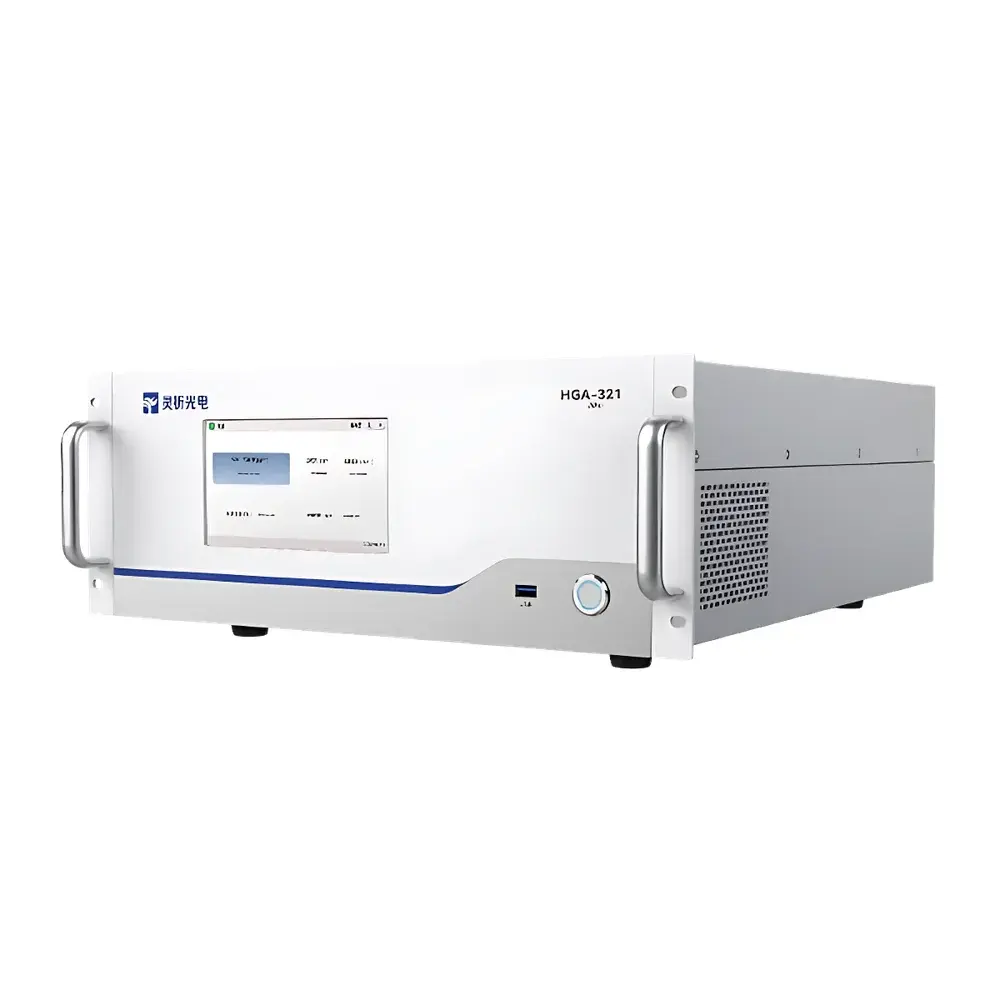
HGA-321 High-Precision Gas Analyzer by LINGXI Optoelectronics
| Brand | LINGXI Optoelectronics |
|---|---|
| Origin | Zhejiang, China |
| Model | HGA-321 |
| Detection Principle | Cavity Ring-Down Spectroscopy (CRDS) |
| Detectable Gases | CO₂, CH₄, NH₃, N₂O, H₂O |
| Compliance | Designed for environmental monitoring per ISO 14001-aligned field deployment |
| Software | Embedded real-time spectral processing with audit-trail logging |
| Data Output | RS232/RS485, Ethernet, optional analog 4–20 mA |
| Operating Temperature | 15–35 °C |
| Power Supply | 100–240 VAC, 50/60 Hz |
Overview
The HGA-321 High-Precision Gas Analyzer is an engineered solution for continuous, field-deployable trace-gas quantification in atmospheric science and environmental compliance applications. Built upon Cavity Ring-Down Spectroscopy (CRDS), the instrument delivers absolute concentration measurements without reliance on external calibration standards during routine operation. CRDS operates by injecting pulsed laser light into a high-finesse optical cavity formed by ultra-low-loss mirrors; gas-phase absorption is determined from the exponential decay rate of light intensity within the cavity—directly proportional to molecular number density. This first-principles methodology ensures traceability to fundamental physical constants, supporting metrological rigor required for regulatory-grade data collection. The HGA-321 is specifically optimized for ammonia (NH₃) detection at sub-pptv (parts-per-trillion by volume) sensitivity, while simultaneously resolving CO₂, CH₄, N₂O, and H₂O across overlapping near-infrared absorption features. Its compact optical cavity design minimizes residence time and enhances temporal resolution—critical for eddy covariance flux studies and transient emission characterization.
Key Features
- Sub-pptv detection limits for NH₃ (≤0.1 pptv @ 1 Hz, 1σ), validated against NIST-traceable reference gases
- Integrated multi-species quantification: simultaneous real-time measurement of CO₂, CH₄, N₂O, NH₃, and H₂O with cross-interference compensation algorithms
- Passivated internal flow path featuring SilcoNert®-coated stainless-steel tubing to minimize NH₃ surface adsorption and memory effects
- Self-referencing calibration architecture: CO₂ and H₂O channels serve as in-situ physical references to correct for mirror degradation, pressure drift, and temperature-induced cavity length variation
- Zero-consumables operation: no carrier gases, scrubbers, or replaceable filters required—reducing total cost of ownership and operational downtime
- Ruggedized industrial enclosure (IP54-rated) with active thermal stabilization (±0.1 °C control) for stable cavity alignment under ambient field conditions
Sample Compatibility & Compliance
The HGA-321 accepts sample gas streams at flow rates of 0.5–2.0 L/min with inlet pressure tolerance of 80–110 kPa. It accommodates humid samples up to 95% RH without condensation risk, leveraging heated sample lines and dual-stage thermoelectric cooling for dew-point management. All gas-contact surfaces comply with EPA Method TO-11A material compatibility requirements. Data integrity meets GLP/GMP-aligned documentation standards: onboard timestamping, digital signature support, and configurable audit trails satisfy FDA 21 CFR Part 11 readiness. Instrument firmware and data logs are structured to align with ISO 14064-2 (GHG inventory verification) and EU Directive 2003/87/EC monitoring guidelines. Calibration history, mirror reflectivity diagnostics, and cavity decay constant trends are exportable in CSV/NetCDF formats for third-party QA/QC review.
Software & Data Management
The embedded Linux-based acquisition system runs LINGXI’s proprietary CRDS Control Suite v3.2, providing local touchscreen interface and remote web access via HTTPS. Real-time spectral fitting employs least-squares deconvolution of multi-line Voigt profiles, with automatic baseline correction and pressure-broadening compensation. Raw ring-down decay waveforms and fitted parameters are archived at user-selectable intervals (100 ms to 1 hr). Data export supports Modbus TCP, MQTT, and FTP protocols for integration into SCADA, ICMS, or cloud-based environmental dashboards (e.g., AWS IoT Core, Azure IoT Hub). Firmware updates are delivered via signed OTA packages with SHA-256 verification. All configuration changes generate immutable log entries—including operator ID, timestamp, parameter name, pre-change value, and post-change value—for full forensic traceability.
Applications
- Urban and regional air quality networks requiring long-term NH₃ trend analysis and source apportionment
- Flux tower deployments for agricultural NH₃ emissions quantification using eddy covariance or relaxed eddy accumulation methods
- Mobile monitoring platforms assessing vehicle exhaust composition and aftertreatment system efficiency
- Laboratory studies of secondary particulate formation (e.g., ammonium nitrate aerosol nucleation)
- Indoor air quality assessment in livestock housing, wastewater treatment facilities, and fertilizer storage areas
- Validation campaigns for satellite-based GHG retrievals (e.g., TROPOMI, OCO-3) requiring ground-truth point measurements
FAQ
Does the HGA-321 require periodic calibration with certified standard gases?
No—its CRDS architecture enables zero-point stability and span accuracy verification through internal CO₂/H₂O referencing. Certified standards are only recommended annually for metrological validation or after major maintenance.
Can the analyzer operate unattended for extended periods in remote locations?
Yes—it supports solar-powered configurations with low-power sleep modes (<5 W standby), integrated data buffering (≥30 days), and watchdog-triggered auto-recovery.
How does the system handle water vapor interference in NH₃ measurement?
H₂O is co-quantified at high spectral resolution and used to dynamically correct NH₃ line broadening and collisional shift effects via embedded HITRAN-based modeling.
Is raw spectral data accessible for custom algorithm development?
Yes—full-resolution decay transients and calibrated absorbance spectra are available via API endpoint or direct SD card export in HDF5 format.
What certifications does the instrument hold for international deployment?
CE marking (EMC Directive 2014/30/EU, Low Voltage Directive 2014/35/EU); RoHS 2011/65/EU compliant; pending UL 61010-1 certification for North American markets.







