
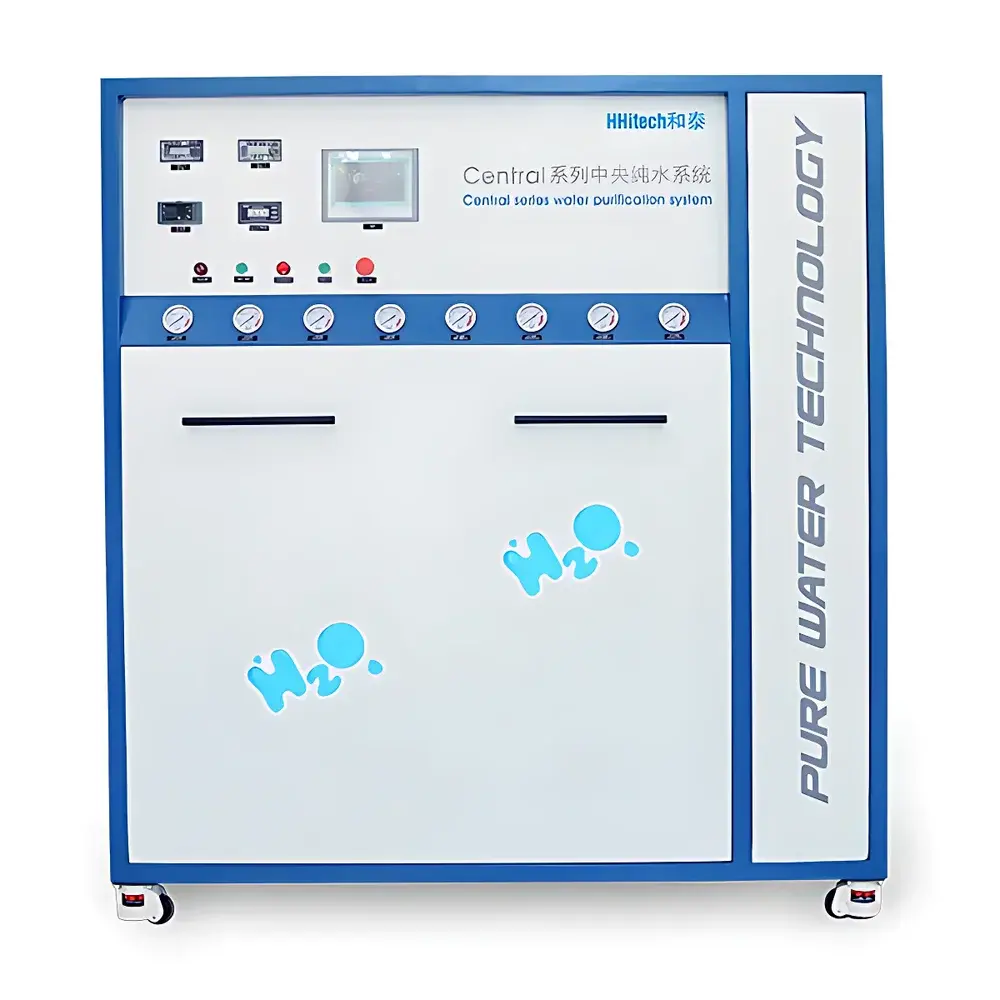
HHitech Central Series Centralized Ultra-Pure Water System
| Brand | HHitech |
|---|---|
| Origin | Shanghai, China |
| Manufacturer Type | Direct Manufacturer |
| Product Category | Domestic |
| Model | Central |
| Price Range | USD 7,000–14,000 (FOB) |
| Purified Water Grade | ASTM Type I / GB/T 6682-2008 Grade I |
| Resistivity | ≥18.2 MΩ·cm at 25°C |
| Heavy Metals & Soluble Silica | <0.1 ppb |
| Total Organic Carbon (TOC) | <3 ppb |
| Microbial Count | <1 CFU/mL |
| Endotoxin | <0.001 EU/mL |
| Particles (>0.1 µm) | <1 particle/mL |
| Production Capacity | 250 L/h or 500 L/h |
| Feed Water Requirement | Municipal tap water (TDS < 200 ppm, 5–45°C, pressure 0–5.0 kgf/cm²) |
| System Configuration | Integrated pretreatment + dual-stage RO + EDI + 150 L stainless steel RO storage tank + 280 L stainless steel EDI product tank + recirculating distribution loop |
| Optional Upgrades | DI polishing cartridge, 185/254 nm UV oxidation module, 5 kDa UF membrane, 0.22 µm MF filter |
| Compliance | Meets ASTM D1193-20, CLSI A2–A24, USP <1231>, EP 2.2.44, CAP Laboratory Standards, and GLP/GMP data integrity requirements per FDA 21 CFR Part 11 (with optional audit trail software package) |
Overview
The HHitech Central Series Centralized Ultra-Pure Water System is an engineered solution for centralized high-purity water supply in multi-laboratory facilities, research campuses, and pharmaceutical QC environments. Designed around a validated, multi-stage purification architecture, the system integrates pretreatment (quartz sand filtration, activated carbon adsorption, ion exchange softening, and 5 µm microfiltration), dual-stage reverse osmosis (RO), continuous electrodeionization (EDI), and closed-loop stainless steel storage and distribution. Its core function is to convert municipal or groundwater feed into consistently compliant ASTM Type I / GB/T 6682-2008 Grade I ultrapure water — characterized by resistivity ≥18.2 MΩ·cm, TOC <3 ppb, endotoxin <0.001 EU/mL, and sub-particulate (<0.1 µm) counts below 1 particle/mL. The system operates with two standard flow rates: 250 L/h and 500 L/h at 25°C, enabling scalable deployment across medium-throughput laboratories requiring stable, uninterrupted supply without point-of-use bottlenecks.
Key Features
- Integrated monolithic design: All subsystems — including dual-stage RO skid, EDI stack, 150 L 316L stainless steel RO water reservoir, 280 L 316L EDI product tank, and recirculating pump manifold — are factory-assembled and pre-validated to eliminate field integration risks and ensure hydraulic consistency.
- PLC-based process control architecture: Equipped with industrial-grade Siemens or Omron PLC controllers providing real-time monitoring and automated response for feed pressure, interstage differential pressure, tank level (ultrasonic + float switch redundancy), flow rate, temperature-compensated resistivity, TOC (optional), and leak detection across all wetted zones.
- Intuitive HMI interface: 7-inch color LCD touchscreen with multilingual UI (English default), graphical system status mapping, one-touch actuation of pumps/valves, and embedded event logging (≥10,000 entries with timestamp and operator ID).
- Electrical safety compliance: Full galvanic isolation between power circuits and fluid paths; low-voltage (≤24 VDC) actuation for solenoid valves and sensors; redundant overpressure, underlevel, dry-run, and UV lamp failure alarms.
- Modular upgrade path: Standard EDI output can be further polished via optional add-on modules — including mixed-bed deionization (DI), dual-wavelength (185/254 nm) UV photooxidation, ultrafiltration (5 kDa MWCO), and sterile-grade microfiltration (0.22 µm PES) — to meet application-specific demands for LC-MS, cell culture, or molecular diagnostics.
Sample Compatibility & Compliance
The Central Series delivers water that conforms to internationally recognized analytical and regulatory benchmarks. Its output meets or exceeds the specifications defined in ASTM D1193-20 (Type I), USP “Water for Pharmaceutical Purposes”, European Pharmacopoeia EP 2.2.44, CLSI Document A2–A24, and GB/T 6682-2008 (Grade I). For regulated environments, optional firmware enables 21 CFR Part 11-compliant electronic records — including user authentication, immutable audit trails, electronic signatures, and exportable CSV/Excel logs — supporting GLP, GMP, and ISO/IEC 17025 laboratory accreditation. The system’s stainless steel wetted surfaces (316L), sanitary clamp connections (DIN 11851), and zero-drain recirculation loop minimize biofilm risk and support routine sanitization via hot water (80°C) or ozone.
Software & Data Management
Data integrity is maintained through embedded logging with configurable retention policies. The HMI stores operational parameters, alarm history, maintenance prompts (e.g., cartridge replacement countdown), and calibration events. With optional RS232 or USB connectivity, raw data streams — including resistivity, TOC (if equipped), flow totals, and UV intensity — can be exported to LIMS or SCADA platforms. An optional cloud-enabled gateway supports remote diagnostics, predictive maintenance alerts, and fleet-wide performance benchmarking across multiple Central installations. All firmware updates are digitally signed and installed via secure USB transfer to prevent unauthorized modification.
Applications
This system serves as primary water source for applications demanding stringent chemical and biological purity: high-performance liquid chromatography (HPLC), gas chromatography–mass spectrometry (GC-MS), inductively coupled plasma atomic emission spectroscopy (ICP-AES) and mass spectrometry (ICP-MS), atomic absorption spectroscopy (AAS), total organic carbon (TOC) analyzers, ion chromatography (IC), electrochemical sensors, trace elemental analysis (sub-ppt level), nucleic acid amplification (PCR, qPCR), DNA sequencing, mammalian cell culture (including monoclonal antibody production), electrophoresis, and reagent preparation for ELISA and immunoassays. Its recirculating architecture ensures stable pressure and temperature delivery to multiple points-of-use simultaneously — critical for automated analyzers and cleanroom utilities.
FAQ
What feed water quality is required for optimal system performance?
Municipal tap water with TDS ≤200 ppm, temperature between 5–45°C, and inlet pressure of 0–5.0 kgf/cm² is recommended. Higher TDS or hardness may reduce RO membrane lifespan and increase regeneration frequency of pretreatment stages.
Can the Central system integrate with existing building plumbing infrastructure?
Yes — it features standardized 1.5” sanitary tri-clamp or ISO-KF connections and supports both pressurized and gravity-fed distribution loops. Custom manifolds and pressure-reducing stations are available upon request.
Is validation documentation provided?
Factory acceptance test (FAT) reports, IQ/OQ protocols, and blank PQ templates aligned with ISO 9001 and ASTM E2500 are supplied. On-site commissioning support and third-party validation services can be arranged.
How often does the EDI module require servicing?
Under typical municipal feed conditions, the EDI stack operates continuously for ≥2 years without chemical regeneration. Performance monitoring via real-time resistivity and current draw enables condition-based maintenance scheduling.
Does the system support remote monitoring and alarm notification?
With optional Ethernet or 4G LTE gateway, SMS/email alerts for critical faults (e.g., low-level, high TOC, UV failure) and live dashboard access via web browser are available.



