
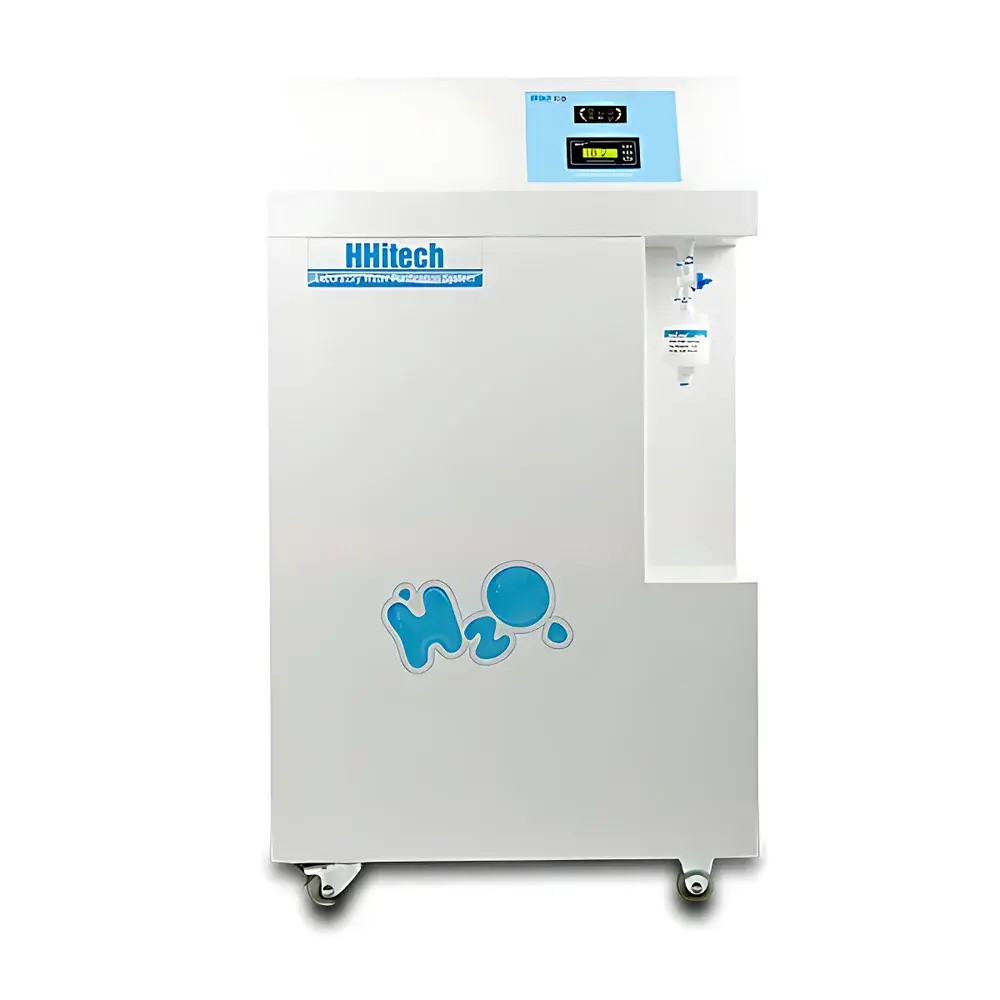
HHitech Pilot-QE Economical Ultra Pure Water System
| Brand | HHitech |
|---|---|
| Origin | Shanghai, China |
| Manufacturer Type | Direct Manufacturer |
| Product Category | Domestic |
| Model | Pilot-QE |
| Price Range | USD 1,400 – 4,200 (est.) |
| Purified Water Grade | ASTM Type I / ISO 3696 Grade 1 / GB/T 6682-2008 Class I |
| Resistivity | 10–18.2 MΩ·cm at 25 °C |
| Heavy Metals & Soluble Silica | <0.1 ppb |
| Total Organic Carbon (TOC) | <3 ppb |
| Microbial Count | <0.01 CFU/mL |
| Endotoxin | <0.001 EU/mL |
| Particles (>0.1 µm) | <1 particle/mL |
| Flow Rate | 45–125 L/h (at 25 °C, 200 ppm TDS feed) |
| Feed Water Requirement | Municipal tap water, TDS ≤200 ppm, 5–45 °C, pressure 1.0–4.0 kgf/cm² |
| RO Membrane | Dow FilmTec™ FT30 HR (USA-sourced) |
| Final Polishing Resin | Dow Optipore™ SD-2 nuclear-grade ion exchange resin |
| UV Wavelengths | 185 nm & 254 nm (imported low-pressure mercury lamp) |
| UF Module | MWCO 5000 Da, PES membrane (imported) |
| Terminal Filter | 0.2 µm PES hydrophilic membrane (NSF-certified) |
| Internal Storage | Dual 15 L pressurized tanks |
| Enclosure | Powder-coated stainless steel chassis |
| Compliance | NSF/ANSI 58, GLP-compliant design, meets ISO/IEC 17025 environmental monitoring prerequisites |
Overview
The HHitech Pilot-QE Economical Ultra Pure Water System is a laboratory-grade, integrated water purification platform engineered for consistent production of Type I ultrapure water per ASTM D1193, ISO 3696, and GB/T 6682-2008 standards. It employs a multi-stage purification architecture combining pre-filtration (PP + activated carbon), high-rejection reverse osmosis (RO), dual-stage deionization (DI), dual-wavelength ultraviolet oxidation (185/254 nm), ultrafiltration (5000 Da MWCO), and terminal 0.2 µm sterile filtration. This configuration ensures removal of particulates, ions, organics, nucleases, endotoxins, and microorganisms — delivering water suitable for HPLC, LC-MS, cell culture, molecular biology (PCR, qRT-PCR, transfection), trace metal analysis, and semiconductor rinsing applications. The system operates continuously under ambient laboratory conditions (5–45 °C), with automatic pressure regulation, real-time resistivity monitoring, and fail-safe operational logic to maintain integrity across extended duty cycles.
Key Features
- Microprocessor-controlled operation with animated LED LCD interface displaying real-time status: RO flush, DI regeneration, tank fill level, low-pressure alert, leak detection, and service countdown
- Three programmable RO membrane antiscalant rinse protocols: power-on initialization, low-flow recovery after interruption, and scheduled 30-second flush every 2 hours — extending membrane service life beyond 24 months under typical municipal feed conditions
- Integrated dual 15 L NSF-certified pressurized storage tanks — minimizing footprint while enabling stable delivery pressure without external booster pumps
- High-brightness backlit resistivity/conductivity sensor (0.01 µS/cm resolution) calibrated in-line for UPW, DI, and RO streams; includes factory-traceable certificate of calibration
- NSF-certified fluid path: all tubing, quick-connect fittings, and housings conform to NSF/ANSI 58 for RO systems and NSF/ANSI 61 for potable water contact materials
- Modular purification core: replaceable RO cartridge (Dow FilmTec™ FT30 HR), dual-column nuclear-grade resin pack (Dow Optipore™ SD-2), and field-serviceable UV/UF assembly — designed for rapid maintenance with minimal downtime
- GLP-aligned mechanical design: corrosion-resistant powder-coated stainless steel chassis, leveling feet for vibration-dampened placement, and internal routing space for future integration of recirculation loops or central distribution manifolds
Sample Compatibility & Compliance
The Pilot-QE is validated for compatibility with analytical instrumentation requiring ultrapure water input, including but not limited to: ICP-MS, AAS, IC, TOC analyzers, and automated DNA synthesizers. Its output meets or exceeds the water quality specifications mandated by USP , EP 2.2.44, and JP 17 for purified water used in pharmaceutical manufacturing and QC testing. Endotoxin levels (<0.001 EU/mL) and bioburden (<0.01 CFU/mL) comply with ISO 13485 Annex A requirements for medical device production support. All wetted components carry NSF/ANSI 58 and 61 certification documentation. The system supports audit-ready data logging when paired with optional RS232/USB interface modules compliant with FDA 21 CFR Part 11 electronic record requirements.
Software & Data Management
While the Pilot-QE operates via embedded firmware without cloud connectivity, its control module supports time-stamped event logging (e.g., alarm triggers, filter replacement reminders, conductivity excursions) stored locally on non-volatile memory. Optional HHitech DataLink™ software (v3.2+) enables USB-based export of daily water quality summaries, cumulative runtime metrics, and maintenance history — formatted as CSV for integration into LIMS or ELN platforms. Audit trails include operator ID (via optional RFID badge reader), timestamp, parameter value, and action taken — satisfying GLP documentation requirements for regulated laboratories. No proprietary drivers are required; standard CDC-class USB serial emulation ensures cross-platform compatibility with Windows, macOS, and Linux hosts.
Applications
- HPLC and UHPLC mobile phase preparation and column equilibration
- LC-MS solvent blanks and calibration standard dilution
- Mammalian and stem cell culture media formulation and buffer preparation
- Next-generation sequencing library prep and CRISPR reagent dilution
- Atomic spectroscopy (ICP-OES, ICP-MS) standard stock solution preparation
- Pharmaceutical stability studies per ICH Q5C guidelines
- Calibration of conductometric and amperometric sensors
- Electronics-grade cleaning of photomasks and wafers in R&D cleanrooms
FAQ
What feed water quality is required for optimal performance?
Municipal tap water with TDS ≤200 ppm, temperature between 5–45 °C, and inlet pressure of 1.0–4.0 kgf/cm² (14–58 psi). For feed TDS >200 ppm, an external softener or antiscalant dosing unit is recommended to prevent RO membrane fouling.
Can the system be integrated into a centralized water distribution network?
Yes — the chassis includes reserved internal volume and standardized 1/4″ NPT ports for adding a recirculation pump, UV loop sterilizer, and level-controlled reservoir — enabling conversion to a Pilot-QE SP-series central supply node.
How often must consumables be replaced?
Under typical lab usage (60 L/day, 200 ppm feed), RO membranes last 24–36 months; dual DI columns require replacement every 6–12 months; 0.2 µm terminal filters every 3–6 months; and UV lamps annually or after 9,000 hours of operation.
Is third-party validation support available?
HHitech provides IQ/OQ protocol templates aligned with ISO 9001 and GMP Annex 15, plus optional on-site qualification services performed by ISO/IEC 17020-accredited engineers.
Does the system meet FDA 21 CFR Part 11 requirements?
The base unit does not include electronic signature capability, but optional DataLink™ modules with password-protected user roles, audit trail encryption, and electronic record archiving satisfy Part 11 Subpart B controls when deployed in validated environments.



