
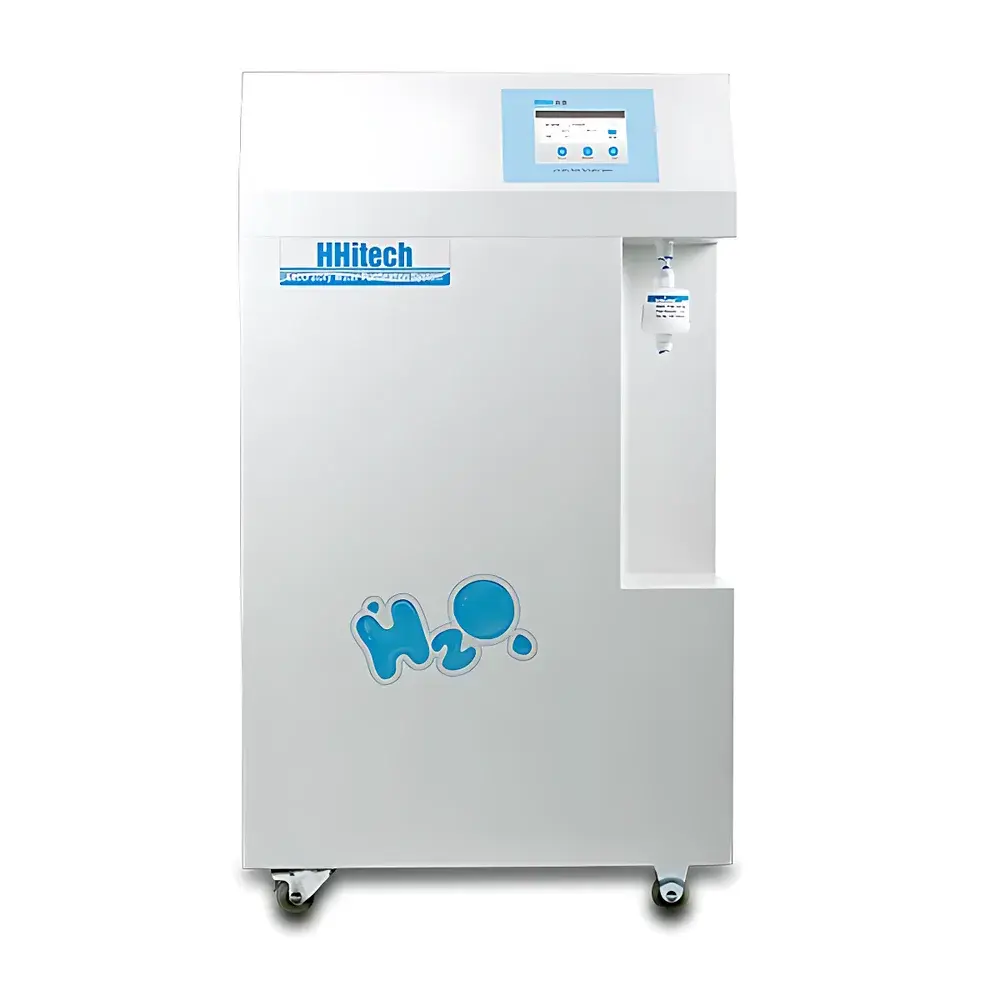
HHitech Pilot Ultra Pure Water System
| Brand | HHitech |
|---|---|
| Origin | Shanghai, China |
| Manufacturer Type | Manufacturer |
| Product Origin | Domestic |
| Model | Pilot |
| Price Range | USD 7,000–14,000 (FOB) |
| Purified Water Grade | Type I (ASTM D1193-20) |
| Resistivity | 18.2 MΩ·cm @ 25 °C |
| Heavy Metals & Soluble Silica | <0.01 ppb |
| Total Organic Carbon (TOC) | <3 ppb |
| Microbial Count | <0.01 CFU/mL |
| Endotoxin | <0.001 EU/mL |
| Particles (>0.1 µm) | <1 particle/mL |
Overview
The HHitech Pilot Ultra Pure Water System is an integrated, touch-enabled laboratory water purification platform engineered for continuous production of Type I ultrapure water (ASTM D1193-20, ISO 3696:1987, CLSI EP22-A, USP , EP 2.2.43) from municipal tap water. It employs a multi-stage purification architecture combining pretreatment (PP/KDF/AC), dual-stage reverse osmosis (RO), electrodeionization (EDI) or mixed-bed deionization (DI), optional ultraviolet oxidation (185/254 nm UV), ultrafiltration (MWCO 5000 Da), and 0.2 µm PES terminal filtration. The system is designed for centralized distribution in core laboratories, pilot-scale manufacturing facilities, biotech R&D centers, and clinical testing environments where consistent, trace-contaminant-free water is required for HPLC, LC-MS, cell culture, molecular biology (PCR, qRT-PCR, sequencing), and trace metal analysis.
Key Features
- 5-inch full-color capacitive touchscreen interface with animated menu navigation and multilingual UI support (English, German, French, Spanish)
- Triple-point real-time water quality monitoring: feed water, RO permeate, and final UP water — displayed without manual sampling
- Dual independent quantitative dispensing: programmable volume (10–999,999 mL) and resistivity-triggered dispensing (1.0–18.25 MΩ·cm)
- Recirculating UP loop with on-demand activation/deactivation to minimize microbial proliferation; configurable flow rate and circulation interval
- Comprehensive manual disinfection suite: “Loop Sanitization”, “Point-of-Use Sanitization”, “Tank Refill”, “Manual Drain”, and “Sanitization Stop”
- Smart consumables management: user-definable service intervals for PP, KDF, AC, RO membrane, UP resin, UF, UV lamp, and PES filter; lifetime tracking with auto-alerts
- Full system time/date configuration, standby timer (0–60 min), scheduled shutdown (0–24 h), and alarm logging for low feed pressure, tank overflow, and conductivity/resistivity excursions
- NSF/ANSI 61-certified fluid path components including tubing, fittings, and valves; stainless steel (304) powder-coated chassis compliant with GLP structural requirements
- Modular footprint: built-in dual 15 L pressurized storage tanks; optional external reservoir integration (up to 500 L); floor-standing design with adjustable leveling feet
- Factory- and user-level password protection (dual-tier access control) for all system configurations, calibration parameters, and maintenance logs
Sample Compatibility & Compliance
The Pilot system delivers water meeting or exceeding the most stringent international specifications for analytical and life science applications. Its output complies with GB/T 6682–2008 (China), GB/T 33087–2016 (ultrapure water for instrumental analysis), ASTM D1193–20 (Type I), CLSI EP22-A (water for clinical laboratories), USP (Water for Pharmaceutical Purposes), and European Pharmacopoeia 2.2.43. All critical performance metrics — including resistivity, TOC, endotoxin, RNase/DNase, and sub-0.1 µm particle counts — are continuously monitored and logged. The UF/UVF configuration satisfies ISO 13485 and FDA 21 CFR Part 11 requirements for electronic records when paired with audit-trail-enabled data export (see Software section). Final water is suitable for ICP-MS, GF-AAS, ELISA, stem cell expansion, and IVF media preparation.
Software & Data Management
The embedded controller features non-volatile internal memory capable of storing ≥12 months of timestamped operational data, including hourly conductivity/resistivity readings, UV intensity decay, UF transmembrane pressure differentials, and consumables usage duration. Data export is performed via USB 2.0 interface in CSV format, preserving full metadata (event type, severity level, timestamp, operator ID if logged in). Optional firmware upgrade supports encrypted export and configurable audit trail generation per FDA 21 CFR Part 11 Subpart B (electronic signatures, record retention, and change control). Historical alarms, calibration events, and service history are searchable by date range, parameter, or event category. No cloud connectivity is enabled by default; all data remains on-device unless explicitly exported.
Applications
- HPLC, UHPLC, and LC-MS mobile phase preparation and instrument rinsing
- Trace elemental analysis (ICP-OES, ICP-MS, GF-AAS) requiring ultra-low background metals
- Molecular biology workflows: PCR master mix preparation, oligonucleotide synthesis, NGS library construction
- Cell culture media formulation and passaging, including primary neuronal and pluripotent stem cell lines
- In vitro fertilization (IVF) and embryology labs requiring endotoxin- and nuclease-free water
- Pharmaceutical QC testing per USP and EP 2.2.43 for injectables and parenterals
- Calibration standard preparation for clinical chemistry analyzers and immunoassay platforms
- Centralized water distribution to multiple benchtop instruments across multi-floor laboratory buildings
FAQ
What feed water quality is required for optimal Pilot system performance?
Municipal tap water with TDS ≤ 500 ppm, chlorine ≤ 3 ppm, and SDI ≤ 5 is recommended. Pre-filtration is mandatory for high-silt or high-iron sources.
Can the Pilot system be validated per GMP/GLP requirements?
Yes. IQ/OQ documentation templates are provided. Full validation support includes installation qualification protocols, operational qualification test scripts, and performance qualification acceptance criteria aligned with ASTM D1193 and ISO 21648.
How often must consumables be replaced under typical lab usage?
RO membranes: 2–3 years (with automated anti-scaling flush); UP resin cartridges: 6–12 months (dependent on feed water TDS and daily UP volume); UV lamps: 12 months; UF modules: 18–24 months; PES final filters: 3–6 months.
Is remote monitoring supported?
No native Ethernet/Wi-Fi interface is included. Remote status checks require periodic USB data extraction and local review. Optional third-party SCADA integration is available via 4–20 mA analog outputs and Modbus RTU (RS485).
Does the system support integration with building management systems (BMS)?
Yes — dry-contact relay outputs (NO/NC) are provided for low-level alarm, high-level alarm, and system fault states; analog 4–20 mA signals for resistivity and flow rate are configurable.



