
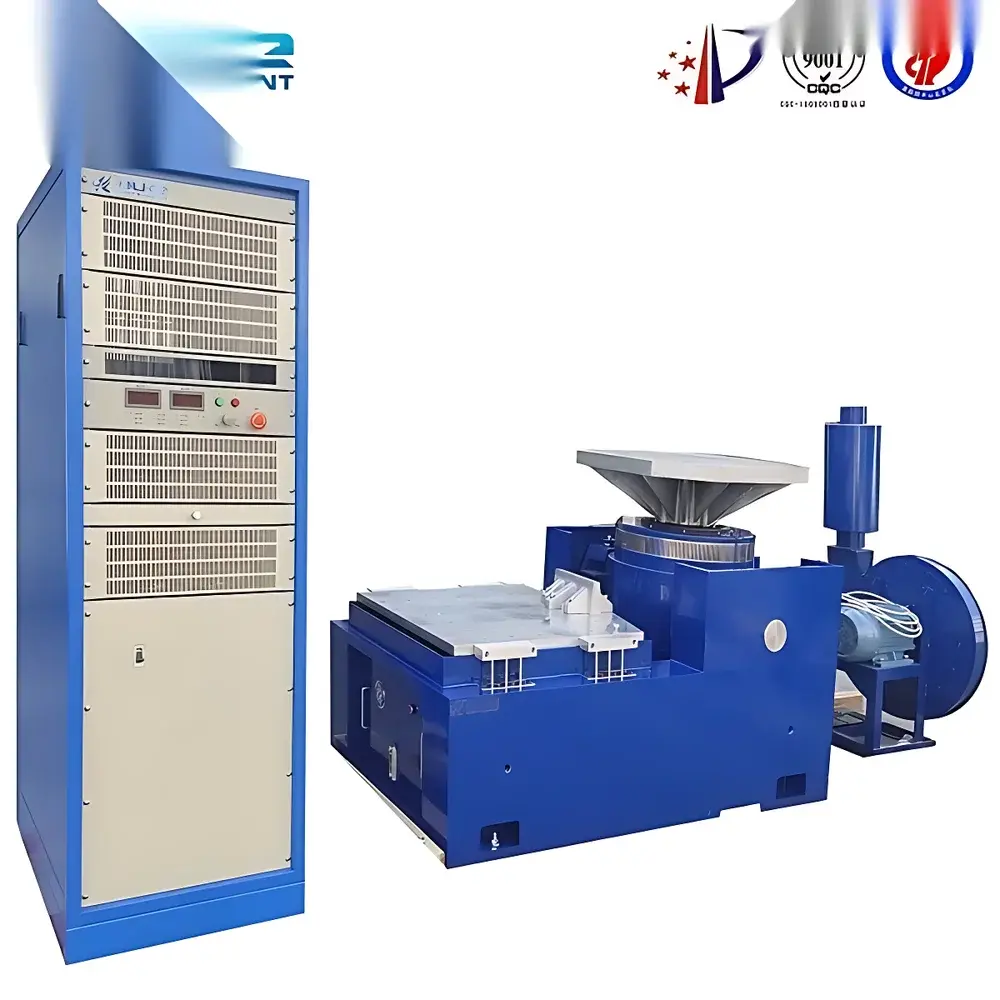
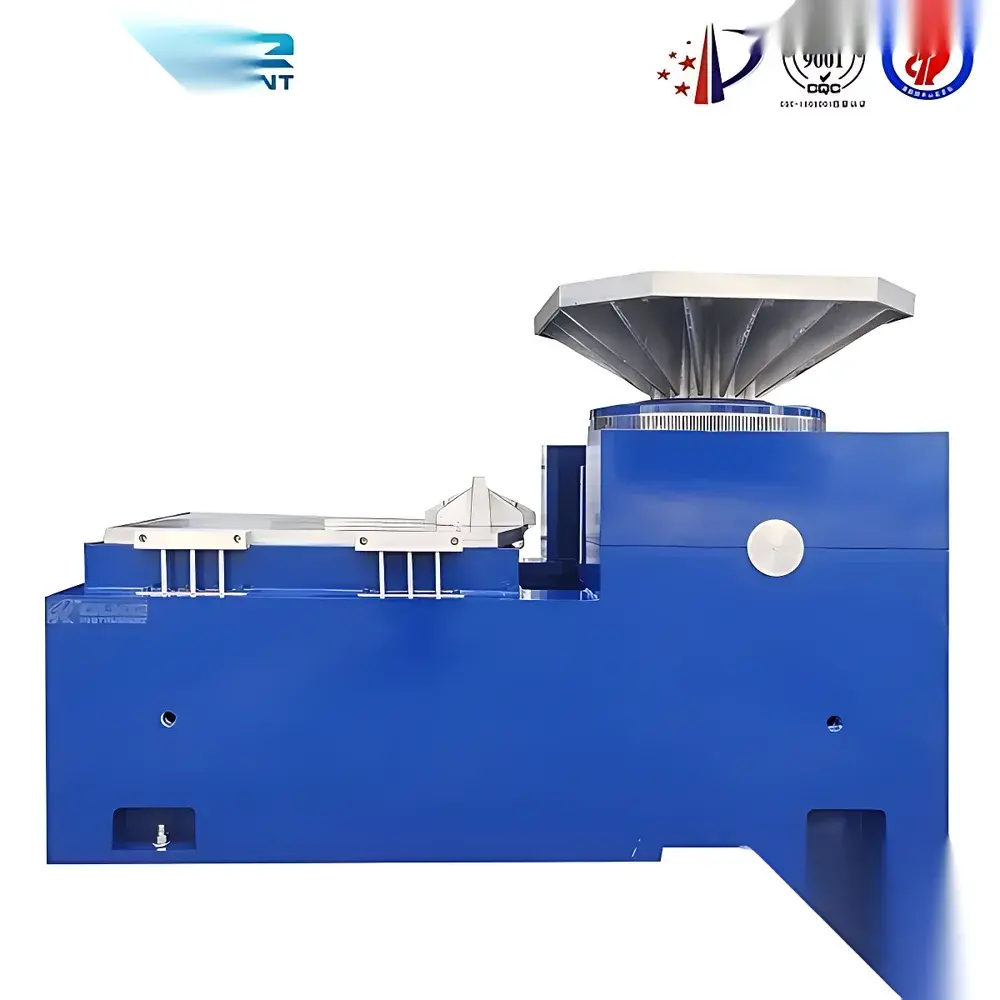
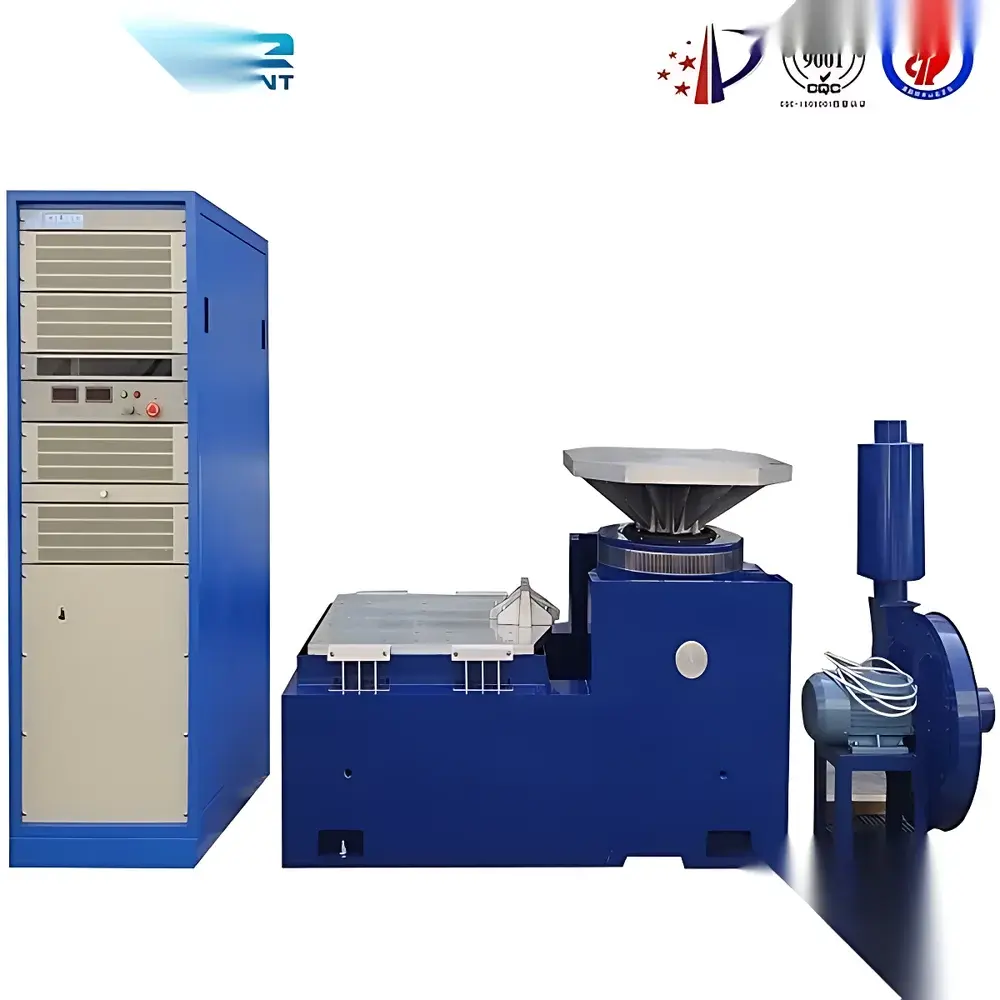
High-Frequency Vertical Vibration Testing System
| Brand | OEM |
|---|---|
| Origin | Imported |
| Manufacturer Type | Authorized Distributor |
| Price | USD 21,000 (FOB) |
| Table Surface | 500 × 500 mm |
| Max Load Capacity | 100 kg |
| Vibration Axes | X/Y/Z (Vertical Dominant) |
| Frequency Range | 1–600 Hz / 1–3000 Hz / 1–5000 Hz (Model-Dependent Selection) |
| Amplitude | 0–5 mm peak-to-peak |
| Max Acceleration | <20 g |
| Frequency Resolution | 0.01 Hz |
| Frequency Accuracy | ±0.1 Hz |
| Waveform | Sinusoidal |
| Timing Control | Single/Segment/Multi-Segment (0–9999 h/min/sec) |
| Input Power | AC 220 V / 50 Hz or AC 380 V / 50 Hz |
| Electromagnetic Immunity | Enhanced EMI Suppression Circuitry |
| Table Material | Non-Magnetic, Electrostatically Neutral Aluminum Alloy |
Overview
The High-Frequency Vertical Vibration Testing System is an electromechanical shaker platform engineered for precision sinusoidal vibration simulation in laboratory and production quality assurance environments. Based on electromagnetic excitation principles, it generates controlled vertical (Z-axis dominant) and optional triaxial (X/Y/Z) motion to replicate dynamic mechanical stresses encountered during transportation, handling, and operational service life. Designed in strict conformance with GB/T 2423.10–2008 — the Chinese national standard aligned with IEC 60068-2-6 for environmental testing of electrical and electronic products — the system delivers traceable, repeatable acceleration profiles across a broad frequency spectrum. Its core architecture integrates high-stiffness moving coil actuators, low-inertia aluminum alloy table construction, and real-time closed-loop feedback control to ensure long-term stability and minimal drift under sustained operation.
Key Features
- Four-point synchronous excitation mechanism ensures uniform acceleration distribution across the full 500 × 500 mm test surface, minimizing modal distortion and edge attenuation.
- Embedded amplitude prediction algorithm enables rapid, non-iterative amplitude calibration — reducing setup time while maintaining compliance with ISO 10816-1 vibration severity thresholds.
- Programmable timing architecture supports single-point dwell, multi-segment sequences, and nested sweep cycles (e.g., 10–30 Hz up-sweep → 30–10 Hz down-sweep → repeat), all definable via front-panel interface or remote command.
- Stepless amplitude adjustment (0–5 mm p-p) combined with fixed-frequency and linear/logarithmic sweep modes accommodates diverse test standards including MIL-STD-810H Method 514.8, ASTM D999, and JIS Z 8701.
- Dedicated EMI-hardened control electronics — featuring shielded cabling, ferrite suppression, and galvanic isolation — eliminate measurement artifacts caused by ambient electromagnetic fields, critical for testing sensitive sensors, MEMS devices, and RF modules.
- Non-magnetic, static-dissipative table surface prevents interference with magnetic storage media, Hall-effect sensors, and electron-beam instrumentation during concurrent testing.
Sample Compatibility & Compliance
The system accommodates specimens up to 100 kg with rigid mounting via threaded inserts or vacuum fixtures. It supports qualification testing of printed circuit assemblies (PCBAs), automotive ECUs, medical device enclosures, consumer electronics housings, and aerospace avionics subassemblies. All operational modes comply with GB/T 2423.10–2008, and its metrological performance aligns with ISO/IEC 17025 requirements for accredited vibration laboratories. Optional calibration certificates (traceable to NIM or NIST equivalents) and audit-ready test logs support GLP/GMP-regulated environments.
Software & Data Management
A Windows-based PC software suite (included) provides remote configuration, real-time waveform monitoring, automated report generation (PDF/CSV), and digital signature-enabled test record archiving. The software enforces role-based access control and maintains full audit trails per FDA 21 CFR Part 11 requirements, including operator ID, timestamped parameter changes, and electronic signatures for test initiation and completion. Data export supports integration with LIMS platforms and statistical process control (SPC) dashboards.
Applications
- Structural integrity validation of solder joints and BGA interconnects under resonant excitation.
- Resonance search and fatigue life estimation for automotive interior components (e.g., infotainment modules, instrument clusters).
- Package integrity assessment per ISTA 3A and ASTM D4728 for e-commerce logistics simulation.
- Pre-shipment screening of electro-mechanical assemblies prior to field deployment.
- Research-grade modal analysis when coupled with external laser Doppler vibrometry or accelerometer arrays.
FAQ
What frequency ranges are available, and how are they selected?
Three configurable frequency bands are offered: 1–600 Hz (standard), 1–3000 Hz (high-frequency option), and 1–5000 Hz (ultra-high-frequency variant). Selection is determined at order entry based on actuator coil design and armature mass; retrofitting is not supported.
Is the system suitable for random vibration testing?
No — this system is optimized exclusively for deterministic sinusoidal excitation. Random vibration capability requires a separate electrodynamic shaker with dedicated controller and PSD synthesis firmware.
Can the unit be integrated into an existing environmental test chamber?
Yes — the base frame includes M12 mounting interfaces and optional thermal isolation brackets. Electrical feedthroughs must be specified separately to maintain chamber integrity.
What documentation is provided for regulatory submissions?
Each unit ships with a Factory Calibration Report (including frequency response curve and linearity verification), GB/T 2423.10–2008 conformance statement, CE Declaration of Conformity, and RoHS compliance certificate.
How is traceability maintained for long-duration tests?
Internal RTC (real-time clock) with battery backup ensures uninterrupted timekeeping. All test events — including start/stop, mode transitions, and fault triggers — are logged with microsecond-resolution timestamps synchronized to system uptime.



