
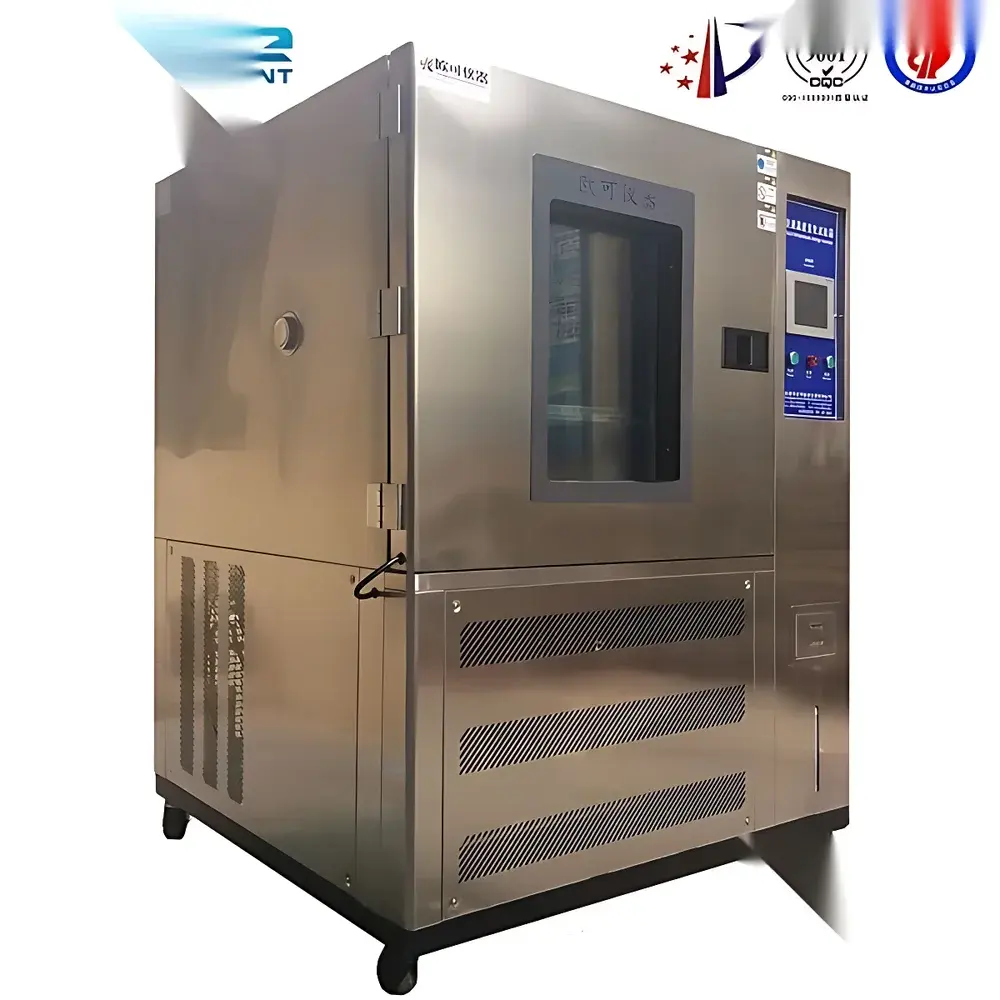
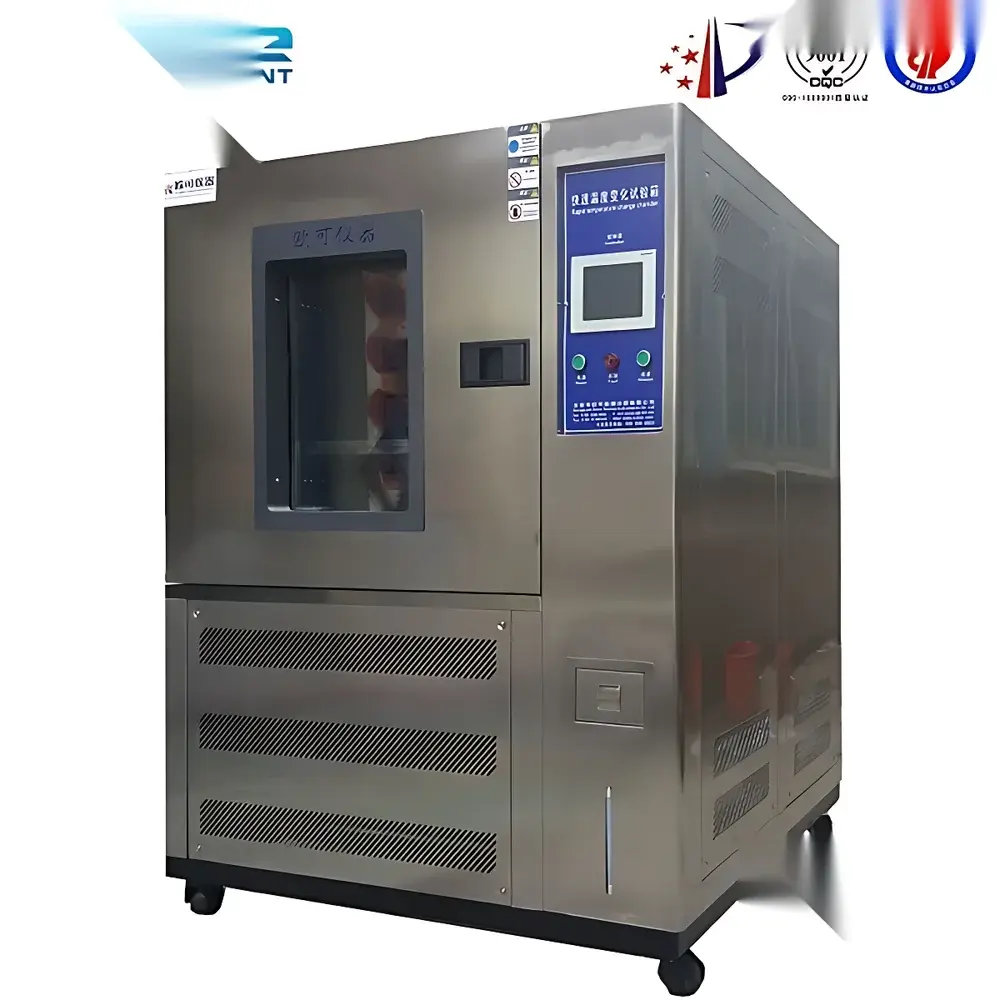
High-Performance Thermal Shock Test Chamber – Dual-Zone Rapid Temperature Transition System
| Key | Brand: Other Brands |
|---|---|
| Origin | Imported |
| Manufacturer Type | Authorized Distributor |
| Price | USD 14,000 (FOB) |
| High-Temp Zone Range | RT to +150 °C |
| Low-Temp Zone Range | RT to −40 °C |
| Transfer Time Between Zones | ≤15 s |
| Temperature Recovery Time | ≤5 min |
| Dwell Time per Zone | ≥1 h or until specimen thermal stabilization |
| Compliance Standards | MIL-STD-810H (Method 503.5), GJB 150.3A–2009, GJB 150.4A–2009, GB/T 2423.1–2023, GB/T 2423.2–2023, GB 10592–2023 |
Overview
The High-Performance Thermal Shock Test Chamber is an engineered dual-zone environmental simulation system designed to evaluate material and component resilience under extreme, rapid temperature transitions. Operating on the principle of mechanical transfer between isolated high-temperature and low-temperature chambers, it subjects test specimens to abrupt thermal excursions—typically defined as transitions exceeding 10 K/s in ambient air—and quantifies structural integrity, interfacial adhesion, solder joint reliability, and dimensional stability following repeated thermal cycling. Unlike single-chamber ramp-rate systems, this configuration eliminates thermal mass interference, ensuring strict adherence to dwell-time requirements and minimizing overshoot/undershoot during zone transitions. It is widely deployed in qualification testing for aerospace avionics, automotive power electronics, military-grade PCB assemblies, and high-reliability semiconductor packaging where failure modes such as delamination, crack propagation, or coefficient-of-thermal-expansion (CTE) mismatch must be identified early in the design validation cycle.
Key Features
- Dual independent chamber architecture with fully segregated hot and cold zones—eliminates cross-contamination and enables precise dwell control per IEC 60068-2-14 and MIL-STD-810H Method 503.5.
- Automated specimen transfer mechanism with ≤15-second transition time between zones, verified via calibrated platinum resistance thermometers (PRTs) mounted at specimen location.
- Temperature recovery time ≤5 minutes post-transfer, maintained within ±2 °C tolerance of setpoint across full operational range (−40 °C to +150 °C).
- Integrated forced-air circulation with non-turbulent flow profile to ensure uniform temperature distribution (±1.5 °C spatial uniformity per GB 10592–2023).
- Industrial-grade stainless-steel interior with double-wall vacuum-insulated construction; external cladding meets IP54 ingress protection rating.
- Programmable controller supporting up to 999 cycles, customizable dwell times, sequence logic (e.g., hot→cold→ambient soak), and real-time deviation alarms.
Sample Compatibility & Compliance
This thermal shock chamber accommodates specimens up to 500 mm × 500 mm × 500 mm (W×D×H) and supports standard mounting fixtures including DIN rail adapters, PCB carriers, and threaded base plates. All internal surfaces are electropolished 304 stainless steel, compatible with flux-free solder evaluation and conformal coating durability assessment. The system complies with national and international environmental test standards including GJB 150.3A–2009 (high-temperature exposure), GJB 150.4A–2009 (low-temperature exposure), GB/T 2423.1–2023 (cold), GB/T 2423.2–2023 (dry heat), and GB 10592–2023 (test chamber performance specification). Full traceability documentation—including factory calibration certificates for all PRT sensors, chamber uniformity mapping reports, and thermal transition validation data—is supplied with each unit. Optional audit-ready configurations support GLP/GMP environments through configurable electronic signatures and 21 CFR Part 11–compliant audit trails.
Software & Data Management
Control and monitoring are managed via a Windows-based HMI running proprietary firmware compliant with IEC 62443-3-3 security guidelines. The software provides synchronized multi-channel logging (up to 16 thermocouple inputs), real-time trend visualization, automatic report generation in PDF/CSV formats, and export of raw time-series data for statistical process control (SPC) analysis. All test profiles are stored with version control, user access logs, and timestamped modification history. Data integrity safeguards include cyclic redundancy checks (CRC), write-once archival mode, and encrypted local database storage. Optional integration with enterprise LIMS or MES platforms is supported via OPC UA 1.04 interface with TLS 1.2 encryption.
Applications
- Qualification of BGA, QFN, and wafer-level chip-scale packages under JEDEC JESD22-A104 accelerated thermal cycling protocols.
- Validation of adhesive bond strength in composite aircraft structures per ASTM D3410 and MIL-HDBK-17.
- Reliability screening of EV battery modules subjected to charge/discharge thermal transients.
- Testing of optical sensor housings exposed to desert-to-arctic deployment scenarios.
- Failure analysis root-cause investigation for solder voiding, intermetallic growth, and die attach degradation.
- Supporting MIL-STD-750 Method 1071 (thermal shock) and IPC-9701A (performance qualification of interconnects).
FAQ
What is the maximum specimen weight supported without compromising thermal response time?
The chamber supports specimens up to 25 kg; however, thermal inertia effects require adjustment of dwell time per GJB 150.1A–2009 Annex C guidance. A thermal mass correction factor table is provided in the operator manual.
Can the system be configured for three-zone operation (hot/ambient/cold)?
No—this model is strictly dual-zone. Three-zone capability requires the TS-3X series, which includes a dedicated ambient stabilization chamber and separate ISO Class 7 clean-air purge option.
Is NIST-traceable calibration included with delivery?
Yes—each unit ships with a full calibration certificate issued by an ILAC-MRA accredited laboratory, covering temperature uniformity, transition timing, and recovery accuracy across the full operating envelope.
How is condensation managed during cold-to-hot transfers?
A programmable pre-heating sequence activates the hot chamber’s dehumidification heater 30 seconds prior to specimen entry, maintaining relative humidity below 20% RH at +150 °C to prevent moisture-induced oxidation or flash boiling.



