
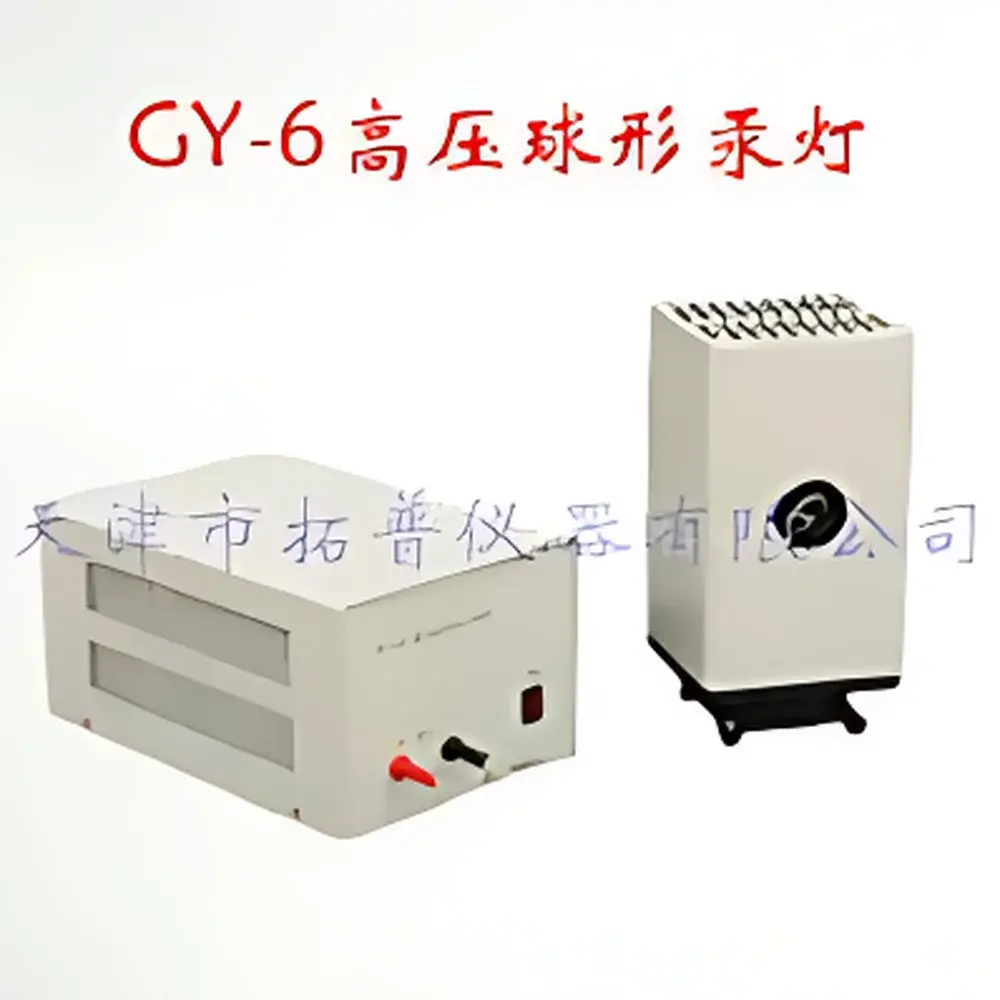
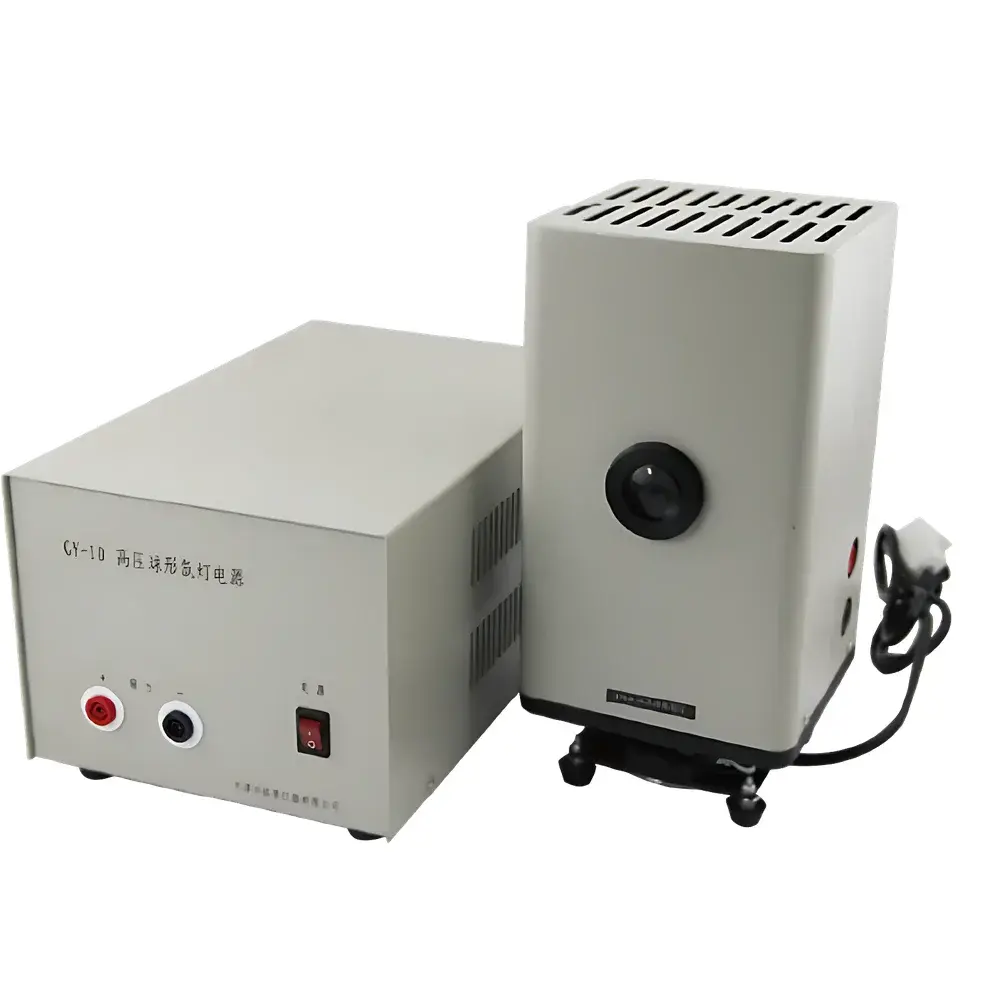
High-Pressure Spherical Mercury Lamp GY-6 by TOP
| Brand | TOP (TP) |
|---|---|
| Origin | Tianjin, China |
| Manufacturer Type | Direct Manufacturer |
| Country of Origin | China |
| Model | GY-6 |
| Power Rating | 200 W |
| Spectral Output | Intense UV and Visible Continuum + Characteristic Mercury Emission Lines (e.g., 253.7 nm, 365 nm, 404.7 nm, 435.8 nm, 546.1 nm, 577–579 nm) |
| Lamp Geometry | Spherical Arc Tube |
| Operating Position | Universal (Horizontal/Vertical) |
| Rated Lifetime | ≥1,000 hours (at rated power, with proper cooling) |
| Cooling Requirement | Forced-air or water-cooled fixture recommended |
Overview
The TOP GY-6 High-Pressure Spherical Mercury Lamp is a precision-calibrated arc discharge light source engineered for demanding optical metrology, spectroscopic calibration, and fluorescence excitation applications. Operating at 200 W, it generates high-radiance emission across the ultraviolet (UV) and visible (VIS) spectral range (185–700 nm), combining a continuous thermal background with sharp, well-defined atomic emission lines intrinsic to mercury vapor under high-pressure conditions (typically 2–10 MPa in the arc tube). Its spherical quartz envelope ensures isotropic spatial emission distribution and optimal thermal stability during extended operation—critical for reproducible irradiance delivery in collimated beam paths. Unlike low-pressure mercury lamps, the GY-6’s elevated pressure broadens line profiles slightly while maintaining sufficient resolution for wavelength reference use, making it suitable as a secondary standard for spectrometer wavelength calibration per ISO/IEC 17025-compliant laboratories.
Key Features
- Spherical fused silica arc tube geometry enabling uniform angular radiance and minimized self-absorption effects
- Stable 200 W DC or AC-powered operation with integrated thermal cutoff protection
- Characteristic mercury emission peaks at 253.7 nm (strongest UV line), 365 nm (UVA), 404.7 nm (violet), 435.8 nm (blue), 546.1 nm (green), and 577–579 nm (yellow doublet)—traceable to NIST SRM 2034 reference spectra
- Rated operational lifetime ≥1,000 hours when operated within specified voltage tolerance (±5%) and with adequate heat dissipation (minimum 2 m/s airflow or equivalent water cooling)
- Compatible with standard E26/E27 or PG12-2 base sockets depending on fixture configuration; electrical connections conform to IEC 61195 safety standards
- No integrated ballast—requires external constant-current or regulated AC power supply meeting lamp ignition voltage (≥1 kV) and running current specifications
Sample Compatibility & Compliance
The GY-6 lamp is designed for integration into optical benches, monochromator entrance slits, fluorescence microscope epi-illumination paths, and UV-VIS spectrophotometer calibration modules. It meets mechanical and photometric requirements for Class A spectral calibration sources per ASTM E275 and ISO 6947. The quartz envelope transmits down to ~185 nm, supporting applications in ozone-free UV environments. As a non-laser coherent source, it complies with IEC 62471 Photobiological Safety classification (Risk Group 2 for UV exposure without optics; RG3 when focused). For GLP/GMP-regulated facilities, lamp replacement logs, output intensity verification (via NIST-traceable radiometer), and warm-up stabilization time (≥15 min to photometric equilibrium) must be documented per internal SOPs.
Software & Data Management
While the GY-6 operates as a standalone analog light source, its spectral output is fully compatible with third-party spectroradiometric software platforms including Ocean Insight OceanView, Avantes ASE, and Horiba FluorEssence. Users may import NIST-referenced emission line databases (e.g., NIST Atomic Spectra Database v12.0) to perform automated peak identification and wavelength validation. When paired with a calibrated CCD spectrometer and thermally stabilized mount, the system supports audit-ready data export in CSV or HDF5 format—including timestamps, integration time, lamp hours, and ambient temperature—for 21 CFR Part 11–compliant electronic records where applicable.
Applications
- Wavelength calibration of UV-VIS spectrophotometers, monochromators, and array detectors
- Excitation source for qualitative and quantitative fluorescence microscopy (e.g., DAPI, FITC, TRITC channel validation)
- Reference irradiance source in photobiology studies assessing UV action spectra (per CIE S 013)
- Line-source validation in optical alignment systems requiring stable, discrete-wavelength references
- Teaching laboratories for atomic emission spectroscopy experiments and quantum energy level demonstrations
- Environmental monitoring instrument verification (e.g., UV absorption analyzers for NO₂ or SO₂)
FAQ
What is the recommended warm-up time before photometric stability is achieved?
A minimum of 15 minutes is required for radiant flux to stabilize within ±1% under constant power and thermal conditions.
Can the GY-6 be operated in vertical orientation?
Yes—its spherical design supports universal mounting; however, vertical operation requires confirmation of electrode alignment per manufacturer’s installation guide to avoid arc wander.
Is this lamp compliant with RoHS or REACH directives?
Yes—the quartz envelope and mercury amalgam formulation comply with EU Directive 2011/65/EU (RoHS 2) Annex III exemptions for scientific instrumentation, and material declarations are available upon request.
How often should spectral output be re-verified for calibration-critical use?
NIST-traceable radiometric verification is recommended every 200 operating hours or prior to each high-accuracy calibration campaign.
Does TOP provide a spectral irradiance certificate with each unit?
A factory-measured relative spectral power distribution (SPD) chart is included; full NIST-traceable absolute irradiance certification is available as an optional add-on service.




