
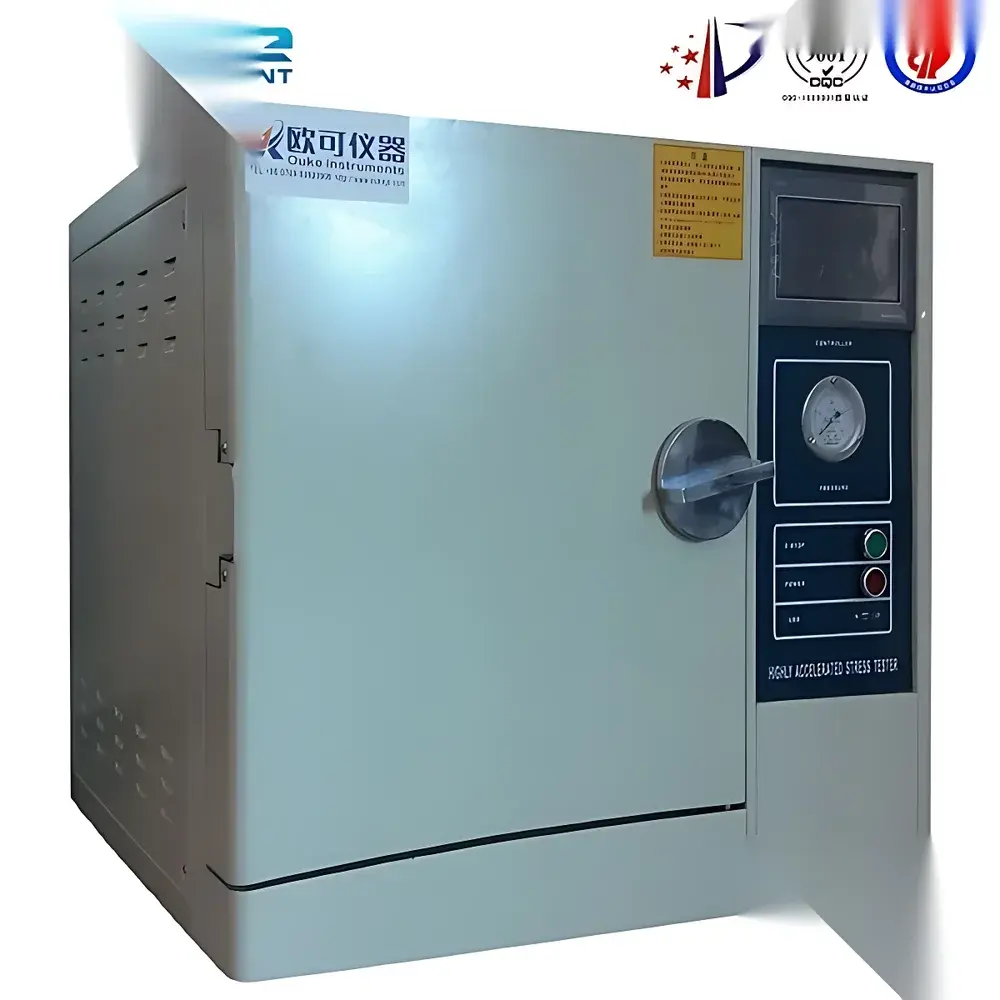
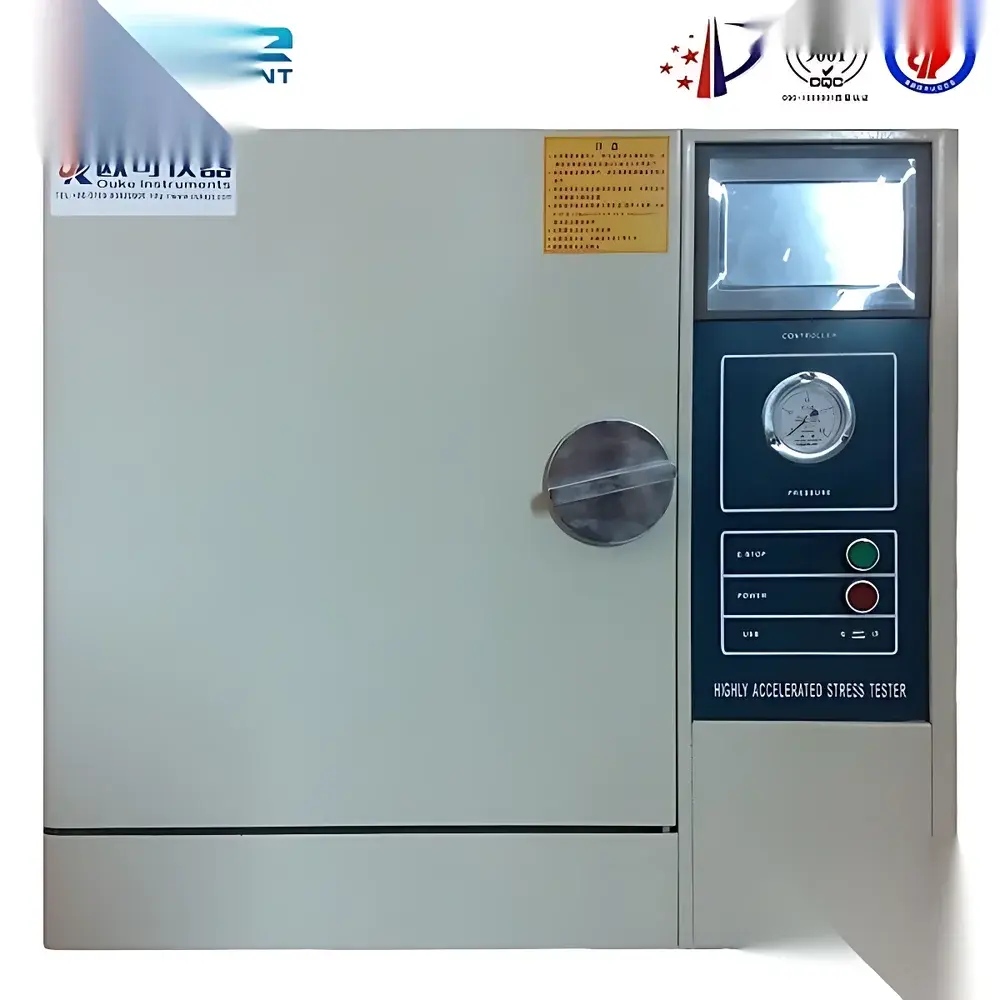
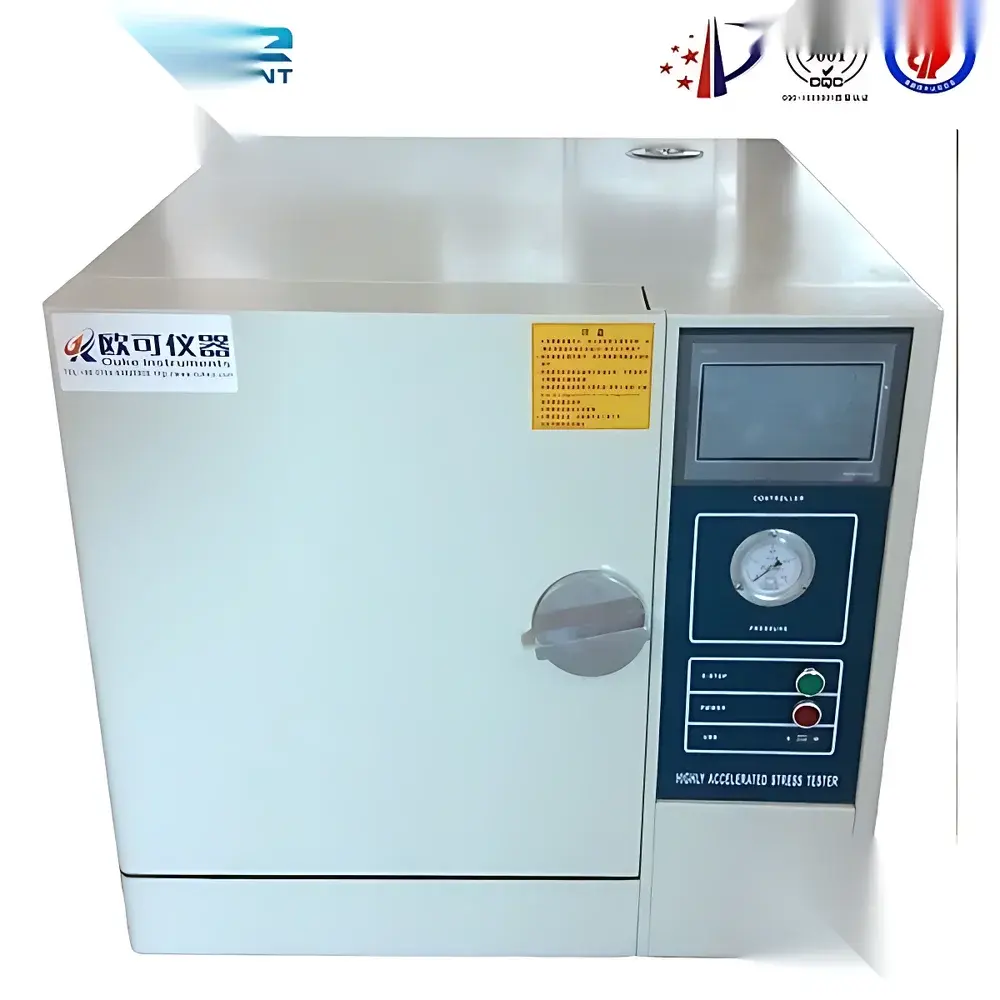
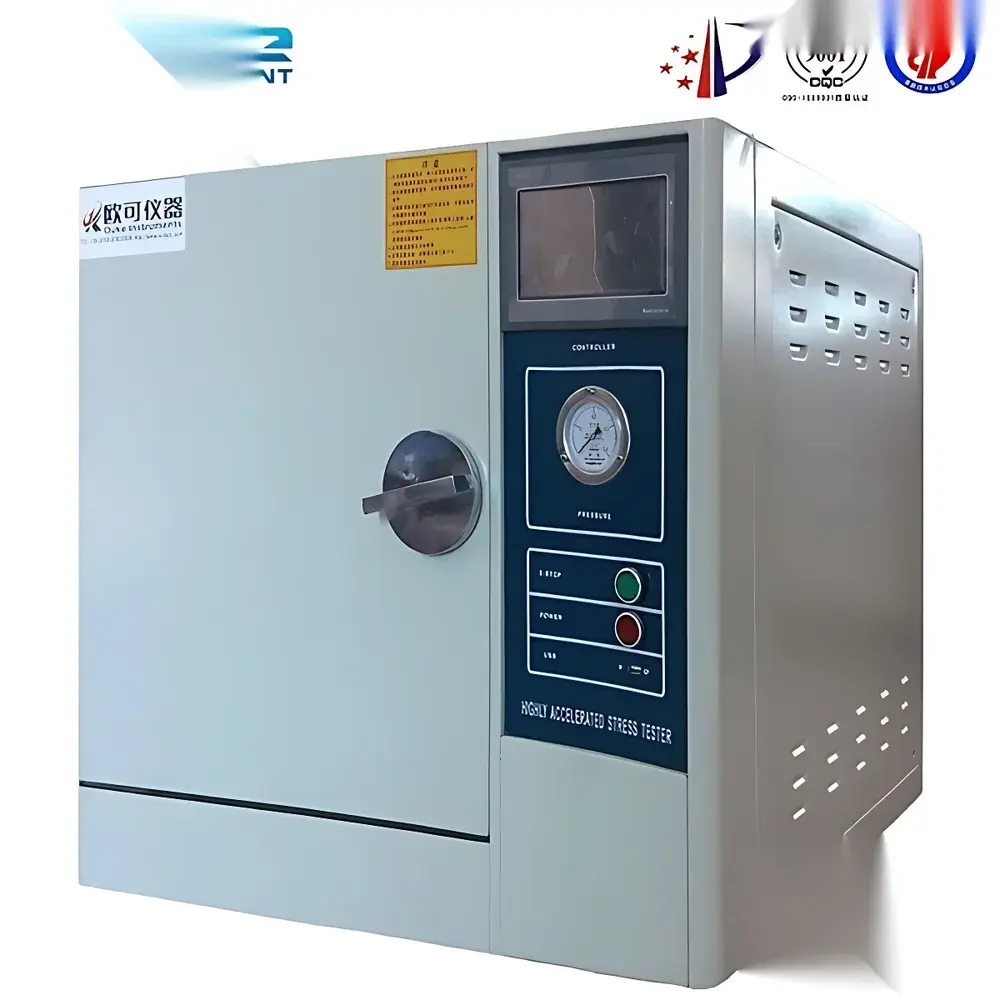
High-Pressure Steam Autoclave Chamber for Accelerated Reliability Testing
| Brand | Other Brands |
|---|---|
| Origin | Imported |
| Manufacturer Type | Authorized Distributor |
| Temperature Range | 105–132°C, 105–142.9°C, or 105–155°C |
| Pressure Range | 0.2–2.0 kg/cm² (gauge), 0.2–3.0 kg/cm² (gauge), or 0.2–3.5 kg/cm² (gauge) |
| Humidity Range | 75–100% RH (adjustable) |
| Temperature Resolution | 0.1°C |
| Humidity Resolution | 0.1% RH |
| Pressure Resolution | 0.1 kg/cm² |
| Temperature/Humidity Uniformity | ±0.5°C / ±5% RH |
| Non-Saturated Control Stability | ±0.5°C / ±2.5% RH |
| Saturated Control Stability | ±0.5°C / 100% RH |
| Chamber Dimensions (ID × Depth) | Φ25×35 cm, Φ30×45 cm, Φ40×55 cm, or Φ50×60 cm |
| Optional Bias Terminals | 8 (standard), up to 55 (configurable) |
| External Air Supply | Supported for pressure ramp-up |
| Pressurization Time | ~45–55 min (dependent on configuration) |
| Controller Interface | Bilingual (English/Chinese) display with USB and RS-232C ports |
| Data Logging | Real-time curve export via USB |
Overview
The High-Pressure Steam Autoclave Chamber is an engineered environmental stress test system designed for accelerated moisture-induced reliability evaluation of electronic components, printed circuit boards (PCBs), packaging materials, and hermetic seals under controlled high-temperature, high-humidity, and elevated-pressure conditions. Operating on the principle of saturated steam pressurization, it replicates harsh field environments—such as tropical climates or sealed enclosure condensation—to induce moisture diffusion, intermetallic corrosion, delamination, and conductive anodic filament (CAF) formation in a reproducible laboratory setting. Unlike legacy systems relying on theoretical vapor pressure interpolation, this chamber employs direct, real-time sensor fusion: calibrated platinum resistance thermometers (PRTs), capacitive humidity sensors, and piezoresistive pressure transducers deliver synchronized, traceable measurements—eliminating estimation errors and ensuring metrological integrity throughout each test cycle. Its architecture conforms to the physical basis of JEDEC JESD22-A102 (Steady-State Temperature-Humidity-Bias Life Test) and supports qualification protocols aligned with AEC-Q200, MIL-STD-883, and IEC 60068-2-66.
Key Features
- Triple-range pressure capability (up to 3.5 kg/cm² gauge) enables flexible test profile selection—from standard autoclave sterilization-equivalent conditions to aggressive accelerated aging per IPC-TM-650 2.6.25.
- Precision dual-mode humidity control: non-saturated operation for gradient-driven moisture ingress studies; saturated steam mode for full condensation simulation at 100% RH.
- Bilingual touchscreen controller with embedded data logging, real-time trend visualization, and export-ready curve files (CSV format) via USB or RS-232C interface.
- Modular bias terminal array (8 standard, expandable to 55 channels) rated for 125 V AC/DC at 1 A, supporting in-situ electrical monitoring during stress exposure—critical for HALT/HASS and failure mechanism analysis.
- External compressed air interface for rapid, repeatable pressurization cycles; integrated safety interlocks comply with ISO 13857 and EN 61000-6-2 for electromagnetic compatibility and mechanical safeguarding.
- Thermally optimized chamber wall design minimizes thermal gradients; validated uniformity of ±0.5°C and ±5% RH across all standard cavity configurations.
Sample Compatibility & Compliance
The chamber accommodates a broad range of sample geometries—including bare dies, QFN/QFP packages, BGAs, multilayer ceramic capacitors (MLCCs), and molded plastic housings—within its four standard internal dimensions. Its structural design adheres to mechanical robustness requirements for reliability testing equipment: avoidance of cantilevered elements, welded/cast frame construction for large-volume units, and precision-machined locating features for removable fixtures to suppress parasitic vibration and ensure repeatable mounting stiffness. All electrical subsystems undergo screening per MIL-STD-202G for shock and vibration resilience. The system is compatible with GLP-compliant audit trails when integrated with validated third-party LIMS platforms and satisfies functional safety prerequisites for Class II medical device component qualification per IEC 62304 Annex C.
Software & Data Management
The embedded controller firmware supports configurable test sequences, multi-step ramp/soak profiles, and alarm-triggered event logging (e.g., deviation >±0.8°C or >±3% RH). Exported datasets include timestamped temperature, relative humidity, absolute pressure, and optional bias voltage/current traces—formatted for direct import into MATLAB, JMP, or Weibull++ for statistical lifetime modeling. When deployed in regulated environments, optional software validation packages provide IQ/OQ documentation templates compliant with FDA 21 CFR Part 11 requirements, including electronic signature support, audit trail generation, and user-access-level management.
Applications
- Qualification of moisture sensitivity levels (MSL) per J-STD-020.
- Failure analysis of solder joint degradation and package cracking under thermo-hygro-mechanical stress.
- Validation of conformal coating barrier performance and adhesive bond integrity.
- Accelerated life testing (ALT) of automotive ECUs exposed to under-hood humidity cycling.
- Reliability screening for aerospace-grade hybrid microcircuits subjected to ground storage conditions.
- Process development support for wafer-level packaging and fan-out wafer-level packaging (FOWLP).
FAQ
What standards does this autoclave chamber support for qualification testing?
It is configured to execute JEDEC JESD22-A102, IPC-TM-650 2.6.25, and MIL-STD-883 Method 1030, with traceable calibration paths to NIST-traceable reference standards.
Can the chamber maintain true saturation at 100% RH while applying pressure?
Yes—the system uses direct steam saturation control with feedback from high-accuracy capacitive RH sensors, enabling stable 100% RH operation across the full pressure and temperature operating envelope.
Is remote monitoring and control possible?
While the base controller supports local USB/RS-232C connectivity, Ethernet-enabled variants are available with OPC UA server integration for SCADA and centralized lab management systems.
How is data integrity ensured during long-duration tests (e.g., 96+ hours)?
Internal non-volatile memory buffers all sensor data continuously; power-loss recovery preserves timestamps and resumes logging without gap upon restoration.
Are custom chamber sizes or material options available?
Yes—custom stainless-steel interior linings (e.g., Hastelloy C-276 for aggressive chemical resistance) and extended-depth cavities can be engineered upon request, subject to lead-time and validation requirements.
Related Products



