
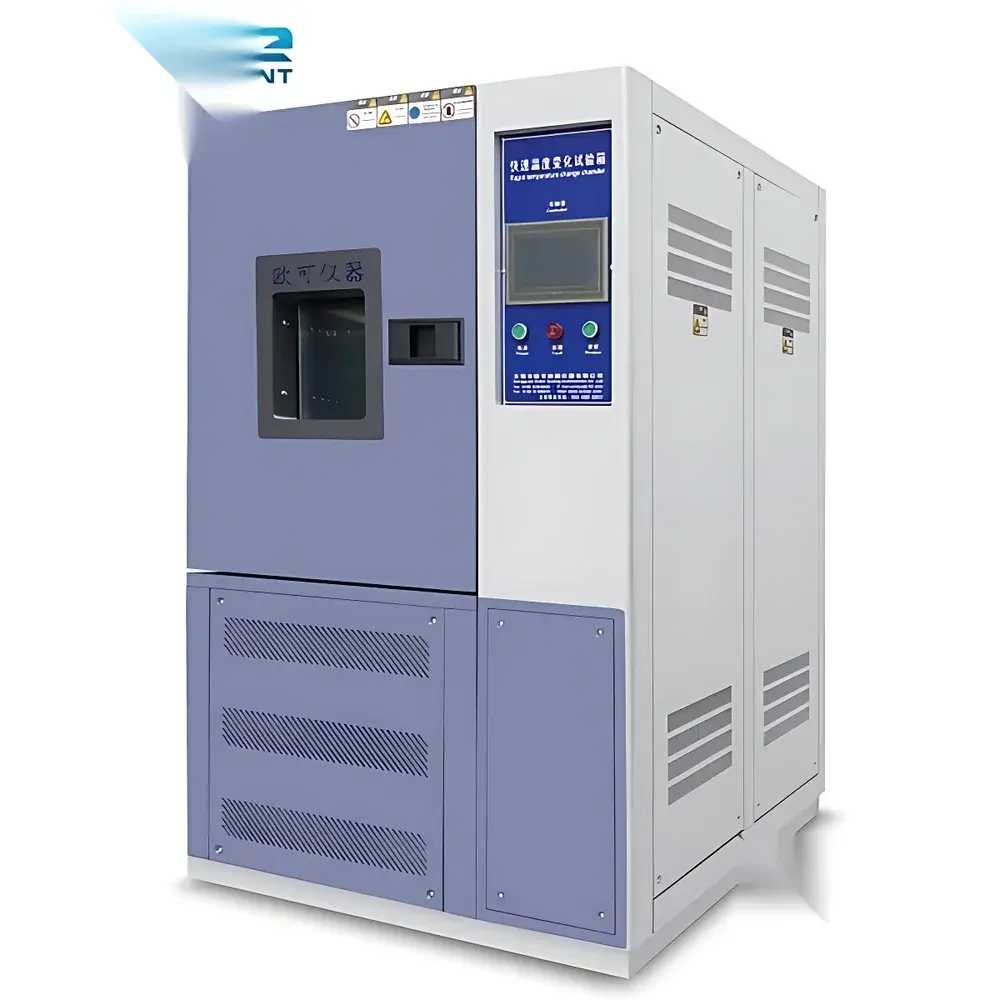
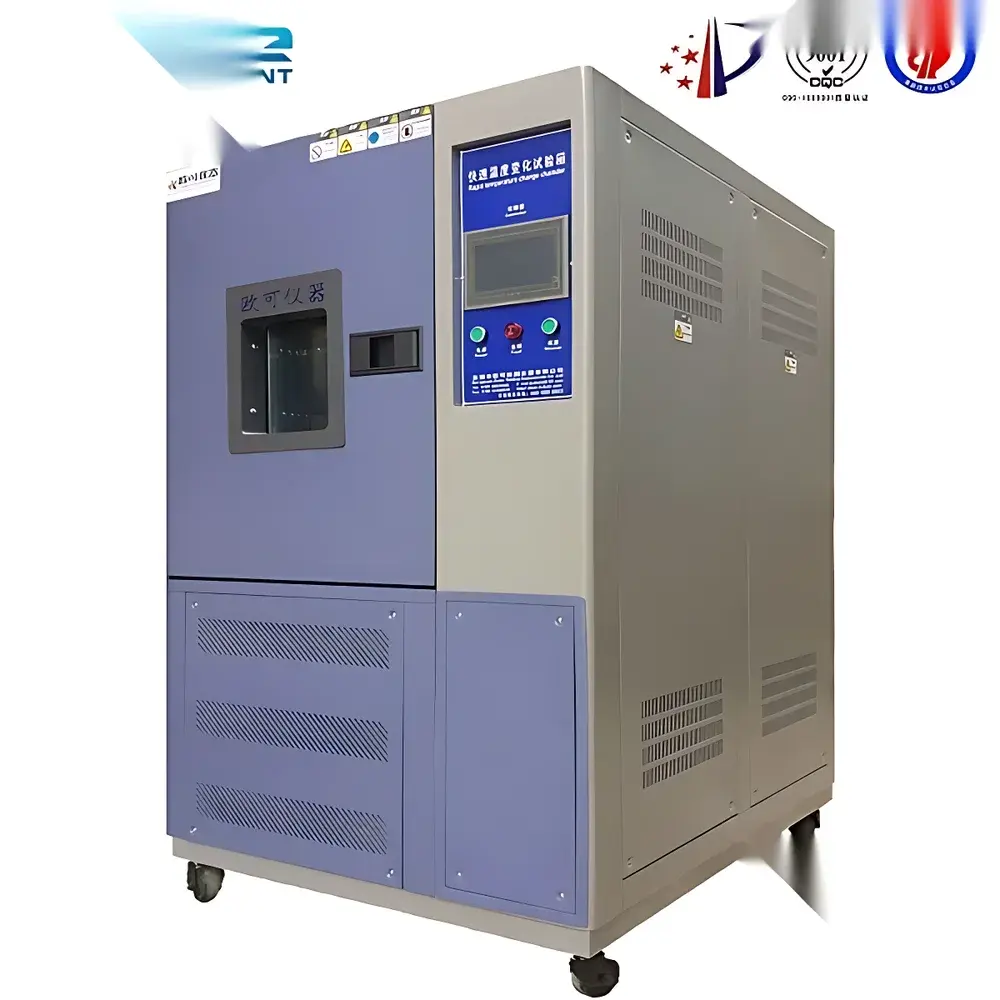
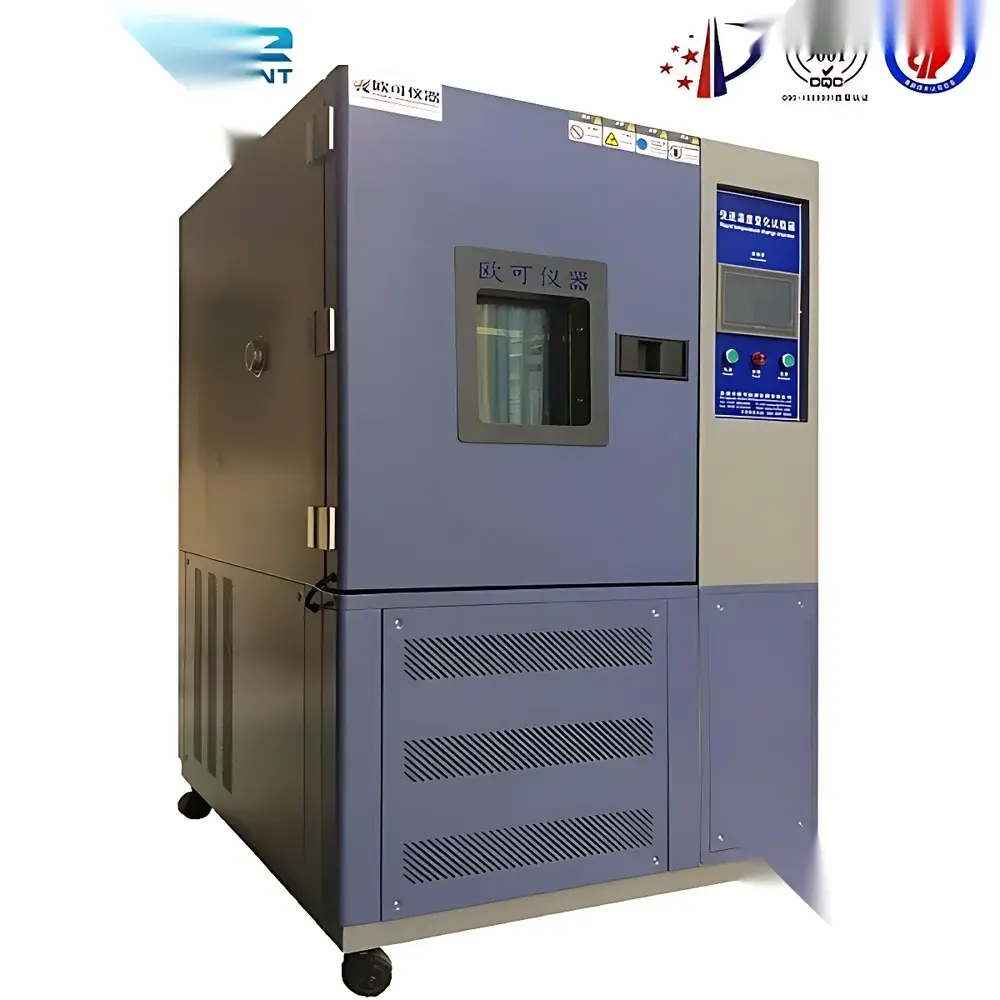
High-Speed Thermal Cycling Chamber Manufacturer (Custom OEM/ODM Supply)
| Brand | Other Brands |
|---|---|
| Origin | Imported |
| Manufacturer Type | General Distributor |
| Price | USD 2,650 (FOB) |
| Construction | A3 Steel Exterior with Phosphating & Electrostatic Powder Coating |
| Interior Material | SUS304 Stainless Steel 2B Finish |
| Insulation | Ultra-Thin, High-Density Glass Fiber |
| Door Seal | Dual-Layer High-Temperature-Resistant Silicone Rubber |
| Controller | TEMI300 Microcomputer-Based Temperature & Humidity Integrated Controller |
| Viewing Window | Multi-Layer Tempered Glass with Heating & Defrosting + LED Illumination |
| Standard Accessories | 2 Adjustable Test Sample Racks, 1 Φ50 mm Cable Port |
| Safety Protections | Leakage Current Protection, Short-Circuit Protection, Over-Temperature Cut-off, Low-Water Alarm, Compressor High-Pressure Shutdown, Overload & Over-Current Protection |
| Power Supply | AC 220 V or 380 V ±10%, 50 Hz, 3-Phase 4-Wire |
| Operating Ambient | 5–30 °C, ≤85% RH |
| Compliance | GB/T 2423.1–1993 (Cold Test), GB/T 2423.2–1993 (Dry Heat Test), GB/T 2423.4–1993 (Damp Heat, Steady State) |
Overview
The High-Speed Thermal Cycling Chamber is an environmental simulation system engineered for precise and repeatable rapid temperature transition testing under controlled thermal and humidity conditions. Based on forced-air convection with optimized airflow distribution and high-efficiency refrigeration-heating coupling, the chamber delivers programmable thermal ramp rates up to 10 °C/min (typical, dependent on load and setpoint range), enabling accelerated stress screening (ESS) and reliability validation of electronic components, automotive ECUs, aerospace subsystems, and industrial control modules. Its design adheres to fundamental principles of thermodynamic equilibrium control and transient thermal response modeling, ensuring traceable test repeatability across multiple cycles. The chamber operates within a standard temperature range of –70 °C to +150 °C and humidity range of 20–98% RH (depending on temperature), supporting both standalone thermal cycling and combined temperature-humidity profiles.
Key Features
- Robust dual-layer structural architecture: exterior A3 carbon steel with phosphated surface treatment and electrostatic epoxy-polyester powder coating; interior lined with mirror-finished SUS304 stainless steel (2B grade) for corrosion resistance and cleanability.
- High-performance insulation system utilizing ultra-thin, low-conductivity glass fiber (density ≥48 kg/m³), minimizing thermal bridging and enhancing energy efficiency during dynamic cycling.
- TEMI300 microprocessor-based controller with integrated PID algorithms for temperature and humidity regulation — featuring real-time digital display, programmable multi-segment profiles (up to 99 segments), data logging capability, and RS485 communication interface.
- Dual-seal door assembly with compression-molded silicone rubber gaskets rated for continuous operation from –70 °C to +200 °C, ensuring long-term sealing integrity and minimal leakage rate (<0.5% volume/hr).
- Multi-layer heated and defrosted observation window with embedded LED lighting, providing unobstructed visual monitoring without condensation interference during low-temperature operation.
- Comprehensive safety architecture including independent mechanical over-temperature cut-offs, refrigerant high-pressure switches, phase-loss detection, ground-fault circuit interruption (GFCI), and automatic water-level monitoring for humidification systems.
Sample Compatibility & Compliance
This thermal cycling chamber accommodates a wide variety of sample types—including PCB assemblies, sensor modules, battery packs, optical housings, and medical device enclosures—via two adjustable stainless-steel sample racks and a centrally located Φ50 mm cable port with silicone grommet. All operational parameters are calibrated and verified in accordance with ISO/IEC 17025-accredited procedures. The system satisfies national and international environmental test standards including GB/T 2423.1–1993 (cold), GB/T 2423.2–1993 (dry heat), GB/T 2423.4–1993 (damp heat steady state), and serves as a functional equivalent to IEC 60068-2-1, IEC 60068-2-2, and MIL-STD-810H Method 502.7 for laboratory-based thermal stress evaluation. It supports GLP-compliant test documentation when paired with optional audit-trail-enabled software.
Software & Data Management
The TEMI300 controller supports external data acquisition via Modbus RTU protocol over RS485. Optional PC-based software (sold separately) enables full profile programming, real-time monitoring, automated report generation (PDF/CSV), and electronic signature support compliant with FDA 21 CFR Part 11 requirements for regulated industries. All logged data includes timestamp, setpoint, actual chamber values, alarm events, and operator ID — stored with SHA-256 hash integrity verification. Data export conforms to ASTM E2500-13 guidelines for equipment qualification records.
Applications
- Accelerated life testing of automotive electronics subjected to extreme ambient transitions (e.g., engine bay thermal shock).
- Qualification of avionics hardware per DO-160 Section 4 (Temperature Variation) and Section 5 (Altitude/Temperature).
- Reliability assessment of Li-ion battery modules under repeated charge/discharge cycles coupled with thermal excursions.
- Validation of hermetic seal integrity in MEMS devices using thermal gradient-induced stress analysis.
- Environmental stress screening (ESS) of military-grade connectors and RF components prior to field deployment.
- Material compatibility testing for conformal coatings, adhesives, and potting compounds exposed to cyclic thermal-hygroscopic loading.
FAQ
What is the typical thermal ramp rate achievable with this chamber?
Standard configuration supports average ramp rates of 5–10 °C/min between –40 °C and +85 °C under no-load conditions; actual performance varies based on sample mass, thermal inertia, and humidity setpoints.
Can the chamber operate in humidity-free thermal cycling mode?
Yes — the humidification system can be disabled independently, allowing pure temperature cycling from –70 °C to +150 °C without moisture introduction.
Is third-party calibration certification available?
Yes — NIST-traceable calibration certificates (including temperature uniformity, stability, and ramp verification) are available upon request, aligned with ISO/IEC 17025 scope.
Does the system support remote monitoring and control?
Via optional Ethernet gateway module and dedicated SCADA integration package, enabling secure web-based access and alarm notification via SMTP/SNMP protocols.
What maintenance intervals are recommended for long-term reliability?
Compressor oil and refrigerant filter replacement every 24 months; door gasket inspection and cleaning quarterly; controller firmware updates per manufacturer release schedule (typically biannual).



