
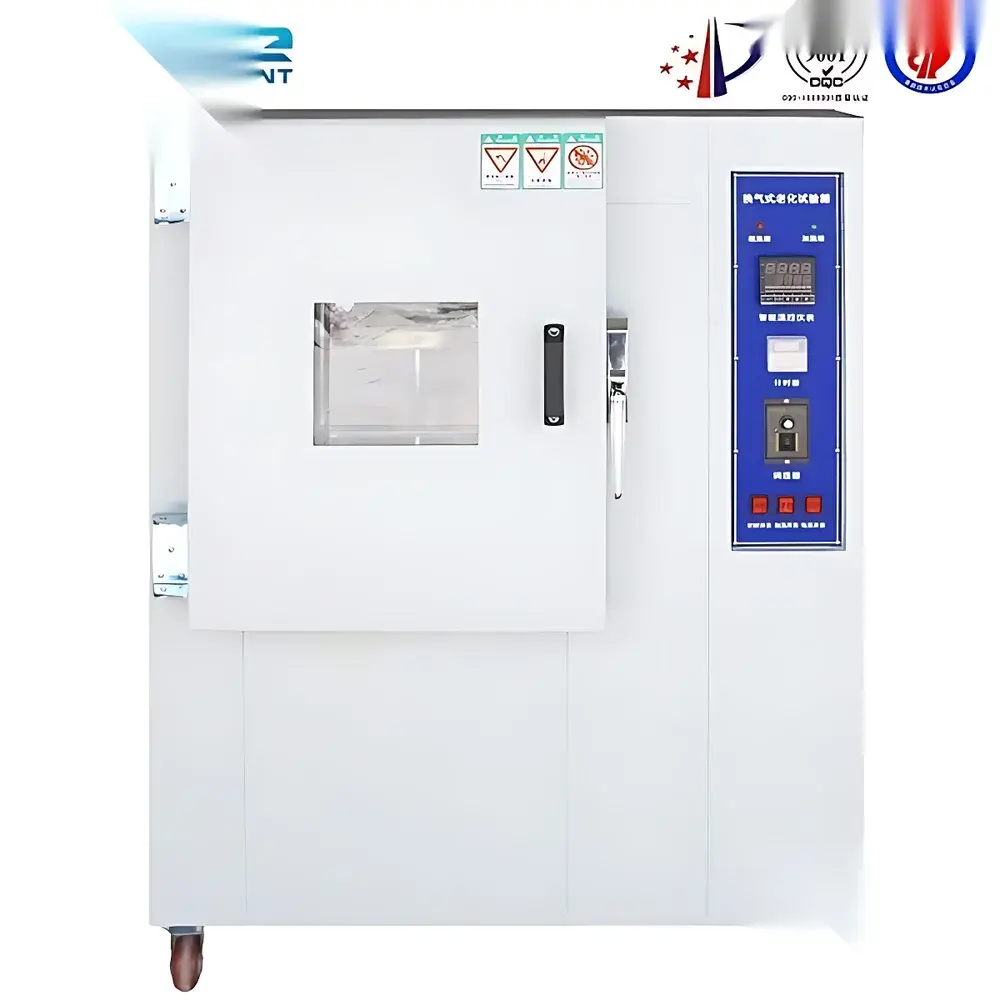
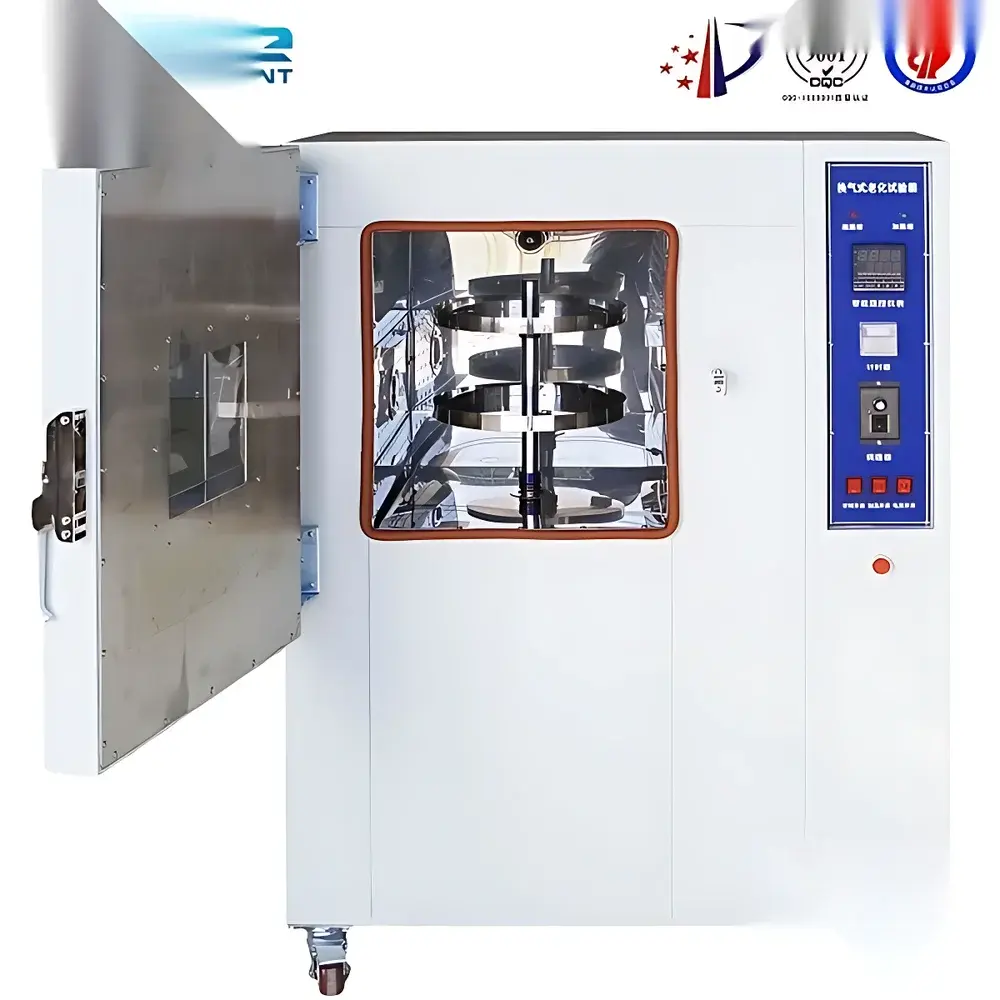
High-Temperature Air-Exchange Aging Test Chamber – OK-HQ Series (Imported, OEM-Supplied)
| Key | Brand: Other Brands |
|---|---|
| Origin | Imported |
| Manufacturer Type | Authorized Distributor |
| Price | USD 2,650 (FOB Reference) |
| Temperature Range | RT+10°C to 200°C/300°C |
| Temperature Uniformity | ±2°C |
| Temperature Fluctuation | ±0.5°C |
| Air Exchange Rate | 2–100 cycles/hour |
| Adjustable Exchange Interval | 1 min–99 h |
| Chamber Insulation | High-Density Glass Fiber |
| Internal Material | SUS304 Stainless Steel |
| External Material | A3 Steel with Powder Coating |
| Controller | PID-Based Digital Microcomputer with Timer (1–9999 min) |
| Safety Protections | Overtemperature, Overcurrent, Leakage, Motor Overheat, Short-Circuit |
| Compliance | ASTM D5423-09 (Type II), ASTM D5374-93 (2005), UL 1581, GB/T 2423.2, IEC 60068-2-2, JIS C 0040, VDE 0470 |
Overview
The OK-HQ Series High-Temperature Air-Exchange Aging Test Chamber is an engineered environmental simulation system designed for accelerated thermal aging evaluation of polymeric and insulating materials under controlled oxidative conditions. Based on the principle of forced-convection air exchange within a thermally stabilized chamber, it replicates long-term exposure to elevated temperatures and ambient oxygen levels—critical for assessing degradation mechanisms such as oxidation-induced embrittlement, tensile strength loss, surface cracking, and insulation resistance decay in wires, cables, rubber compounds, textiles, and plastic components. Unlike static oven systems, this chamber integrates precision-regulated airflow dynamics to maintain consistent oxygen partial pressure and thermal homogeneity across the test volume—enabling reproducible, standards-aligned aging protocols per ASTM D5423 (Type II laboratory ovens) and IEC 60068-2-2.
Key Features
- Robust dual-layer chamber construction: Inner liner fabricated from electropolished SUS304 stainless steel (mirror finish) for corrosion resistance and ease of cleaning; outer shell formed from cold-rolled A3 steel with durable epoxy-polyester powder coating.
- High-efficiency thermal insulation using ≥80 mm thick ultra-fine glass fiber matting—minimizing heat loss and improving energy efficiency during extended high-temperature operation.
- Horizontal forced-air circulation system with low-noise, high-temp-rated centrifugal blower and symmetrical baffle-guided airflow distribution—ensuring temperature uniformity ≤±2°C across full working volume.
- Digital PID microprocessor controller with real-time display of setpoint, actual temperature, elapsed time, and remaining timer duration; resolution: 0.1°C for both setting and indication.
- Programmable air exchange control: Independent adjustment of exchange frequency (2–100 cycles/hour) and interval timing (1 minute to 99 hours), enabling precise replication of service-life oxidative stress profiles.
- Integrated instrumentation suite: Digital voltmeter, ammeter, and watt-hour meter for real-time power consumption monitoring and energy accountability during qualification testing.
- Standardized 50 mm diameter test port on left sidewall (with silicone gasket seal) for external sensor feedthrough, voltage biasing, or signal line routing without compromising chamber integrity.
- Rotating sample platform (diameter options: Φ250–Φ700 mm) with low-RPM drive—promoting uniform exposure of multi-sided specimens to thermal and oxidative gradients.
Sample Compatibility & Compliance
The OK-HQ chamber accommodates flat, cylindrical, and flexible specimens—including insulated wires, elastomeric hoses, textile laminates, and molded polymer parts—within defined working volumes ranging from 100 L to 800 L. Its design meets mechanical and thermal performance requirements specified in multiple international standards: ASTM D5423-09 (Type II forced-ventilation ovens), ASTM D5374-93(2005) (electrical insulation aging), UL 1581 (wire and cable reference testing), GB/T 2423.2 (Chinese national standard for high-temperature testing), IEC 60068-2-2 (environmental testing—Part 2: Tests), JIS C 0040 (Japanese industrial standard for heat resistance), and VDE 0470 (German safety certification for insulating materials). All models support GLP-compliant documentation when paired with optional data logging accessories.
Software & Data Management
While the base configuration features a standalone LED/PID controller, optional RS485 communication interface enables integration with PC-based data acquisition platforms (e.g., LabVIEW, MATLAB, or custom SCADA systems) for automated logging of temperature, cycle count, runtime, and power metrics. The controller supports audit-trail-capable event logging (power-on, setpoint change, alarm activation) when used with compliant software—facilitating traceability for ISO/IEC 17025-accredited laboratories and FDA 21 CFR Part 11–aligned workflows where electronic records are required. Firmware updates and calibration verification procedures follow documented manufacturer protocols aligned with ISO/IEC 17025 Clause 5.6.
Applications
- Evaluation of thermal-oxidative stability of PVC, PE, XLPE, EPDM, silicone rubber, and fluoropolymer insulation systems.
- Accelerated life testing of automotive wiring harnesses under SAE J1128 or ISO 6722 conditions.
- Pre-qualification screening of aerospace-grade elastomers per AMS 3675 and MIL-DTL-83528.
- Quality assurance testing for photovoltaic cable materials (UL 4703, TÜV 2PfG 1169).
- Research into degradation kinetics of biodegradable polymers exposed to elevated ambient oxygen.
- Validation of shelf-life predictions for medical device packaging materials per ISO 11607.
FAQ
Is this chamber suitable for continuous operation at 300°C?
Yes—models rated for 300°C maximum operating temperature feature upgraded heating elements, high-temp motor windings, and enhanced insulation; continuous duty is supported with proper ventilation and maintenance intervals.
Can the air exchange rate be validated independently?
Yes—using calibrated anemometry and volumetric flow measurement at the exhaust/intake ports, users may verify actual exchange cycles per hour against set values per ASTM D5423 Annex A3.
Does the unit include NIST-traceable calibration documentation?
Factory calibration certificates (including temperature uniformity and controller accuracy verification) are provided; NIST-traceable field calibration services are available through authorized service partners.
What electrical supply requirements apply?
Standard units require single-phase 220–240 VAC, 50/60 Hz; higher-power models (≥6 kW) may require three-phase input—consult technical specifications prior to installation.
Are custom chamber dimensions or material finishes available?
OEM engineering support is offered for modified internal geometry, alternative liner materials (e.g., Hastelloy), or integrated humidity control modules—subject to minimum order quantities and lead time confirmation.



